
Data Migration Services








We offer a comprehensive suite
of data migration services
We migrate databases between environments and repository types, handling assessment, schema conversion, data transfer, and validation
- Analyze the source database, data types, and schemas
- Map data between source and target
- Build the extract, transform, and load workflows
- Convert the schema to migrate the database structure
- Validate data quality after migration and monitor performance
Migrate your data and databases
to any cloud platform
AWS database migration services
Azure database migration services
GCP database migration services
Data migration challenges we help solve
| Challenge | The concern | How we address it |
|---|---|---|
| Underestimated scope and cost | "Due to delays, scope that widens mid-project, and resource needs that grow after the migration has started." | We plan for the full scope from the start, including the cleansing, remapping, testing, and rework that straight-transfer estimates usually miss. A time reserve covers contingencies, and the budget accounts for operational costs, licensing, and user training. Spending is checked against set thresholds throughout, so any deviation is caught early and corrected before it grows. |
| Downtime and business disruption | "We can't take our core systems offline. People are working in them every day." | We select the migration strategy that fits the use case, whether immediate, incremental, or parallel, keeping the source system running at critical times. The rollout is sequenced so any interruption stays within a window the business can absorb. |
| Data loss and integrity issues | "How do we know nothing goes missing or gets corrupted along the way?" | Before migration begins, we inventory the data and create reliable backups that can be restored at any point. Automated error detection, logging, and handling catch issues as they arise, and we validate the data at both ends to confirm it arrives complete, accurate, and consistent. |
| Hidden dependencies | "Half our reports and tools connect to this data, and we're not sure which ones." | We map application and data dependencies before the move, tracing what connects to what. Downstream systems and integrations are tested after migration to confirm nothing relying on the data has broken. |
AI solutions for data migration
Intelligent schema mapping
Our engineers apply machine learning to map fields between source and target systems automatically. The models propose accurate mappings across large schemas, which our team validates, cutting manual error and shortening the mapping phase.
AI anomaly and error detection
We use machine learning to monitor the migration environment continuously, flagging corrupted values, outliers, and irregular patterns as they appear, so problems are caught in transit instead of surfacing weeks later.
Real-time monitoring and reporting
Our specialists track the migration as it runs, using AI-optimized monitoring to catch issues immediately, maintain data integrity, and keep downtime low through real-time visibility and detailed reporting.
Automated data validation
We automate validation with AI-assisted tooling that checks migrated data for compliance with predefined standards, running completeness and accuracy checks at both ends to confirm each transformation before it is accepted.

Benefits of data migration

Faster performance
Speed up processing and make better use of resources with high-performing cloud-based data environments.

Easy scalability
Scale your data infrastructure up or down on demand to match seasonal peaks, steady growth, and changing business needs.

Stronger security
Protect data from breaches and unauthorized access with the mature security tools and compliance standards of established cloud providers.

Reliable continuity
Keep operations running through built-in backup and disaster recovery, limiting both data loss and downtime when something fails.

Wider data access
Give teams real-time access from any location by centralizing data in the cloud, ending the delays of information split across offices and systems.

Better decisions
Base decisions on faster, more accurate insight from a modern cloud data platform instead of relying on outdated reports.
-
Faster performance
Speed up processing and make better use of resources with high-performing cloud-based data environments.
-
Easy scalability
Scale your data infrastructure up or down on demand to match seasonal peaks, steady growth, and changing business needs.
-
Stronger security
Protect data from breaches and unauthorized access with the mature security tools and compliance standards of established cloud providers.
-
Reliable continuity
Keep operations running through built-in backup and disaster recovery, limiting both data loss and downtime when something fails.
-
Wider data access
Give teams real-time access from any location by centralizing data in the cloud, ending the delays of information split across offices and systems.
-
Better decisions
Base decisions on faster, more accurate insight from a modern cloud data platform instead of relying on outdated reports.


Best practices of data migration we follow


Security and compliance first
We protect data throughout the move with encryption, multi-factor authentication, and a zero-trust model, backed by rigorous security testing. The migration tooling is selected to meet the standards that apply to your business, including ISO and GDPR.

Risk assessment and mitigation
We analyze the existing infrastructure, validate the source data, and map data dependencies to define the project scope. We then simulate failure scenarios, prepare disaster recovery plans, and take data snapshots to catch and correct issues as the project runs.

Migration strategy selection
We select the approach that fits your data volume and system complexity, whether an immediate cutover or a phased rollout. The strategy is set to keep downtime as low as the situation allows.

Continuous validation and testing
We test for performance and accuracy at each stage of the migration. Every transformation is checked and confirmed before it is accepted.

Zero-disruption delivery
We use synchronization techniques that keep source systems live while the migration runs in the background, so teams stay productive during the transition.
Our data migration process
Discovery
- We study your systems and data to surface risks early, and establish security and backup protocols that protect the target environment from day one.
Migration design
- Our specialists design a migration approach matched to your goals, data volume, and system complexity, with accuracy and compliance written into the plan.
Data extraction
- We pull data from the current setup under controlled, secure conditions and ready it for the move ahead.
Data cleansing
- We clean the extracted data, clearing duplicates, gaps, and errors to lift its quality before migration.
Data loading
- We transfer the prepared data into the target system while preserving its integrity and structure.
Testing and validation
- We check the migrated records at every stage, confirming each meets the parameters set for the new environment.
Transition management
- We oversee the cutover to the new system with downtime kept to a minimum and operations running.
Post-migration review
- We assess the finished migration to confirm accuracy and close out any remaining issues.
Documentation and handover
- We hand over complete documentation and knowledge transfer, equipping your team to operate the new system on their own.
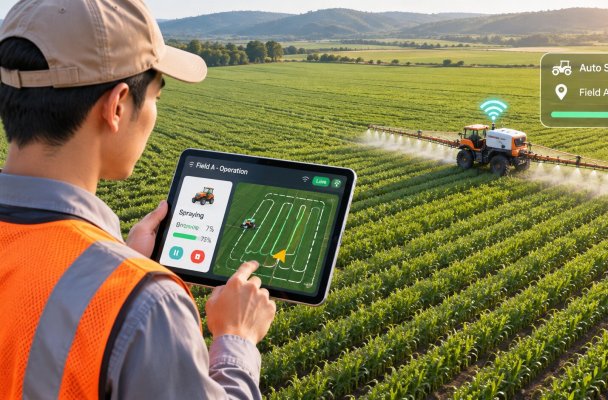

How a multi platform IoT architecture delivered real time supervision and ISO task tracking for field robots
Delivered a multi-platform precision agriculture ecosystem bridging Windows, mobile, and web applications, enabling remote telemetry tracking, ISOBUS machine terminal displays, and 2D/3D field task execution for autonomous agricultural robots.

A field camera app and verification album automate tamper proof photo documentation for site inspections
Engineered an end-to-end field evidence platform linking a mobile tag camera with a cloud-managed album, embedding digital blackboards, validating image authenticity in real time, and automating bulk audit report exports.

Synchronized tablet imaging and AI heatmaps enhance cervical cancer screening workflows for clinicians
Extended the capture, select, and paint screens of a cervical cancer screening support tool, so clinicians can review images with a heatmap overlay, mark areas of interest, and keep every view aligned from one screen to the next.

How a seamless Rails modernization enabled automated cloud scheduling and multi account AWS protection
Modernized a mission-critical Ruby on Rails management portal without operational downtime, bringing multi-account AWS oversight, automated server runtimes, AMI backups, and multi-channel incident dispatch into a single control plane.
-
How a multi platform IoT architecture delivered real time supervision and ISO task tracking for field robots
Delivered a multi-platform precision agriculture ecosystem bridging Windows, mobile, and web applications, enabling remote telemetry tracking, ISOBUS machine terminal displays, and 2D/3D field task execution for autonomous agricultural robots.
-
A field camera app and verification album automate tamper proof photo documentation for site inspections
Engineered an end-to-end field evidence platform linking a mobile tag camera with a cloud-managed album, embedding digital blackboards, validating image authenticity in real time, and automating bulk audit report exports.
-
Synchronized tablet imaging and AI heatmaps enhance cervical cancer screening workflows for clinicians
Extended the capture, select, and paint screens of a cervical cancer screening support tool, so clinicians can review images with a heatmap overlay, mark areas of interest, and keep every view aligned from one screen to the next.
-
How a seamless Rails modernization enabled automated cloud scheduling and multi account AWS protection
Modernized a mission-critical Ruby on Rails management portal without operational downtime, bringing multi-account AWS oversight, automated server runtimes, AMI backups, and multi-channel incident dispatch into a single control plane.
Data migration tools and
platforms we master

FAQ

Data migration is the process of moving business information from one system, location, or format to another, such as shifting from an aging on-premise server to a modern cloud platform. It usually becomes necessary when the current system is slow or costly to maintain, when two organizations or systems are being merged, or when moving to a more efficient environment would lower running costs.

The transfer itself can take hours or days, while the full project usually runs weeks to months. The timeline depends on the volume and complexity of the data, the source and target systems involved, and the migration strategy chosen, since a phased rollout takes longer than a direct cutover.
Cost depends on the scope of work, the migration and testing tools required, infrastructure, personnel, and any user training. Since these vary widely between projects, the most reliable way to get a figure is to share your requirements with us for an estimate.
We start by understanding how the existing system works and identifying the hidden dependencies that tend to cause problems mid-project. From there, we design a transition plan that preserves your business logic while moving the data into a faster, more reliable environment.
Yes. Our team connects the new system to the tools you rely on daily, so your CRM, marketing software, and internal applications work with the new database from day one. Integration is planned alongside the migration, not bolted on afterward.
The usual ones are data compatibility issues, integrity and security concerns, downtime during the move, and the risk of data loss. Each is manageable with proper planning and experienced execution, which is where most of the value in a migration partner lies.
Let's talk
Ready to get results?
Our team is here to help.