
Building a multi-device AI biometric screening platform for healthcare
Built a connected biometric screening platform across web and desktop, giving administrators and end users access to AI-powered screening results online and offline.
PROJECT OVERVIEW
Field | Content |
Client | A Japan based healthcare technology company providing AI powered biometric screening tools |
Industry | Healthcare |
Engagement Model | Dedicated development team, extended across multiple engagements on the same platform |
Core Technology Stack | ReactJS, Node.js, Python, ElectronJS, Microsoft Azure |
ABOUT THE CLIENT
This case study is based on a real VNEXT project. The client's identity and certain project details have been anonymized or generalized for confidentiality purposes.
Our client is a Japan based healthcare technology company that provides AI powered biometric screening, analyzing pupillary response patterns to help identify signs of fatigue, stress, or physical impairment in individuals such as athletes and other at risk groups. Exact financials are withheld for confidentiality.
THE CHALLENGE
Building a diagnostic tool around pupillary response analysis meant working in a specialized medical and ophthalmological domain, where a misunderstood clinical concept could shape an entire feature the wrong way.
The AI model at the center of the platform was developed by a separate, independent team outside VNEXT, which meant every schedule depended on coordination across two organizations with different working rhythms and priorities, not just on VNEXT's own delivery pace.
As the platform proved itself, the client kept asking for more: an admin console for managing biodata and monitoring AI analysis errors, a dedicated web experience for end users to view their own results, and eventually a desktop application for branch and system admins who needed to keep working even without a stable network connection, syncing data automatically once back online. Each addition had to fit into a system that was already live and already depended on for real screening work.
PROJECT OBJECTIVE
The client wanted to move beyond a single AI powered analysis tool into a complete screening platform: one where administrators could manage biodata and catch analysis errors quickly, end users could view their own results directly, and branch and system admins could keep working reliably even offline, all without ever pausing the system already in daily use to build the next piece.
APPROACH AND METHODOLOGY
Because this platform grew across a specialized medical domain, an external AI team, and several new device targets, VNEXT's approach had to cover more than writing code well. Four practices carried the most weight.
Building fluency in a specialized medical domain
Rather than rely on the client to fully specify every clinical detail, the bridge engineer took on dedicated research into pupillary response analysis as a domain, then scheduled frequent, focused meetings with the client to confirm requirements against that growing understanding, so specifications reflected real clinical meaning rather than a surface level reading of a document.
Coordinating cleanly across two development teams
With the AI model owned by a separate team, VNEXT's own project management defined shared working rules both teams could follow and kept a close eye on cross team commitments, so a slower response from the AI side surfaced early as a schedule risk rather than as a surprise near a release date.
Adopting each new platform deliberately
Extending the system onto Azure infrastructure, and later onto an Electron based desktop client, meant building solid expertise in each platform quickly and on purpose: engineers dedicated study time before writing production code, worked from official documentation and established best practices, and escalated directly to platform level support channels whenever a technical question needed an authoritative answer.
Confirming direction before writing formal documents
Early user interface requirements shifted more than once as the client's own thinking evolved. Instead of rewriting formal design documents every time, the team used quick diagrams to confirm shared understanding first, only committing requirements to formal documentation once the client had settled on a direction, which kept rework contained to sketches rather than finished specifications.
TEAM SCALE
VNEXT matched team size to the nature of each engagement, from a larger group of engineers during the platform's core build out to smaller, focused teams for later feature specific work such as the desktop app and its end user facing web module, all under the same Dedicated Team model VNEXT uses for other long running accounts.
- Dev Lead / Tech Lead: owned frontend architecture and user experience quality, and mentored the team through technical seminars and documentation
- Backend Developer / Solution Architect: designed and managed API versions, backend security, and reusable frameworks shared across the platform's modules
- QC Lead: owned test quality and delivery timelines, and kept team checklists current as new issues surfaced
- Business Analyst: translated business requirements into detailed specifications and user flows, and stayed the team's point of reference for spec questions
THE SOLUTION AND TECHNOLOGY STACK
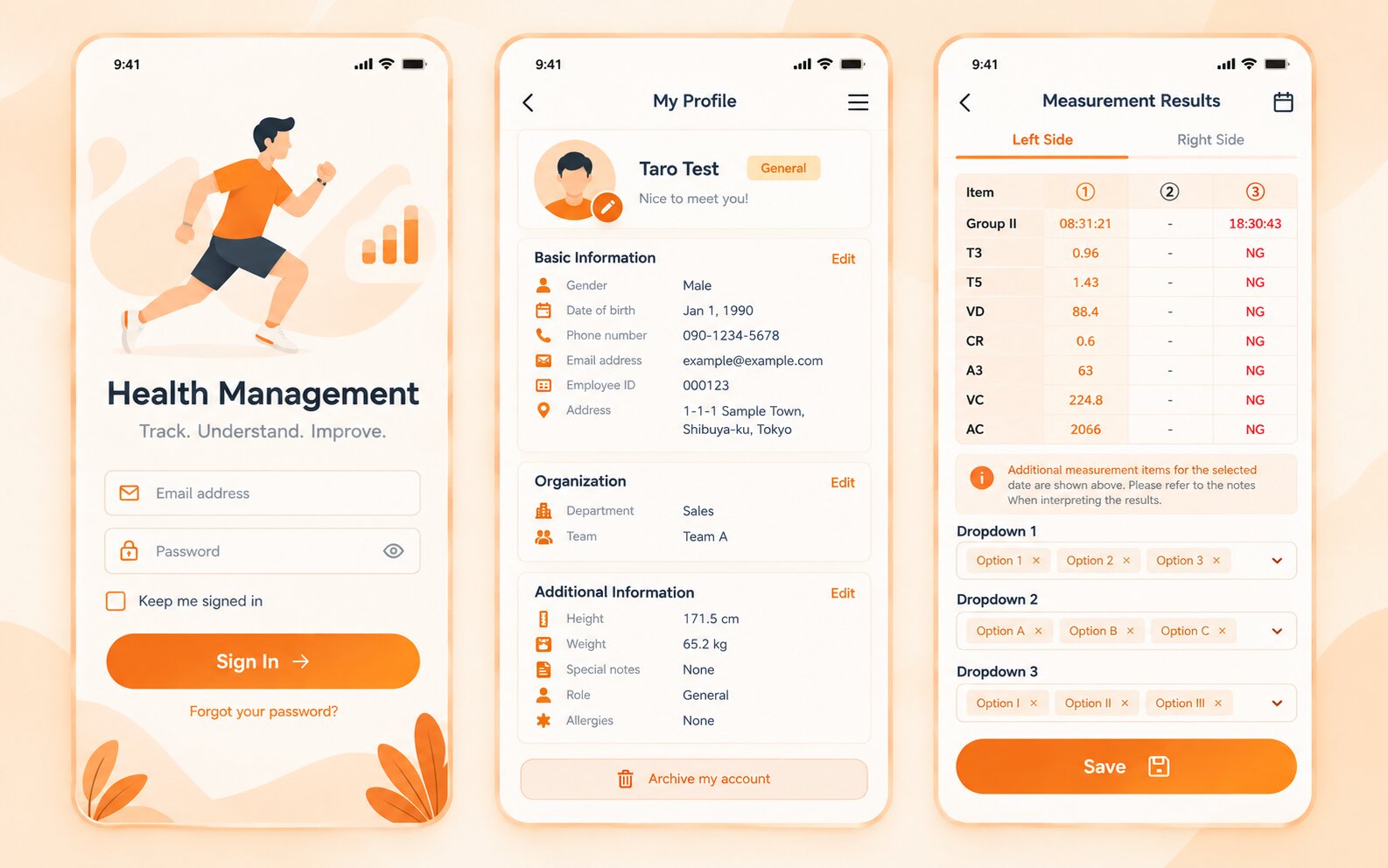
What began as a single AI powered analysis tool grew, engagement by engagement, into a full screening platform reachable from an admin console, an end user web app, and a desktop application built for environments where the network cannot always be trusted.
What was built
- AI powered biodata analysis engine and admin console: lets administrators register biodata, review AI analysis results, and investigate flagged errors from a single filterable view
- End user facing web application: gives individual users, such as athletes, direct access to their own screening results and history, through a mobile responsive interface built for checking results on the go
- Offline capable desktop application: connects branch and system admins to the platform even without a live network connection, syncing data automatically once connectivity returns
- A separate, multi language web module: extends the platform to a broader tier of end users, supporting both Japanese and English
Each addition was built to plug into the existing platform rather than stand apart from it, so the admin console, the end user web app, and the desktop client all read from and write to the same underlying biodata and analysis records.
Technology Stack
Layer | Technology / Platform Used |
Web Frontend | ReactJS |
Desktop Frontend | ElectronJS |
Backend and AI Integration | Node.js, Python |
Database | Microsoft SQL Server, Azure Cosmos DB |
Cloud and Infrastructure | Azure App Service, Application Gateway, Azure Active Directory B2C, Virtual Network, Bastion |
Process Management | PM2 |
This engagement sits alongside VNEXT's broader AI development practice, which covers building and integrating AI powered features into production software across healthcare, retail, and other industries.
THE RESULTS
What began as a single AI powered analysis tool now runs as a complete screening platform, used every day across admin, end user, and offline environments.
- One tool became four connected products: the platform now spans an AI powered admin console, an end user facing web application, an offline capable desktop app, and a dedicated multi language module, all built on the same underlying data
- Faster error investigation: administrators catch and investigate flagged AI analysis errors from a single filterable view instead of searching across separate records
- Uninterrupted screening, even offline: the desktop application for branch and system admins keeps working without a network connection and syncs automatically the moment connectivity returns
- Three years of continuous expansion: the client returned engagement after engagement to add new capability to the same platform, extending its reach without ever rebuilding the foundation underneath it
For a healthcare technology company whose product depends on accurate, always available screening, that combination, faster investigation, offline reliability, and steady expansion without a rebuild, is what turns a single AI tool into infrastructure the client relies on every day.
You may also like
-
Building a connected AI-powered learning platform for business English training
-

Modernizing a legacy enterprise messaging app for secure corporate communication
-
Building a digital repair order app for automotive dealers
-
Sustaining reliable SAP ERP delivery for a Japanese manufacturing partner
-
Automating urban safety with IoT road heating systems

Related capabilities
Let's talk
Ready to get results?
Our team is here to help.
 3 REVIEWS