
Sustaining reliable SAP ERP delivery for a Japanese manufacturing partner
Delivered SAP ERP add-ons across SD, MM, FICO, and PP for a Japanese manufacturing partner, maintaining consistent delivery as requirements and team structure changed.
PROJECT OVERVIEW
Field | Content |
Client | An established SAP implementation partner in Japan, serving manufacturing sector clients at a meaningful operating scale |
Industry | Manufacturing, SAP Enterprise Systems |
Engagement Model | Dedicated Labo Team |
Core Technology Stack | SAP ABAP, SAP Fiori, Smartform, ALV, Dynpro |
ABOUT THE CLIENT
This case study is based on a real VNEXT project. The client's identity and certain project details have been anonymized or generalized for confidentiality purposes.
Our client is a well established SAP implementation partner in Japan, serving manufacturing companies with ERP deployment, proprietary product development, and ongoing system maintenance. Exact financials are withheld for confidentiality, though the company operates at a meaningful scale within Japan's SAP partner ecosystem, and depends on specialized SAP expertise to keep its own clients' production, sales, and finance systems running smoothly.
THE CHALLENGE
Every add on VNEXT built had to meet two demanding standards at once: strict Japanese business requirements and equally strict Japanese quality expectations, with little room for error once a feature reached the client's own manufacturing customers.
The work itself was technically dense. Requests spanned four core SAP modules, Sales and Distribution, Materials Management, Financial Accounting and Controlling, and Production Planning, each with its own business logic and its own way of breaking if handled carelessly.
Partway through the engagement, the scope shifted further into Production Planning work for one of the client's manufacturing customers, at a point when the team's deepest expertise still sat in Materials Management. On top of that, the project ran on an agile model that produced frequent requirement changes needing a fast, considered response.
PROJECT OBJECTIVE
The client needed a development partner who could keep pace with Japanese manufacturing grade SAP requirements without constant hand holding, even as the scope of work moved into modules the team had not deeply worked in before. The goal was to keep add on delivery accurate and on schedule regardless of who was on the team at any given point in time.
APPROACH AND METHODOLOGY
Every request that reached the team followed the same underlying discipline, even as the specific technical challenge changed from one module to the next. What changed over time was how much of that discipline the team had to build for itself, rather than simply follow.
How a request moved from ask to delivery
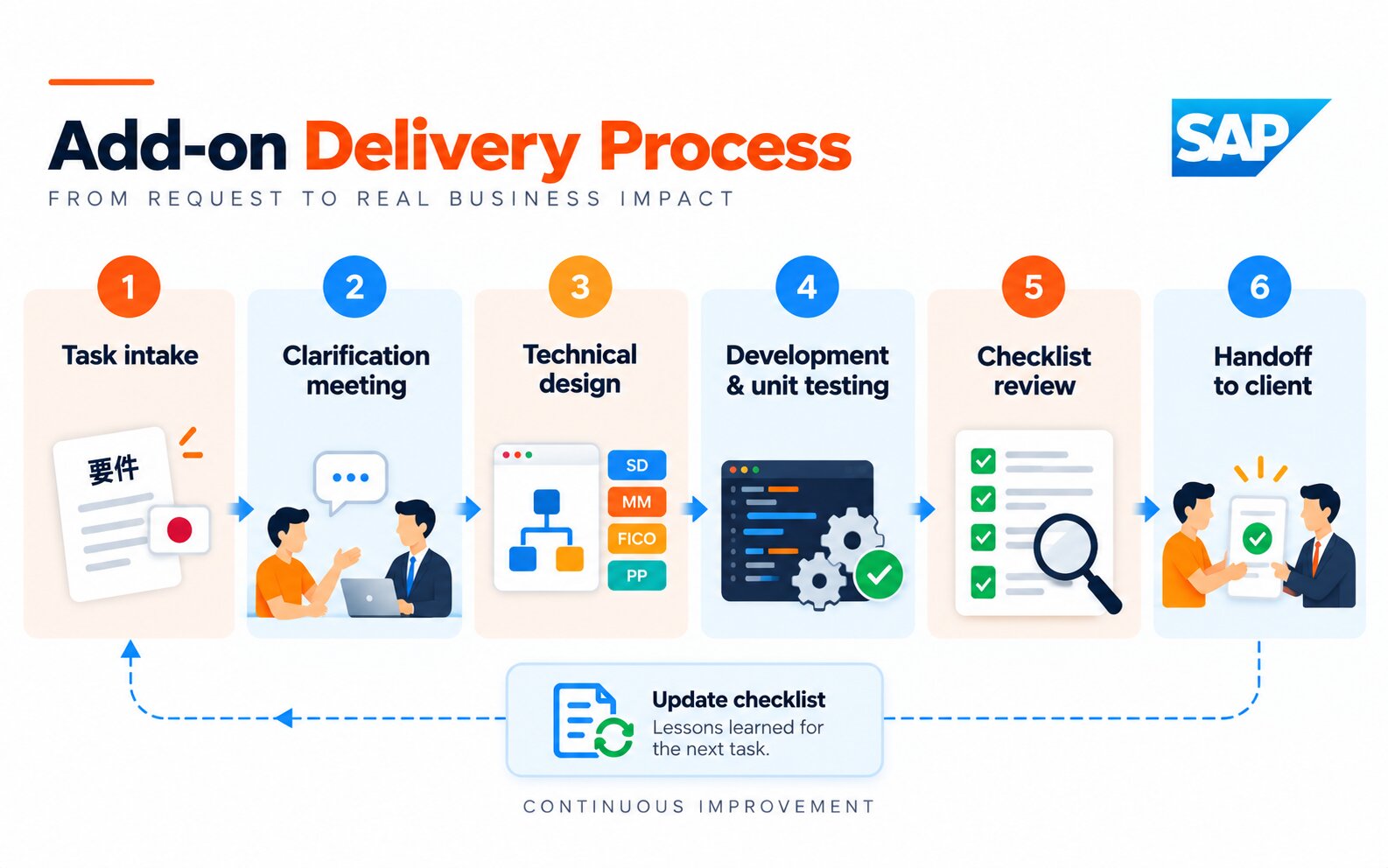
Each piece of work started life as a business requirement from the client, often expressed in Japanese and grounded in the client's own manufacturing customer's operational rules. Before any code was written, the team held a requirement clarification meeting to walk through the request in detail and confirm its understanding back to the client, a step that mattered more in SAP work than in most software, since a misunderstood field mapping or approval flow in a module like Financial Accounting and Controlling can surface as a silent data error months later rather than an obvious bug.
Once the requirement was confirmed, the team produced a detailed technical design for the relevant module before writing any ABAP code, covering the objects to be built or extended, such as ALV reports, Smartforms, Dynpro screens, or BAPI and enhancement logic, and how they would connect to the client's existing configuration. Development followed that design closely, with unit testing built into the same cycle rather than treated as a separate final gate, so that defects surfaced while the context was still fresh. A running checklist of mistakes seen on earlier tasks was checked before each handoff, turning individual lessons into a standing safeguard for the whole team rather than something only the original engineer remembered.
Building fluency in a module the team had not worked in deeply
The clearest test of this discipline came when scope moved into Production Planning work while the team's strongest hands on experience still sat in Materials Management, two SAP modules that look adjacent on an org chart but behave very differently in practice, since Production Planning logic is driven by manufacturing schedules and bills of materials rather than the stock movements and vendor terms that shape Materials Management. Rather than let bridge communicators translate requirement documents on general SAP familiarity alone, VNEXT trained them specifically on Production Planning business concepts, so that a document written for a production planner in Japanese would come out the other side meaning the same thing to a developer in Vietnam.
Staying ahead of an agile client's shifting requirements
Because the client's own delivery model was agile, requirement changes arrived often and needed a fast, considered response rather than a rigid one. Daily progress meetings with the client did double duty: they surfaced schedule risk from new or changed requirements early enough to negotiate priority together, rather than the team absorbing the impact silently and letting a deadline slip without warning.
TEAM SCALE
VNEXT sized this engagement to match workload at each stage, from a peak of 18 engineers during the account's most intensive stretch to a lean team of around 15 maintaining and extending it today, under the same Dedicated Team model VNEXT uses for other long running accounts.
- SAP ABAP full stack developers: handled end to end add on development, from technical design through coding
- SAP module specialists: covered Sales and Distribution, Materials Management, Financial Accounting and Controlling, and Production Planning, with several team members building fluency across more than one module over time
- Bilingual team members: three to four engineers held JLPT N1 Japanese certification, enabling direct requirement discussions without relying solely on a bridge communicator
- Technical specialists: several engineers expanded their skill set over time to include BAPI, Enhancement framework, and Function Module development, in addition to the original ALV, Smartform, Dynpro, and interface work
THE SOLUTION AND TECHNOLOGY STACK
In SAP terms, an add on is code that extends what the standard system can do without modifying its core, the safer and more upgrade friendly way to make an ERP fit a business that standard configuration alone cannot cover. That was the nature of almost everything built here: reports, forms, screens, and integration logic layered on top of the client's existing SAP environment rather than changes to the environment itself.
Scope delivered
- Add on development for the client's SAP ERP environment, spanning both SAP ECC and SAP S/4HANA
- Business functions covered: Sales and Distribution (SD), Materials Management (MM), Financial Accounting and Controlling (FICO), and Production Planning (PP)
- Full delivery cycle per request: detailed technical design, ABAP coding, and unit testing before handoff
Handling all four modules inside one team, rather than splitting the work across separate vendors by module, gave the client a single point of accountability for how an add on in one module behaved once it touched data or logic owned by another, which is often where the hardest SAP bugs actually live.
Technical capabilities used on every request
- Smartform: custom print and PDF output documents, such as invoices, delivery notes, and production forms
- ALV (ABAP List Viewer): interactive, filterable list reports that give end users structured views of transactional data
- Dynpro: custom screen development for data entry flows specific to the client's own processes
- Interfaces (I/F): data exchange between the SAP system and outside applications
- BAdI (Business Add-Ins): flexible enhancement points for injecting custom logic without touching standard SAP code
- BAPI (Business API): standardized, reusable calls for integrating SAP with other systems and processes
- User Exits: predefined customization hooks built into standard SAP programs
- CDS View (Core Data Services): modern, semantically rich data models for reporting and app development
- BDC (Batch Data Communication): bulk data entry and migration into SAP through simulated transaction input
Early work leaned most heavily on Smartform, ALV, Dynpro, and interfaces. As scope deepened, the team added BAdI, BAPI, User Exits, and Function Modules to the mix, the tools that let a team extend SAP behavior precisely at the point it needs changing rather than working around it, enabling steadily more complex customization requests without a larger team.
This engagement sits alongside VNEXT's broader SAP development practice, which covers implementation, ABAP and Fiori development, and long term application management for manufacturing, logistics, and retail clients across Japan and beyond.
Technology Stack
Layer | Technology / Platform Used |
SAP Development | SAP ABAP, SAP Fiori |
UI and Reporting Components | ALV, Smartform, Dynpro, CDS View |
Integration | BAPI, BAdI, User Exits, Function Modules, BDC, Interfaces |
Modules Covered | Sales and Distribution (SD), Materials Management (MM), Financial Accounting and Controlling (FICO), Production Planning (PP) |
THE RESULTS
What began as a single support contract has grown into a steady, long running partnership that keeps expanding because the client keeps trusting VNEXT with more of its platform.
- Upgrade safe delivery: every add on extended the standard system without modifying its core, keeping the client's SAP environment clean and ready for a future move to S/4HANA instead of carrying custom patches that complicate every upgrade
- Faster turnaround on repeat work: unit testing built into the same cycle as development, plus a standing checklist of past mistakes, kept rework low and let similar requests move faster over time
- One accountable partner across four modules: consolidating Sales and Distribution, Materials Management, Financial Accounting and Controlling, and Production Planning under a single team spared the client the overhead of coordinating separate vendors per module
- Consistent quality even into unfamiliar territory: Production Planning requests reached the same standard as the team's stronger Materials Management work once the module knowledge gap was closed
For a SAP implementation partner whose own clients feel every add on directly, upgrade safe code, fast turnaround, and a single point of accountability across modules are the outcomes that actually matter.



Related capabilities
Let's talk
Ready to get results?
Our team is here to help.
 3 REVIEWS