
Keeping one enterprise messenger seamless across four native platforms
Maintained and expanded an enterprise-grade messaging service across native iOS, Android, web, and Windows clients, keeping four separate codebases perfectly synchronized while delivering frequent updates that never compromised system stability.
PROJECT OVERVIEW
Field | Content |
Client | A provider of a secure business messaging service for companies, schools, and public offices |
Industry | Enterprise Software & DX |
Engagement Model | Dedicated development team |
Scale and Duration | An ongoing development and maintenance engagement across four client platforms |
Core Technology Stack | Objective C, Java, JavaScript, C# |
ABOUT THE CLIENT
This case study is based on a real VNEXT project. The client's identity and certain project details have been anonymized or generalized for confidentiality purposes.
Our customer runs a secure messaging service for organizations that want the ease of a chat app without the risks of a consumer one. Companies, schools, and public offices use it to talk with a limited circle of members, share files, and keep conversations findable later. For a service like that, trust is the product. People rely on it every day, and they notice immediately when something behaves differently after an update. Exact financials are withheld for confidentiality.
THE CHALLENGE
A messenger that has been in daily use for years carries a lot of history in its code. Every feature touches several others, so even a small fix has to be made with an eye on everything around it. That is the ordinary reality of a mature product, and it asks a delivery team to be careful as much as it asks them to be quick.
The service also reaches users in four different ways. Native iOS and Android apps, a web client, and a Windows application all talk to the customer's servers, and a bot component sits alongside them. Each one is written in its own language, Objective C, Java, JavaScript, and C#, and each follows the habits of its own platform, which means one improvement can mean four separate pieces of work.
Two practical constraints added to the picture. The web client had to run well on the browsers customers actually use, including older ones alongside current ones, and the libraries the product depended on were aging, so each of them needed attention before it became a risk.
PROJECT OBJECTIVE
Our customer wanted a team that could look after the whole messenger as one product: fixing issues, adding capabilities, and releasing updates on a steady rhythm on every platform, without ever making users feel that an update had changed something they relied on.
APPROACH AND METHODOLOGY
Checking the reach of every change before making it
When our developers picked up a task, they first confirmed with our bridge engineer which other functions the change could affect. That short conversation, held before any code was written, caught most surprises early, and it meant that the people who understood the customer's expectations best were involved while a change was still easy to adjust.
Reviewing every fix after it is made
Each bug fix then went through code review. In a product where features are closely linked, a second pair of eyes is the best protection against a fix that solves one problem while quietly creating another, and it gave our team a shared understanding of the code as the work moved between people.
Keeping the foundations healthy, month after month
Once a month, our developers checked whether each library in use was still supported, so that an aging component could be planned for calmly instead of discovered during an urgent fix. Whenever a new library was chosen, we examined its support for the browsers the web client has to run on before deciding, which kept compatibility a design decision rather than a late surprise.
Working inside the customer's own routine
Our team communicated with the customer through Slack and tracked tasks in the customer's own backlog, so that planning, priorities, and progress stayed visible to the people who depend on the product.
TEAM SCALE
Our team for this engagement reached up to five people, working as a dedicated team that combined planning, development across several platforms, and independent testing.
- Project manager: kept priorities and releases organized across the four client platforms
- Developers: maintained and extended the iOS, Android, web, and Windows clients, and reviewed one another's fixes
- Tester: verified each release across platforms so that the experience stayed consistent for users
THE SOLUTION AND TECHNOLOGY STACK
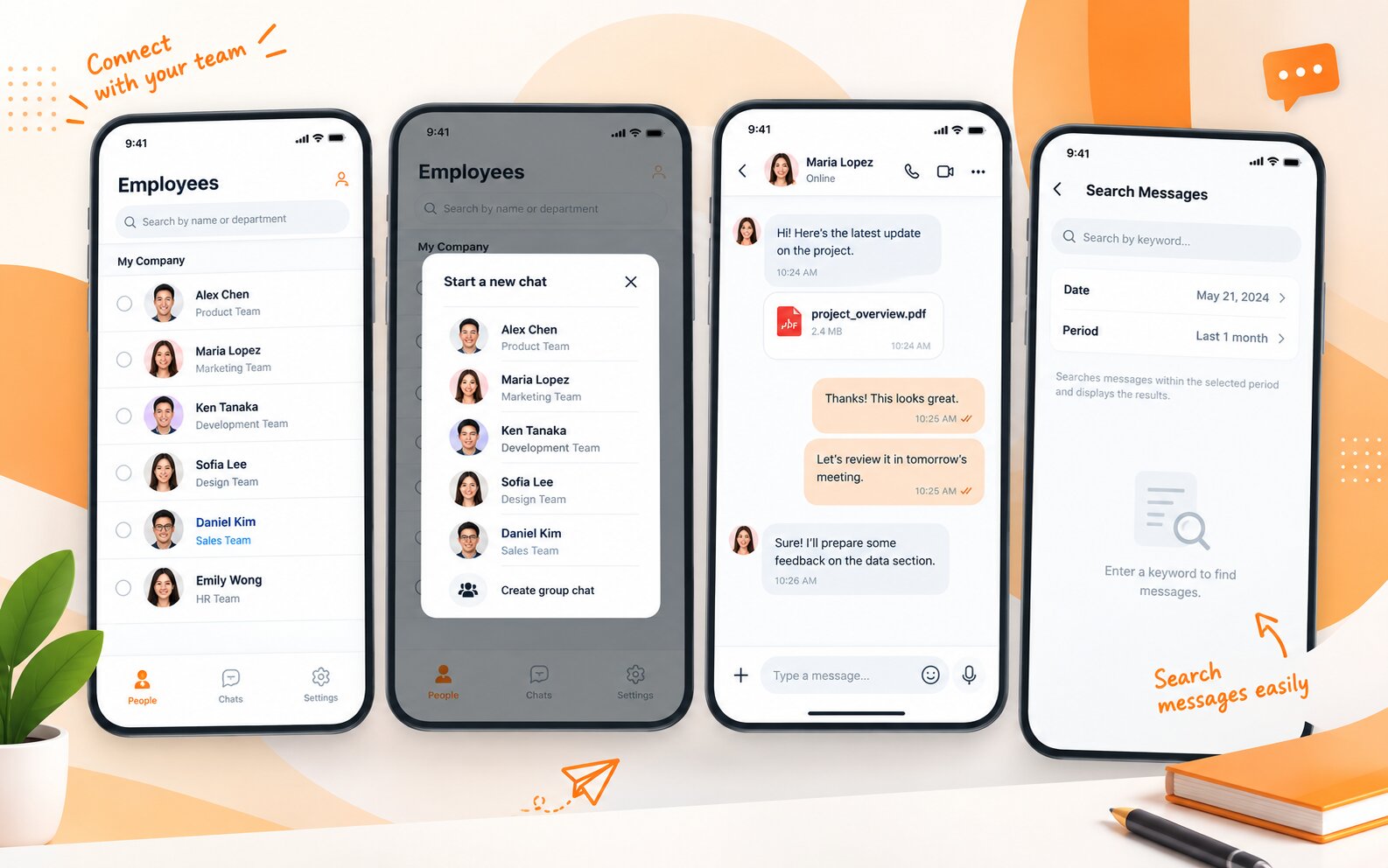
What our team looks after is a single messaging service seen through four different windows, and the work is to keep all four consistent as the product moves forward.
What was built and maintained
- Native iOS app: a messenger for iPhone and iPad with member search, profiles, group conversations, file sharing, and message search by date range
- Native Android app: the same experience for Android users, written in Java
- Web client: a browser version built with jQuery that works across the browsers customers use
- Windows application: a desktop client for people who spend the day at a PC, written in C#
- Bot integration: a bot component that connects the service with the customer's servers
Technology Stack
Layer | Technology / Platform Used |
iOS | Objective C |
Android | Java |
Web | JavaScript, jQuery |
Windows | C#, WinForms |
Collaboration | Slack, the customer's own task backlog |
The same product line was later taken through a broader enterprise messaging modernization, which built on the care described here.
THE RESULTS
A mature product kept its promises to its users, release after release.
- Commitments met: our team delivered the goals it had agreed with the customer
- Updates on a steady rhythm: the apps received frequent updates while the system stayed stable in daily use
- Fixes that do not travel: pre change impact checks and post fix reviews keep a repair in one place from causing trouble in another
- The same product on every device: iOS, Android, web, and Windows users get a consistent experience from one coordinated team
- Fewer surprises from old components: a monthly check on library support keeps planning ahead of problems rather than behind them
For a service whose users never think about the technology until it fails, the best result is that they never have to. Careful, regular, well reviewed maintenance is what keeps a trusted product trusted.
You may also like
-

Modernizing a legacy enterprise messaging app for secure corporate communication
-

Turning smartphones into remote controls for a nationwide network of self service kiosks
-

Security hardware company eliminates manual key handoffs with smart property access
-

Synchronized DeFi product rollout delivers full asset management and staking across three blockchain networks
-

Creating a smarter business English learning experience with AI
-
Japanese healthtech leader enables 100% offline-ready biometric screening on cross-platform medical terminals
-
Measuring project carbon emissions across materials transport and on-site machinery on a unified web platform
-

Replacing paper-heavy training records with a unified cloud platform for driving schools
-

Turning a Legacy Showroom into a 24/7 Global Car Marketplace & Auction Engine

Related capabilities
Let's talk
Ready to get results?
Our team is here to help.