
ERP Integration Services



Challenges we help to
solve with our ERP
integration services


Accurate, unified data
ERP integration pulls information from every system into one dependable source. Your teams work from the same accurate numbers, without the duplicate records and mismatched data.

Full visibility across operations
A connected ERP gives you a single, real-time view of everything happening across your business. You can track performance as it happens, plan ahead, and make informed decisions.

Support for business growth
As your business expands, disconnected systems tend to slow you down and make everyday work harder to manage. Integration keeps your workflows efficient and flexible, so you can scale smoothly without adding complexity.

Better security and compliance
Keeping data safe is far easier when it lives in one place instead of scattered across systems. ERP integration centralizes your information, supports strong access controls, and helps you stay aligned with standards like GDPR and HIPAA.
Less manual work and lower costs
Manually transferring data between systems takes up valuable hours and drives up costs. ERP integration automates these tasks, cuts down on errors, and gives your teams more time for the work that drives real value.
ERP integration methods
- Quick and simple to set up
- Low upfront cost
- Works well for a few stable connections
- Highly flexible and reusable
- Scales well for real-time data
- Suits modern, cloud-first setups
- Handles large data volumes reliably
- Suits complex and legacy environments
- Centralizes control over all integrations
- Fast to deploy with minimal coding
- Scales easily as you grow
- Connects both cloud and on-premise systems
- Hard to scale as you add more apps
- Grows tangled and difficult to maintain
- Each new connection means more custom work
- Needs skilled developers to build and secure
- More effort to set up than simple methods
- Ongoing API management required
- Expensive to implement and run
- Needs skilled resources to manage
- A single hub can become a point of failure
- Ongoing subscription costs
- Some dependence on the platform vendor
- Less suited to highly complex legacy setups
How to pick the best ERP
integration approach
Map your systems and data flows
List every application that needs to connect with your ERP, from your CRM to your e-commerce or warehouse systems. For each one, note what data moves, which way it flows, and how often it needs to update. This gives you a clear scope to work from before comparing methods.
Look at your size and complexity
A simple setup with a few applications may only need point-to-point connections. Growing businesses that need real-time data across modern systems often lean toward API-led integration. Larger organizations with legacy systems tend to get more value from an ESB, while cloud or hybrid environments usually suit iPaaS. Match the method to how complex your operations really are.
Weigh your in-house technology capabilities
Be realistic about your team's technical capacity. iPaaS works well for lean IT teams, since it needs little coding and includes vendor support. API-led and ESB both call for strong development skills or a reliable technology partner to build and maintain them. Point-to-point is manageable at first, but gets harder to handle as connections grow.
Set your budget
Point-to-point costs the least to start, which suits smaller companies. iPaaS adds subscription fees but keeps pricing clear and predictable. API-led involves upfront development effort that pays off through reusable connections over time. ESB needs the biggest initial investment, which makes sense for businesses running complex or legacy systems.
Check your timeline
On a tight schedule, point-to-point and iPaaS connect systems quickly with ready-made connectors and no-code tools. API-led takes more time upfront to build, but each API can be reused later. ESB requires the most planning and setup, making it a better fit for longer-term projects.
Plan for growth
Think about where your business is going, not just where it is now. API-led, iPaaS, and ESB all let you add new systems and ERP modules without rebuilding your setup, with API-led standing out for its reusable, modular connections. Point-to-point is the hardest to scale, since each new connection means more manual work.
Confirm what your vendors support
Before you commit, check that your ERP and connected systems support the method you have in mind. Review API coverage, rate limits, and whether the approach can handle your data volume, so nothing catches you off guard later.
Key ERP modules we integrate
Customer & Revenue
Sales & CRM
By connecting your sales and CRM modules, we keep customer data in one place, automate your pipeline, and help you close deals faster.
Marketing automation
We link your ERP with marketing tools so leads, campaigns, and results all live in a single dashboard, giving you a solid base for data-driven strategies.
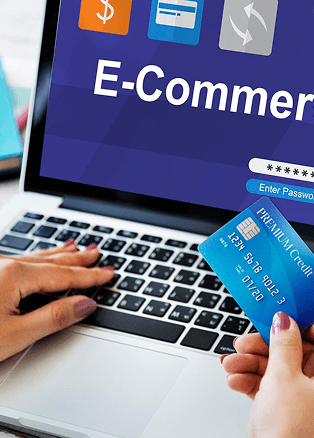
E-commerce
Orders, inventory, and customer data stay in sync across every sales channel once we integrate your e-commerce platform with your ERP.

Operations & Production
Manufacturing & MES
We bring production planning and shop-floor data together by integrating your manufacturing and MES modules, giving you tighter control over operations.
Inventory & Warehouse
Connecting these modules gives you real-time visibility into stock and warehouse activity, helping you cut waste and avoid delays.
Quản lý chuỗi cung ứng (SCM)
We integrate your SCM modules to deliver end-to-end visibility across suppliers, logistics, and fulfilment.

Internal Management
Nhân sự
Managing your team gets easier with connected HR modules that bring payroll, performance tracking, and hiring into one place.
Quản lý dự án
We integrate project management modules to keep tasks, resources, and budgets aligned, so deadlines and costs stay under control.
Accounting & Payment systems
Our team connects accounting and payment modules that automate invoices, track budgets, and handle payments securely.

Dữ liệu và Phân tích
BI & Analytics
We integrate BI and analytics tools to turn your data into real-time dashboards and insights, giving you a clear view of performance.
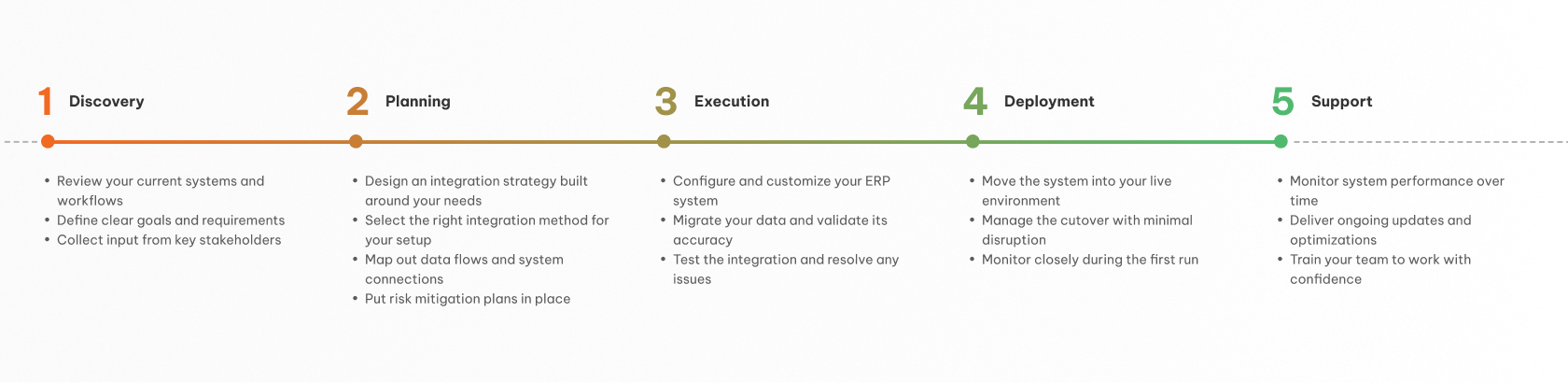
Our ERP integration process

Industries we serve









ERP platforms we master
SAP (SAP S/4HANA)
As a certified SAP partner, we connect SAP S/4HANA with the applications running across your business, from CRM and e-commerce to warehouse and finance systems. Our team handles the technical complexity that comes with enterprise-scale SAP environments, keeping your data consistent and your processes aligned.
Odoo
Proud to be a certified Odoo partner, we integrate Odoo with your in-house systems and third-party services, setting up reliable two-way data exchange in both directions. This extends what Odoo can do for your business and keeps information moving between the tools your teams already rely on.

ERP tùy chỉnh
Running an ERP built specifically for your business? We connect it with internal and external systems through custom connectors, proprietary APIs, or third-party APIs.
Key benefits of ERP integration
One reliable source of data
Connecting your ERP with finance, sales, and marketing systems lets every team work from the same current figures, giving you reporting you can trust.
Less manual work
Data moves between your systems automatically once they are connected, cutting out double entry and reducing errors.
Better team collaboration
Shared dashboards and live updates keep sales, finance, logistics, and HR aligned, since every department draws on the same central data.
Smarter decisions
BI and analytics connected to your ERP deliver real-time reports built on accurate numbers, bringing trends and opportunities into view early enough to act.
Stronger risk control
Full visibility into daily operations helps issues like process breakdowns or compliance gaps surface sooner, well before they grow into real problems.

Câu hỏi thường gặp

ERP integration is important because it connects your ERP system with the other business applications you rely on, removing data silos and giving every team access to accurate, up-to-date information. Without integration, your ERP operates in isolation, leaving data scattered across disconnected systems and teams duplicating the same work. A properly integrated ERP delivers automated workflows in place of manual entry, one reliable source of business data, and a clear view of daily operations to guide decision-making. For most businesses, ERP integration is what turns a standalone platform into the backbone of everyday operations.

The systems most commonly integrated with an ERP include CRM, e-commerce, accounting, HR, supply chain, and business intelligence platforms. The right mix depends on your industry and how you operate. Typical ERP integrations cover:
- CRM and sales platforms such as Salesforce or HubSpot
- Marketing automation tools for campaign tracking and lead management
- E-commerce platforms like Shopify or Magento
- Accounting and payment systems for invoicing and financial reporting
- HR and payroll software for employee and compensation data
- BI and analytics tools for real-time reporting
- SCM, MES, and warehouse systems for manufacturers and distributors
Successful ERP integration starts with mapping your data flows, choosing the right integration method, and testing thoroughly before go-live.
Follow these ERP integration best practices to reduce risk and avoid costly rework:
- Map your systems and data flows so you know what data moves, in which direction, and how often it needs to update.
- Choose an integration method that fits your business, whether point-to-point, API-led, ESB, or iPaaS, based on your setup, budget, and technical capacity.
- Prioritize data quality by cleaning and validating records before migration.
- Build in security and compliance from the start, covering access controls and standards such as GDPR or HIPAA.
- Test thoroughly across every connection before going live.
- Train your teams so the system is genuinely adopted rather than worked around.
Kết nối với chúng tôi
Biến mục tiêu thành kết quả?
Chúng tôi sẵn sàng đồng hành cùng doanh nghiệp.