
SAP WM to EWM migration: When to move, what to expect, and how to keep the warehouse running


Key takeaway
- SAP WM reaches the end of mainstream maintenance with SAP ECC on December 31, 2027. Companies should plan their move to SAP EWM to avoid higher costs for extended maintenance and the limited future of SAP WM in SAP S/4HANA.
- SAP EWM is a more advanced warehouse solution than SAP WM, with real-time stock visibility, wave planning, labor and yard management, and direct control of warehouse automation.
- Small, simple warehouses may be better served by Stock Room Management, and a move planned as part of a wider SAP S/4HANA program usually delivers the best results.
- The safest SAP WM to EWM migration runs step by step, one warehouse at a time, with clean master data, real-volume testing, and a tested rollback plan.
With 55% of organizations running SAP already deployed on SAP S/4HANA but only 34% fully switched to it for daily operations, the stakes for companies still running SAP WM have never been higher. The 2027 maintenance deadline adds even more pressure, as research from ISG shows that about 60% of SAP migrations exceed their planned schedule and budget. With 35% of organizations planning to switch to SAP S/4HANA before the end of 2026, partner and internal delivery capacity is getting tighter every month. It’s clear that warehouses on SAP WM are struggling to keep pace with these demands.
To stay competitive, warehouses need a modern, scalable system like SAP EWM, capable of fast picking, accurate stock control, and close links with transport and automation. The challenge lies in getting there safely. In this article, we will explain when SAP WM to EWM migration makes sense and which risks to expect, then show how to migrate step by step and keep the warehouse running at every stage.
Understanding SAP WM and SAP EWM
SAP Warehouse Management (SAP WM) is the warehouse component of SAP ECC, developed by SAP as part of its Logistics Execution functions. It manages stock at the level of storage bins and controls warehouse movements through transfer orders, from putaway to picking and stock transfers. SAP WM has been part of SAP's ERP suite since the SAP R/3 era and later became a standard component of SAP ECC, which SAP introduced in 2004 as part of SAP ERP 6.0. For many years, it was the default warehouse solution for companies running SAP.
As warehouses grew more complex, SAP developed a more advanced solution, SAP Extended Warehouse Management (SAP EWM). It was first released in the mid-2000s as part of the SAP SCM suite and has been available embedded in SAP S/4HANA since release 1610 in 2016.
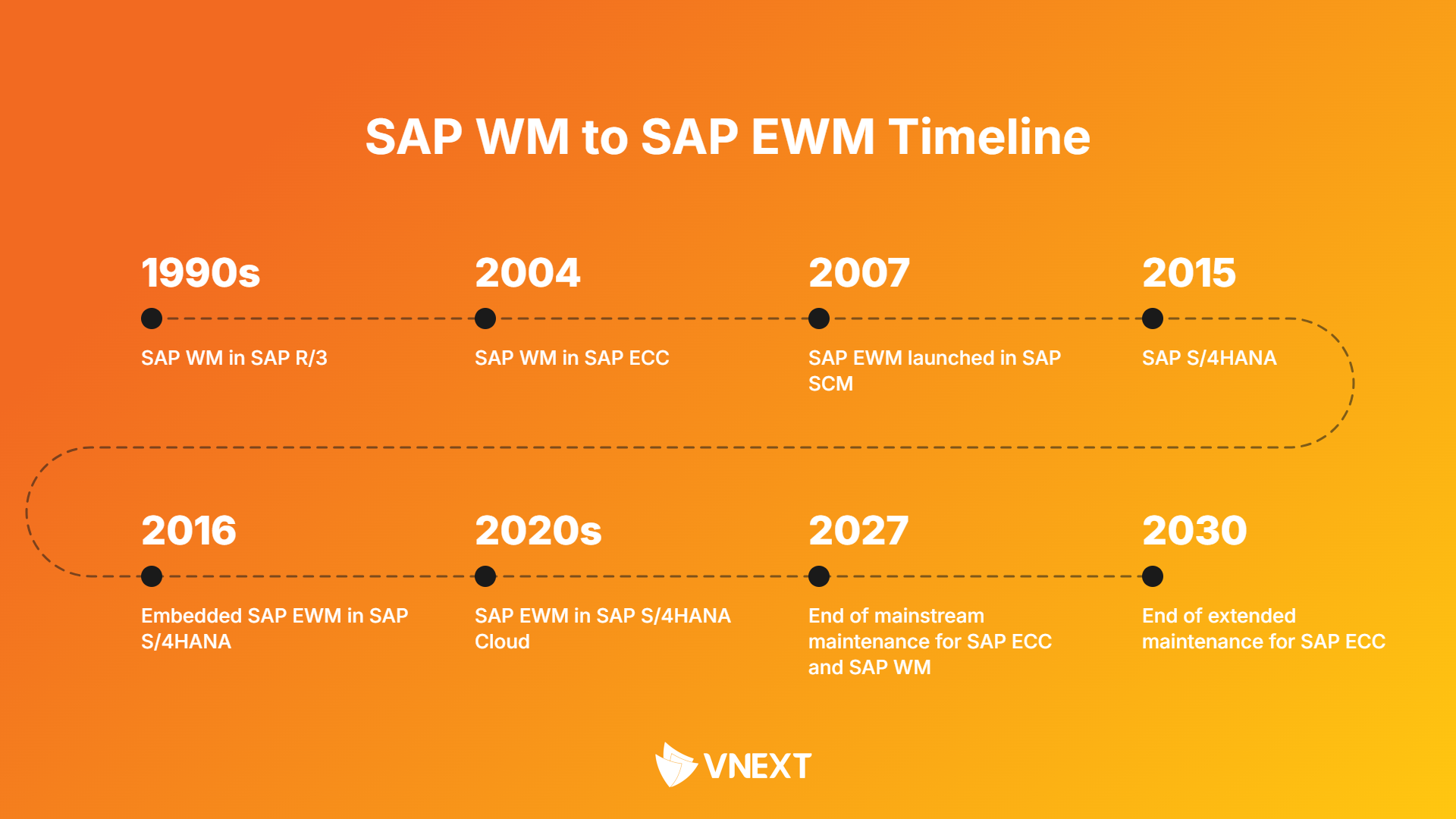
SAP EWM is the successor to SAP WM in SAP S/4HANA. It is built for high-volume and highly automated warehouses, and it adds capabilities that SAP WM never offered, such as labor management, yard management, wave planning, and direct control of conveyors and automated storage through the Material Flow System. SAP EWM runs embedded in SAP S/4HANA or as a separate, decentralized system, with an improved user experience delivered through SAP Fiori apps and a flexible RF framework.
The solution covers the full range of daily warehouse operations, from inbound receiving and putaway to internal picking, packing, and loading. It also integrates with SAP TM for transport planning and with carriers through SAP Business Network, which links warehouse work directly with the wider logistics process.
What is SAP WM to SAP EWM migration?
SAP WM to SAP EWM migration is the process of moving warehouse processes, master data, and stock from SAP Warehouse Management (SAP WM) in SAP ECC to SAP Extended Warehouse Management (SAP EWM) in SAP S/4HANA.
This shift is often described in the broader discussion of SAP WM vs SAP EWM, where companies move from a warehouse module tied to SAP ECC to a more advanced, flexible solution designed for higher volumes, warehouse automation, and closer integration with transport and carriers.
What SAP EWM has that SAP WM doesn’t?
Both systems manage warehouse stock and movements, but SAP EWM goes much further in several key areas. I've outlined the main differences below.
Category | SAP WM | SAP EWM |
Platform and future support | Part of SAP ECC, with mainstream maintenance ending in 2027. In SAP S/4HANA, it remains only in the compatibility scope, with time-limited usage rights. | SAP's strategic warehouse solution for SAP S/4HANA, available embedded or as a decentralized system, with new releases every year. |
Stock visibility | Tracks stock as quants in storage bins, with limited detail on packaging and stock status. | Tracks every item by location, packaging unit, batch, and serial number, and shows in real time whether stock is available, blocked, or under quality inspection. |
Warehouse process control | Uses transfer orders for basic putaway and picking. Multi-step flows usually need custom development. | Supports multi-step processes as standard, such as receiving, inspection, packing, and value-added services, each configured as a clear sequence of tasks. |
Outbound planning | Offers limited options for grouping orders and planning picking work. | Groups orders into waves by carrier, route, or cut-off time, supports cross-docking, and stages goods in route order in line with freight orders from SAP TM. |
Labor management | Has no built-in labor planning. Productivity is usually tracked in separate tools or spreadsheets. | Plans workload by shift, assigns tasks in a smart sequence, and measures worker performance in real time. |
Yard and dock | Does not cover yard or dock activities. | Manages truck check-in, door assignment, and dock appointment scheduling, which reduces waiting times at the gate. |
Warehouse automation | Needs an external warehouse control system or middleware to run conveyors and automated storage. | Controls conveyors, sorters, and automated storage directly through the built-in Material Flow System. |
User experience and analytics | Uses SAP GUI screens, basic RF transactions, and standard lists. Teams often use spreadsheets for daily reporting. | Uses SAP Fiori apps, a flexible RF framework, and a real-time warehouse monitor with KPIs for every area of the warehouse. |
Why do companies move from SAP WM to SAP EWM?
Companies move from SAP WM to SAP EWM to keep their warehouse supported after 2027, handle higher order volumes, and connect warehouse work directly with automation and transport.
Now, here's the reality. As a warehouse grows, SAP WM often becomes harder to manage. New processes usually need custom code. Conveyors and automated storage need extra middleware to talk to SAP. Supervisors end up tracking productivity in spreadsheets, and every change to the warehouse setup takes longer than the last one.
Migration to SAP EWM solves this by giving the warehouse a modern, configurable system inside SAP S/4HANA. Multi-step processes, labor planning, and automation control are available as standard functions, and warehouse teams can adapt processes with far less custom development.
Now, companies don't move to SAP EWM just because of a vendor deadline. The move is driven by real business pressure and clear technical needs that grow as warehouses scale:
- End of mainstream maintenance for SAP ECC: SAP WM depends on SAP ECC, whose mainstream maintenance ends in 2027. Extended support runs until 2030 at a higher cost and with no new functions.
- A limited future for SAP WM in SAP S/4HANA: SAP WM remains only in the compatibility scope of SAP S/4HANA, with time-limited usage rights, and SAP EWM is the strategic successor.
- Stronger integration needs: According to SAPinsider's 2026 benchmark research, 82% of organizations running SAP cite integration between core ERP and line-of-business applications as a key requirement for their transformation. SAP EWM connects natively with SAP TM, yard processes, and carrier networks.
- Growing warehouse automation: Conveyors, sorters, and automated storage are becoming standard in large distribution centers. SAP EWM controls them directly through its built-in Material Flow System, with no separate control software needed.
- High variability in order volumes: In industries like e-commerce, retail, and consumer goods, orders spike during peak seasons. Wave planning and labor management in SAP EWM help warehouses scale picking capacity for those weeks with fewer overtime hours.
- A push for cleaner data: The same SAPinsider research shows data cleansing at the top of the list of technologies organizations running SAP are evaluating, at 45%. A WM to EWM migration is often the moment companies fix years of outdated bin and product data.
The move to SAP EWM is also reflected in market growth. According to MarketsandMarkets, the global warehouse management system market is expected to grow from $4.57 billion in 2025 to $10.04 billion by 2030, at a CAGR of 17.1%, with Asia Pacific as the fastest-growing market. This raises a practical question for every SAP WM user: Is SAP EWM a required upgrade, or a strategic choice that depends on warehouse size, complexity, and growth plans?
Business drivers for migration
Now let’s break down exactly where SAP EWM pulls ahead of SAP WM, side by side, so you can see how each driver shows up in day-to-day warehouse operations. I’ve added quick examples for each point to help you picture what these changes might look like for your team.
Scalability during peak seasons
Scaling a warehouse on SAP WM usually comes down to adding more people, more overtime, and more manual planning. When order volumes jump, supervisors split work by hand and hope the picking teams keep up.
SAP EWM helps the warehouse handle busy periods with built-in planning tools. The system groups orders by carrier or delivery deadline and shares the work evenly between shifts, giving every worker a steady flow of tasks.
Let’s say your warehouse doubles its daily orders during a Christmas sales campaign. With SAP WM, supervisors spend hours each morning sorting orders into lists. With SAP EWM, waves are released automatically, and workers receive the next task on their scanners as soon as they finish the last one.
Process flexibility
SAP WM covers basic putaway, picking, and stock transfers. Anything more complex, such as quality checks before putaway or packing with value-added services, usually needs custom ABAP development.
SAP EWM supports multi-step processes as standard. Each step, from receiving to inspection, packing, and staging, is configured as part of a clear process flow.
Imagine a customer asks you to add labels and kit three products before every delivery. On SAP WM, IT has to build and test a custom solution. On SAP EWM, the team configures a value-added service step and starts using it within days.
Ease of change
Changing SAP WM often involves developers, transports between systems, and long testing cycles. Small adjustments, like a new picking rule, can take weeks to reach the warehouse floor.
SAP EWM moves most of these changes into configuration and Fiori apps. Warehouse key users can adjust putaway and picking strategies with far less help from developers.
For example, your fastest-moving products shift after a new product launch. With SAP EWM, the team updates slotting rules and moves those items closer to the dock in the same week.
Traceability and compliance
Customers and auditors expect a clear record of every batch and serial number. SAP WM tracks stock in bins, but detailed history often has to be pieced together from several reports.
SAP EWM records every movement with its batch, serial number, handling unit, and user. The warehouse monitor shows this history on one screen.
Imagine a supplier reports a quality issue with one batch. With SAP EWM, the team finds every pallet from that batch, blocks the stock, and identifies affected deliveries within minutes.
Maintenance and support
SAP WM depends on SAP ECC, whose mainstream maintenance ends in 2027, with extended support available until 2030 at a higher cost. In SAP S/4HANA, SAP WM remains only in the compatibility scope with time-limited usage rights.
SAP EWM is SAP’s strategic warehouse solution, with regular releases, new functions, and long-term support in SAP S/4HANA.
When the next SAP S/4HANA release arrives, warehouses on SAP EWM gain new features through the standard upgrade. Warehouses still on SAP WM face a growing gap with every year.
Cost efficiency
The real cost of SAP WM goes beyond licenses. Custom code needs maintenance after every change, automation needs separate middleware, and peak seasons bring overtime and temporary staff.
SAP EWM reduces these costs on several fronts. Standard functions replace much of the custom code, the Material Flow System controls automation directly, and labor management helps teams do more work with the same headcount.
Picture a distribution center that runs two separate tools for conveyor control and labor tracking next to SAP WM. Moving to SAP EWM can remove both tools and the interfaces that connect them, along with their yearly license and support fees.
Automation and integration
SAP WM was designed for manual warehouses. Connecting it to conveyors, sorters, or automated storage requires an external warehouse control system and custom interfaces.
SAP EWM connects to automation through its built-in Material Flow System and to transport through native integration with SAP TM and carrier networks.
Say you plan to install an automated storage system next year. With SAP EWM, the equipment talks to SAP directly. With SAP WM, you would need a separate control layer and months of interface testing before the first pallet moves.
“Warehouses still running on SAP WM face growing end-of-maintenance risk and struggle to keep up with today’s order volumes. SAP EWM manages stock in real time and connects warehouse work directly with automation, transport, and carriers as standard. IT teams gain a system that is far easier to maintain, and warehouse staff get clear, guided tasks that help every order go out on time.”
Tan Nguyen, Senior SAP Consultant, VNEXT
When should you not rush to SAP EWM?
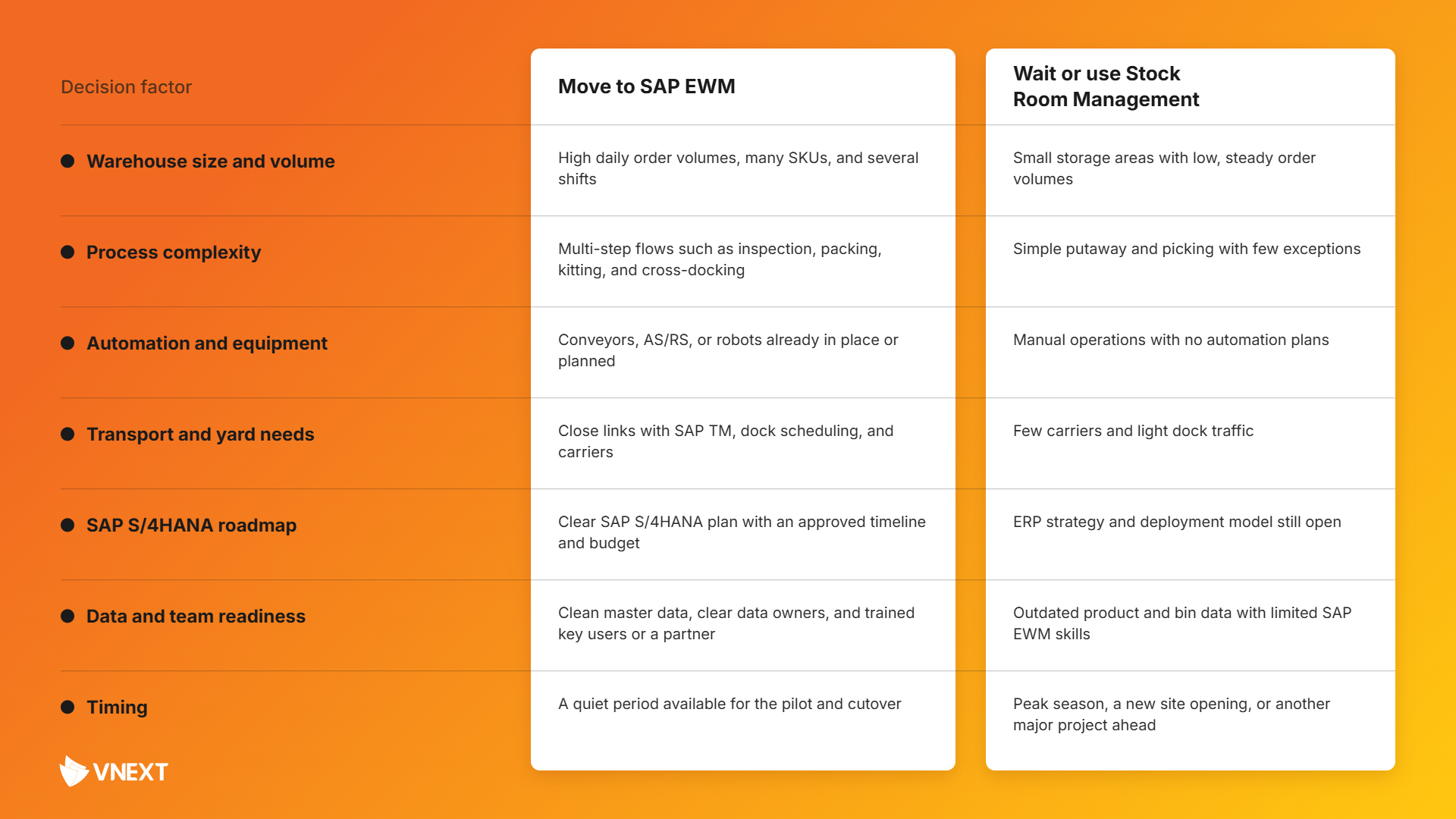
You should not rush into SAP EWM if your warehouse is small and simple, your SAP S/4HANA roadmap is still unclear, or your data and team are not ready for the change.
Now, this is where many companies make costly mistakes. SAP EWM often sounds like the obvious next step after SAP WM, but moving too early can add cost and complexity before the business is ready to benefit from it. A well-timed move, planned as part of a wider SAP ECC to S/4HANA migration, usually delivers far better results.
Common cases when you should wait:
- Small, simple warehouses: If a site has a few hundred bins, manual processes, and low order volumes, the full power of SAP EWM may go unused. In these cases, Stock Room Management in SAP S/4HANA can cover basic bin-level stock control with much less effort.
- No clear SAP S/4HANA roadmap: SAP EWM works best as part of a planned move to SAP S/4HANA. If the overall ERP strategy, deployment model, or timeline is still open, the warehouse project risks being redesigned twice.
- Master data that is not ready: SAP EWM depends on accurate product sizes, weights, packaging data, and bin structures. If no one owns this data today, the migration will carry years of errors into the new system and slow down picking from day one.
- No internal SAP EWM skills or partner: SAP EWM has more configuration options than SAP WM. Without experienced consultants or trained key users, small setup mistakes can turn into daily problems on the warehouse floor.
- Peak season or major site changes ahead: A migration during year-end peaks, a new warehouse opening, or an automation project adds unnecessary risk. It is safer to plan the cutover for a quieter period.
- A tight budget for the wider SAP program: Budget pressure is growing across SAP projects. Budget is now the biggest challenge organizations running SAP report, cited by 61%, up 7 percentage points from the year before, according to ASUG’s 2026 Pulse of the SAP Customer survey. Spreading the warehouse migration across phases can help protect the core S/4HANA program.
What are the risks of SAP WM to EWM migration?
Moving from SAP WM to SAP EWM changes warehouse processes, data structures, and system interfaces at the same time, and the warehouse still has to receive, store, and dispatch goods every day.
Now, this is where complexity usually increases for a period of time. During a phased migration, some warehouses or processes still run on SAP WM in SAP ECC, and others already run on SAP EWM. This mixed setup creates new dependencies, different ways of working between sites, and extra coordination for IT and warehouse teams.
Key risks during migration:
- Stock and bin data errors: Quants, storage bins, and handling units must be mapped to the SAP EWM data model. Small mistakes in this step can lead to stock levels in the system that no longer match what is on the shelves.
- Lost custom logic: Many SAP WM systems carry years of custom programs and user exits. This logic does not move to SAP EWM automatically, and each piece must be replaced with standard functions, rebuilt on SAP BTP, or retired.
- Broken device and automation interfaces: RF scanners, label printers, conveyors, and automated storage are often connected to SAP WM through custom interfaces or a separate control system. Each connection must be rebuilt and tested with SAP EWM before go-live.
- Integration gaps with transport and partners: Links with SAP TM, carriers, and EDI partners change when warehouse processes move to SAP EWM. A missing or delayed message can hold trucks at the dock and delay customer deliveries.
- Parallel running and cutover pressure: Open deliveries, stock in transit, and warehouse tasks must move from SAP WM to SAP EWM at a precise moment. A cutover planned too tightly increases the risk of lost or duplicated stock.
- Slower work during user adoption: SAP EWM uses new screens, task flows, and RF transactions. In the first weeks, picking and putaway often take longer until warehouse staff feel confident with the new system.
7 steps to migrate from SAP WM to SAP EWM safely
The safest way to migrate from SAP WM to SAP EWM is to do it gradually, one warehouse or process at a time, with daily operations running smoothly for customers throughout the project.
Now, this is the key idea. You should never try to switch every warehouse, process, and interface in a single cutover. A "big bang" migration is one of the fastest ways to disrupt deliveries and lose control of stock.
Successful companies treat migration as a step-by-step process, where each change is planned, tested, and reversible.
Step 1: Start with a warehouse and system audit
First, understand what you have today. Review your SAP WM configuration, custom programs, interfaces, and the warehouse processes that change most often. This audit shows which parts can move to SAP EWM standard and which need extra work.
Step 2: Choose the right SAP EWM deployment
Decide between Embedded Basic EWM, Embedded Advanced EWM, and Decentralized EWM. In practice, the choice depends on order volumes, automation plans, and how many ERP systems the warehouse must connect with.
Step 3: Clean and map master data, bins, and stock
Don't move years of outdated data into the new system. Fix product dimensions, weights, and packaging data, remove unused bins, and map every storage type to the SAP EWM structure before the first test load.
Step 4: Redesign processes with SAP standard first
Use SAP EWM standard processes as the starting point and add custom logic only where the business has a clear need. Extensions should run on SAP BTP, keeping the SAP S/4HANA core clean for future upgrades.
Step 5: Rebuild interfaces with devices, automation, and SAP TM
Reconnect RF scanners, label printers, conveyors, and automated storage, and set up integration with SAP TM and carriers. Each interface should be tested on its own before it joins the full process flow.
Step 6: Test with real volumes and run a pilot warehouse
Run several test cycles with real orders from busy periods. Then go live in one representative warehouse or area first, and use the lessons from this pilot to refine processes before the wider rollout.
Step 7: Cut over in phases and provide hypercare
Move the remaining warehouses step by step, using:
- Safety stock built before each go-live
- Mock cutovers to rehearse data loads and timing
- A clear rollback plan for every site
- On-site hypercare in the first weeks after go-live
Daily checklist during the migration
Use this checklist every day from the first pilot go-live until operations are stable.
| KPI | What to check every day | Warning sign | First action |
☐ | Stock accuracy | Compare system stock with cycle count results for fast-moving items and critical bins | Differences above the agreed tolerance | Recount the affected bins and review the latest goods movements |
☐ | Order cycle time | Measure the time from order release to goods issue | Orders taking longer than before go-live for more than two days | Review wave settings and check for blocked or waiting tasks |
☐ | Picking errors | Track wrong items, wrong quantities, and missing items reported at packing | Error rate above the pre-migration level | Check bin data and retrain pickers on the new RF screens |
☐ | Dock waiting time | Record how long trucks wait from arrival to loading | Waiting times growing day by day | Check staging, loading tasks, and dock appointment settings |
☐ | On-time dispatch | Count deliveries leaving the dock by the planned time | More late dispatches than before the migration | Prioritize urgent orders and review carrier cut-off times |
☐ | Interface errors | Review failed messages with SAP S/4HANA, SAP TM, RF devices, and automation | Any message stuck for more than one hour | Reprocess the message and fix the root cause the same day |
☐ | Open tasks backlog | Count warehouse tasks still open at the end of each shift | Backlog growing from shift to shift | Add temporary staff or adjust task priorities for the next shift |
Review these KPIs at a short daily meeting with warehouse supervisors, IT, and the SAP project team. Clear numbers help the team catch problems early and decide quickly when to move to the next site.
Start smart: Choose a partner who’ll get it right
When you kick off an SAP WM to EWM migration, ask your partner to walk you through a real warehouse project they led, step by step. An experienced team will explain how they reviewed the SAP WM setup, cleaned stock and bin data, and handled risks such as outdated custom code or RF interfaces that needed rebuilding. Vague answers, buzzwords, or big customer logos with no detail behind them are red flags.
Ongoing support is where good partners show their value. Ask how they monitor warehouse performance after go-live and how quickly they respond when pickers or supervisors report a problem. A partner who treats go-live as the finish line can make the first weeks much harder for your warehouse team.
At VNEXT, nearly 20 years of experience, 550+ IT professionals, and a team of 70+ SAP engineers stand behind 30+ SAP projects for manufacturers and logistics companies across APAC. We start with a detailed audit of your SAP WM environment, keep existing processes running during the migration, and stay on call after the switch, tracking daily KPIs and fixing small issues before they affect deliveries. That is the difference between a smooth warehouse transition and just another IT project.
Final thoughts
Since SAP WM depends on SAP ECC, whose mainstream maintenance ends in 2027, companies face a clear choice between moving to SAP EWM on their own terms or acting later under time pressure. Waiting too long can bring consequences such as rising support costs, a shortage of experienced consultants as deadlines approach, and rushed cutovers that put daily deliveries at risk. If you are not yet sure whether SAP EWM or Stock Room Management is the right path for your warehouse, our SAP experts can help you understand what the migration will change and how it can benefit your business.
FAQ
Is SAP WM still supported in SAP S/4HANA?
SAP WM is available in SAP S/4HANA only as part of the compatibility scope, with time-limited usage rights. SAP does not develop SAP WM further. SAP Extended Warehouse Management (SAP EWM) is the strategic successor to SAP WM in SAP S/4HANA, and companies planning a move to SAP S/4HANA should plan their warehouse migration to SAP EWM or Stock Room Management.
When does SAP WM reach the end of maintenance?
SAP WM follows the maintenance timeline of SAP ECC. Mainstream maintenance for SAP ECC, including SAP WM, ends on December 31, 2027. Extended maintenance is available until the end of 2030 at a higher cost, with no new functions. Companies still running SAP WM should start planning their SAP EWM migration well before 2027.
What is the difference between SAP WM and SAP EWM?
SAP WM is the basic warehouse component of SAP ECC, covering putaway, picking, and stock transfers. SAP EWM is SAP's advanced warehouse solution for SAP S/4HANA. SAP EWM adds wave planning, labor management, yard management, multi-step processes, and direct control of warehouse automation, and it integrates natively with SAP TM and carrier networks.
Should we choose SAP EWM or Stock Room Management?
Stock Room Management suits small storage areas, spare parts rooms, and simple warehouses with low order volumes. SAP EWM is the better choice for busy distribution centers, 3PL providers, and warehouses with automation, several shifts, or complex processes. The decision depends on warehouse size, process complexity, automation plans, and long-term growth.
Can we migrate to SAP EWM before moving the rest of SAP ECC to SAP S/4HANA?
Yes, in many cases. Decentralized SAP EWM runs as a separate SAP S/4HANA system and can connect to SAP ECC through standard interfaces. This approach allows companies to modernize the warehouse first and move the ERP core later. The right setup depends on your current SAP landscape and should be confirmed by an experienced SAP consultant.

You may also like
-
 Manufacturing SAP/ERP
SAP in smart manufacturing: Shaping the intelligent factory
When I start a new manufacturing project, I usually see the same problem: plants are held back by their own old systems and by piles of production data that nobody puts to use. All this messy information is scattered across outdated ERP systems, separate shop-floor tools, and countless Excel files. Because of this mix of disconnected tools, the business inevitably suffers from fragmented data, slow decisions, and messy, complicated workflows. On the other hand, I've seen that the problem for manufacturers may not be a lack of software, as many have already poured large budgets into digital tools. According to Deloitte's 2025 Smart Manufacturing Survey, 78% of respondents now put more than 20% of their improvement budget into smart technology. They may have modern machines and plenty of expensive analytics software, but the pain point remains, with the shop floor and the business looking at different numbers. The cost of staying disconnected is growing, especially in Asia, because this region now leads the move to smart factories. According to MarketsandMarkets, the Asia Pacific smart factory market is projected to grow from USD 40.24 billion in 2025 to USD 88.47 billion by 2032, with manufacturing execution systems holding the largest share in 2025. Another study highlights that 92% of executives believe smart manufacturing will be the main driver of competitiveness over the next three years. For plants still running on separate systems, that is a clear warning. Their competitors are already making decisions with live data, while they are still waiting for last week’s report. SAP can close this gap, but the software alone won’t do it. In every plant I’ve worked with, the real change came when machine data, shop-floor work, and planning finally started running through the same system. That’s the moment a disconnected shop floor begins to behave like an intelligent factory. Below, I’ll walk you through how SAP in smart manufacturing works from the inside and why it gives a plant a clear view of what’s happening on the line right now. What is smart manufacturing? First of all, what is it? Smart manufacturing connects machines, sensors, production systems, and business processes in a single digital environment. It relies on the Industrial Internet of Things (IIoT), cloud computing, advanced software, and artificial intelligence to give every team, from operators to planners, the same live view of production. In practical terms, it is about using technology to make faster decisions and get more output from the same resources. A well-designed smart manufacturing setup should work with every machine in the plant, old or new, and grow easily as the plant adds more lines and equipment. As all those machines pump out large volumes of data every second, the system needs to process it in real time and turn it into insights that supervisors and planners can act on during the shift. Interest in this approach is high. According to the Smart Factories and Digital Production Survey, only 28% of manufacturers describe their current operations as smart or somewhat smart, while 76% expect to reach that level within two years. Still, wanting to adopt smart manufacturing is very different from knowing how to do it. In many plants, the term ends up covering any digital project, and that is where plans and results start to drift apart. Buying new tools takes a purchase order. Getting them to work together as one connected, data-driven production system takes much more effort. That work starts with a clear picture of how smart manufacturing differs from the way most plants run today, and where the smart factory comes into the story. Smart manufacturing vs traditional manufacturing The biggest difference between smart and traditional manufacturing lies in how data moves through the plant and who can use it to make decisions. The table below compares the two approaches. Aspect Traditional manufacturing Smart manufacturing How systems connect Machines, the MES, and the ERP each run on their own. Data moves between them through file exports, manual re-entry, or a printed report carried to the office. Machines, shop-floor systems, and the ERP share one data flow. A confirmation on the line updates stock and costs in the ERP within minutes. How data is captured Operators write counts and downtime on paper or in Excel, and a supervisor types everything in at the end of the shift. Machines report counts, cycle times, and stops automatically, while operators confirm their work on a tablet at the station. How decisions are made Planners rely on past reports and their own experience, which turns most decisions into reactions to problems that already happened. Planners and supervisors see the current status of every order and machine, which lets them adjust the plan on-time. View of production status Managers find out how a line performed at the end of the shift, and sometimes only at the end of the week. Output, scrap, and OEE for every line are visible on screens while the shift is still running. Quality checks Most problems are found at final inspection, when a whole batch may already be affected. Checks run at each operation, and a failed result can stop the batch on the spot. Every unit keeps a full record of its parts and test results. Maintenance approach Machines are repaired after they break down or serviced on a fixed calendar. Sensor data shows when a machine starts to wear, giving the team time to plan service before it causes a stop. Handling unexpected problems A late supplier or a broken machine leads to a long chain of phone calls and emails, and each team updates its own plan separately. Everyone sees the same problem at the same time, and the plan, stock, and orders are updated in one place. Where smart manufacturing meets the smart factory Smart manufacturing isn’t one system you can buy and install. It is a way of running the business where production, planning, quality, and maintenance use the same data and connected tools. A smart factory is where this happens on the ground, when machines, software, and people in the factory share information as the work goes on. The two work at different levels. Smart manufacturing covers the whole business, from demand planning to suppliers. The smart factory is the plant where that plan becomes daily work. Most companies start with one smart factory and test the results on a few lines. Once it works, they copy the same model to other plants, and that is when a smart factory project grows into smart manufacturing. From Industry 4.0 to the intelligent manufacturing Smart manufacturing grows out of Industry 4.0, which treats connectivity, data, and automation as parts of one operating setup. The most advanced examples are already easy to find. In June 2026, the World Economic Forum announced 16 new awards to its Global Lighthouse Network, bringing the community to 238 of the world’s most advanced manufacturing and supply chain sites. Asia is setting the pace, as China hosted 101 of the world’s 224 lighthouse factories as of January 2026, after the World Economic Forum named 16 Chinese sites in its latest batch of 23. In practice, IIoT sensors capture data from machines, products, and supply chains every second. Cloud platforms store and process that data at scale, and AI helps people see which signals need attention first. Integration keeps shop-floor systems and business applications in step with each other. Digital twins and simulation tools add one more layer, letting teams test a change on a virtual model before applying it on the real line. This is where the idea of the intelligent enterprise comes in. Industry 4.0 focuses on change inside the factory, and the intelligent enterprise, the concept behind SAP’s strategy, applies the same principles to the whole business. SAP puts this into practice by linking shop-floor operations with business processes. In the end, a factory does not become smart on its own. Its value appears once it moves in step with the rest of the business. Decoding the value of connectivity in smart manufacturing Today, manufacturers face constant pressure to deliver more products, in more variants, with shorter lead times. This leads to the need to spot problems on the line and react within minutes, long before they become missed orders. Also, plants should be able to change their plans quickly when demand changes or a supplier is late. Simply adding new machines and software with no clear plan to connect them is no longer effective. Before we go further, let’s look at what a connected factory brings to your business. Full visibility across every line Smart manufacturing shows output, machine stops, and wasted materials for every line and plant on one live screen, which saves managers from chasing supervisors or waiting for reports at the end of the shift. This connected view helps teams notice a slowdown the moment it starts, thus protecting output compared to traditional plants that only see problems once the shift is over, whether they could have been fixed earlier or not. Fewer unexpected breakdowns As machines age, the risk of a sudden breakdown grows with them. Whether a machine starts to shake more than usual or a motor runs hotter than normal, connected sensors spot the change and give the maintenance team time to plan repairs before production stops. It’s built to catch wear early, and machines in good condition keep running with no unnecessary repairs on a fixed schedule. Plans that keep pace with reality Smart manufacturing gives planners a single view of orders, stock, and machine status, which lets them reschedule jobs within minutes when conditions change. Plants get steadier output, less idle time on the line, and a production plan that stays in line with what is happening in the factory. Quality problems caught at the source When a product reading goes outside the allowed limits, smart manufacturing allows you to stop that batch right away, with no need to wait for the final check or a customer complaint to discover the problem. Connected quality checks let your team fix the product at the step where the issue started, keeping waste low and production running smoothly. A complete history for every product Being able to trace every product builds trust with customers, auditors, and regulators. Smart manufacturing allows your plant to link every material, part, and production step in one continuous record, then trace any product back to where it came from in a few clicks. Doing so ensures that product recalls stay small and audits go smoothly whenever someone asks where a product came from. Which SAP solutions make up a smart factory? An SAP smart factory is built from several solutions that work in layers, from the machines on the shop floor up to the ERP and analytics. Each layer has a clear job, and the layers are connected to keep data moving from the machine to SAP S/4HANA and back to the line. The table below shows the role of each layer, the SAP solution behind it, and the output it delivers to the plant. Layer Role SAP solutions and what each one does Output 1. Machines and sensors Create the basic data of the factory, such as whether a machine is running, how many parts it makes, and its temperature or energy use No SAP software at this layer. Machines, control systems, and sensors from any brand provide the data that the other layers use. Live data from every machine and line 2. Connectivity Collect data from machines and send it to SAP in a format the system can read, including data from older machines SAP Plant Connectivity (PCo): reads data from machine control systems and sends it to SAP Edge devices: small computers near the machines that sort the data and send only what is needed Clean, consistent machine data ready to use in SAP 3. Shop-floor work Run production orders on the line, guide operators, and check quality at each step SAP Digital Manufacturing: sends orders to the right machines, shows step-by-step instructions on screens, records finished work and waste, checks quality during production, measures how well each machine performs, and keeps a full history of every product Completed work records, quality results, and a full history of each product 4. ERP core Plan production, manage materials and stock, and track the cost of every order SAP S/4HANA: PP: plans what to produce and creates production orders MM: handles buying and stock QM: manages quality checks and problem reports PM: plans maintenance and repairs FI/CO: calculates product costs and profit Production orders, up-to-date stock levels, and the cost of each order 5. Planning and assets Balance demand with plant capacity, set the order of jobs on key machines, plan maintenance, and bring materials to the line on time SAP IBP: forecasts demand and plans supply across plants and suppliers SAP Asset Performance Management: watches machine condition and warns before a breakdown SAP EWM: prepares materials in the warehouse and delivers them to the line on time Realistic plans, clear job schedules, early maintenance warnings, and materials ready when needed 6. Reports, AI, and add-ons Use data from all layers to create reports, forecasts, and custom apps SAP Analytics Cloud: dashboards, key numbers, and forecasts Joule: SAP's AI assistant that answers questions in everyday language SAP BTP: connects systems and hosts custom apps outside the core ERP Clear dashboards, AI-based insights, and custom apps that keep the core system simple How SAP in smart manufacturing works in a closed loop? SAP in smart manufacturing moves every production signal through a fixed sequence of planning, execution, analysis, and improvement. The exact setup changes from one plant to another, but the basic flow stays much the same. A customer places a new order, or a machine on the line starts to slow down. From there, SAP has to answer three questions. What does the business need to produce? Can the plant deliver it with the materials and capacity it has? And what should change in the next plan based on what happened on the line? Here’s the full loop. Stage 1. Demand enters the loop The demand signal can come from customer orders, sales forecasts, the sales pipeline in a CRM, distributor stock reports, or EDI messages from key customers. In SAP IBP, all of these sources flow into one demand plan that is updated as new data arrives. Along with the quantity, each demand signal usually carries context such as the product, customer, region, requested date, and sales channel. SAP IBP uses this detail to see which part of demand is firm and which part is still a forecast. That split is more important than it may seem. Suppose a customer sends a firm order for 500 units that the sales team had already included in the monthly forecast. SAP IBP needs to recognize that both numbers describe the same demand and count it only once, or the plant will produce twice as much as the market needs. This is known as forecast consumption. Stage 2. SAP S/4HANA checks demand with the plant’s real limits A demand plan still isn’t automatically ready to produce. Production planning checks whether the plant has what it needs to deliver each order. For materials, MRP in SAP S/4HANA compares requirements with stock and open purchase orders. For capacity, it checks how many hours each work center has available. For delivery dates, it confirms that the order can be finished in time. Some decisions happen inside SAP S/4HANA. Others depend on a supplier’s delivery date, a machine that is down for maintenance, or a subcontractor’s free capacity. This is also where missing parts need careful handling. A shortage today doesn’t always signal a late order. A purchase order may already be on the way, or the same part may be in stock at another plant. Planners should check the full picture in MD04 or the Fiori app Monitor Material Coverage before moving orders or switching production to another line. Stage 3. The plan is executed on the shop floor Once the order is released, the plant carries out the work. That could involve staging materials, starting operations, running quality checks, confirming finished quantities, and posting goods receipts. The technical challenge is keeping the shop floor and SAP S/4HANA in step. A confirmed operation, for example, should also update stock levels and order costs in the ERP. SAP Digital Manufacturing sends each confirmation and goods movement to SAP S/4HANA as it happens. It also compares real output with the plan, and when a line slows down, it points to the exact operation, work center, and order involved. In larger setups with several plants and systems, integration services on SAP BTP manage this data flow. A failed posting is the practical risk here. If an operator confirms 500 parts but the goods issue for their components cannot be posted, SAP will show more material in stock than the plant has. Planners should clear these errors every shift to keep stock and costs accurate. Stage 4. Production results are analyzed After execution, SAP passes the production data to analytics tools to explain what happened on the line. A plant manager compares OEE across lines and shifts. A quality engineer looks for links between defects and material batches. A planner checks how real cycle times compare with the times in the plan, for example a machine planned for 60 seconds per cycle that is running at 75. For production results, SAP S/4HANA is often the main source of truth. SAP Analytics Cloud and the analytics built into S/4HANA read the original records from production orders and confirmations, which keeps every figure consistent. This gives managers a clearer view of why a number changed. Stage 5. Lessons from production go back into planning Once a production cycle is complete, SAP sends what the plant has learned back to planning, and the loop starts again. That feedback could be a new capacity figure, an updated supplier lead time, a revised job sequence, or a maintenance alert for a machine that is starting to wear. A useful update does more than report that output was low. It changes the settings behind the next plan, such as real machine capacity or purchasing lead times, and keeps the same problem from happening twice. In some cases, the change happens right away, for example when SAP Asset Performance Management creates a maintenance notification. In others, planners review the trends first and update the planning rules in the next cycle. SAP smart factory use cases The role of SAP in a smart factory changes from one plant to the next. A car parts supplier and a food producer face very different problems, and the use cases below show how SAP helps with the most common ones. Torque data linked to every unit An automotive assembly line is probably the easiest place to see this use case in action. An operator tightens a bolt with a connected tool. SAP Plant Connectivity reads the torque value, and SAP Digital Manufacturing saves it with the serial number of that unit and the operation it belongs to. The same setup also works for press-fit forces, leak tests, and welding settings. Different process, same basic idea. Every key value from the line becomes part of the product's permanent record, ready to show an OEM when a quality question comes up. Automatic batch hold in food production A food production line usually packs several critical checks into one process. A single batch of sauce may pass through cooking, pasteurization, cooling, and filling, and each step has its own limits for temperature and time. For the operators, these checks feel like separate tasks at separate stations. For SAP, they all count toward one decision. Is this batch safe to release? If the pasteurization temperature drops below the limit, SAP Digital Manufacturing puts the batch on hold, and SAP QM records the issue before a single pack reaches the warehouse. AI visual inspection Taking a photo of a finished part creates more than an image. The plant also needs a check for scratches and dents, a check that every component is in place, a pass or fail decision, and a quality record for that unit. With the visual inspection capability in SAP Digital Manufacturing, an AI model reviews each camera image on the line and links the result to the same production order, which gives quality, production, and engineering teams one inspection record to follow and less reliance on checks by eye. Energy use per production order On the line, the operator sees a machine running, a batch moving forward, and a counter going up. The business sees a lot more. With energy meters connected to SAP Digital Manufacturing, that same batch can update energy use per order, the real cost of each product, utility totals for every line, and carbon data for sustainability reports in SAP Analytics Cloud. One ordinary production run becomes part of several business processes. Plant-to-plant performance comparison Comparing plants is really a question of measuring every site in the same way. When a group with factories in Vietnam and Thailand looks at OEE, scrap rates, or output per hour, SAP Datasphere collects the data from each site and applies one shared definition to every figure. SAP Analytics Cloud then shows the results side by side, which makes it clear which plant performs best and which practices are worth copying to the others. Common challenges when building smart manufacturing processes with SAP? Building smart manufacturing processes with SAP sounds simple until older machines, years of messy master data, and a production schedule that cannot stop all enter the picture. That is where the real work begins. Let’s look at what usually makes it difficult. People and skills A smart factory cannot run on technology alone. According to Deloitte, 48% of manufacturers find filling production roles increasingly challenging, and many new systems end up with too few people who know how to use them. That calls for training plans, simple role-based screens, and early involvement of shop-floor teams before go-live. Older machines with no network connection Managers expect live data from every machine, including the ones installed twenty years ago. Many of those machines still need extra sensors, a gateway, or an edge device before SAP Plant Connectivity can read their data. The useful question here is not only which machines can connect. You also need to weigh what each connection costs, especially on lines where the machine itself is close to replacement. Reactive maintenance habits A single breakdown can affect the maintenance team, the production schedule, spare parts stock, and customer delivery dates. Moving from repairs after failure to service based on machine condition is difficult when teams are used to fixing what breaks and do not yet trust the machine data. Clear alert rules in SAP Asset Performance Management, maintenance plans in SAP S/4HANA, and a few early wins on critical machines help build new habits step by step. Material flow that lags behind production Production lines need the right parts at the right time to keep running, but warehouses can not know the exact moment a line will run out. The usual answer is to link material supply to real consumption on the shop floor. Critical and high-volume parts can move to automatic line feeding in SAP EWM, and slower-moving items can stay on regular supply runs with no extra effort from operators. Proving ROI beyond the pilot line Smart factory results do not always grow in a neat, predictable line. A pilot on one line can show quick gains in OEE or scrap, and then the numbers become harder to prove as the project moves to other lines and plants. The rollout needs clear baseline figures, agreed KPIs, a standard template, and regular reviews with management. Otherwise, a successful pilot can lead to stalled budgets, scattered local setups, and doubts about the investment that last long after the first results came in. Final thoughts Let me wrap up by emphasizing that the success of SAP in smart manufacturing depends on complete alignment between how your factory runs and the systems behind it. This calls for a direct link between the machines, shop-floor execution in SAP Digital Manufacturing, and planning, quality, and finance in SAP S/4HANA. Clean master data, a clear plan for older equipment, and teams that are ready to use the new tools from the first day will help you avoid costly rework later on. When built to close real gaps on the shop floor and measured with clear KPIs such as OEE, scrap rates, and on-time delivery, a smart factory goes beyond being a technology project to become a strategic asset that delivers steady gains in output, quality, and resilience for years to come.
-
 Manufacturing SAP/ERP
What is SAP for automotive? Key capabilities, benefits, and future trends
From my practice, the most common issue automotive suppliers face is not a lack of software, but OEM requirements that change faster than their systems can follow. Forecasts arrive through EDI. JIT calls update the plan several times a day. Each OEM expects its own labels, packaging, and delivery format. When planning, production, logistics, and billing each keep their own version of these orders, nobody can reconcile them fast enough to act. For instance, an OEM changes the build sequence for tomorrow’s seats late in the afternoon. The planner updates a spreadsheet, but the shop floor still follows the morning plan. Two racks leave the plant in the wrong order. Nobody finds out until the OEM’s assembly line calls for a part that isn’t there. Finance learns about the expedite costs and chargebacks at month-end close. One of the solutions we offer is SAP implementation for automotive manufacturers and suppliers. SAP is already a familiar choice in this industry, including in Asia. According to SAP’s Q1 2025 earnings call, Hyundai, Kia, and Mazda joined its automotive customer base in that quarter alone, along with the supplier Webasto. What is SAP for automotive? Which capabilities set it apart from a standard ERP? What benefits can your plant expect? Let’s talk more about it today. Additionally, I’ll walk you through the trends shaping SAP for automotive in the next few years. What is SAP for automotive? SAP for automotive is the system of record that connects OEM demand, production, logistics, quality, and billing on one data model, which makes a change in one place visible everywhere else. The practical side of that is easier to see through a single JIT call In a fragmented environment, each of those steps is an email, an EDI file someone re-keys by hand, or a phone call to the plant. In SAP for automotive, they're the same set of numbers viewed by planners, plant teams, logistics, and finance across plants, customers, and currencies. Built on SAP S/4HANA, it adds automotive processes such as scheduling agreements, just-in-time and just-in-sequence deliveries, automotive EDI, and variant-rich production to the standard finance, procurement, and logistics functions of the ERP. That's why, if… Your OEM call-offs and JIT schedules change faster than your team can update spreadsheets Your customers require deliveries in sequence, each with their own EDI messages and labels Your products come in many variants, and every quality claim needs a clear trace back to the batch or serial number SAP for automotive is likely to help. Why SAP ERP for automotive is needed Plans that keep up with OEM call-offs An OEM can change its delivery schedule several times a week, and each change affects what the plant needs to build and buy. In SAP S/4HANA, new forecasts and JIT schedules from the OEM update the scheduling agreement automatically, and MRP uses the new quantities in its next run. When one part goes to three OEMs, planners can quickly see which customer caused the change in demand. Sequenced deliveries without manual checks With JIS delivery, one part in the wrong position can stop the OEM's assembly line. SAP reads each sequenced call-off from the OEM, creates production and picking orders in the right order, prints sequence labels, and sends a delivery confirmation back to the OEM. For a seat or bumper supplier sending several racks per shift, the order is checked in the system. Many variants, full traceability for recalls Recalls are a real risk in Asia's largest car market. According to China's market regulator, the country recalled more than 38 million vehicles between 2021 and 2025. SAP links each product variant to the parts, batches, and serial numbers used to build it. When a supplier has a problem, quality teams can find which vehicles or customers received it in minutes, without digging through paper records. SAP solutions for the automotive industry are used across the whole automotive value chain, but each group relies on a different set of capabilities. The table below shows how OEMs, suppliers, and dealers use it. Users Main processes Key SAP capabilities OEMs (vehicle manufacturers) Planning vehicle production, building cars in sequence on the assembly line, calling off parts from suppliers, managing quality and recalls Variant configuration for vehicle options, PP/DS for sequencing, JIT/JIS call-offs to suppliers, EWM, QM, SAP IBP Tier 1-3 suppliers Receiving OEM forecasts and call-offs, producing parts in high volume, delivering JIT or in sequence, labeling and packaging, invoicing and self-billing Sales scheduling agreements, JIT/JIS supply to customer, automotive EDI, repetitive manufacturing and KANBAN, returnable packaging, batch traceability Importers and dealers Ordering and stocking vehicles, selling to customers, managing service and spare parts Vehicle Management System (VMS), sales and distribution, spare parts logistics with EWM, service management The best SAP ERP modules for automotive companies Picture a planner updating production after a new OEM call-off while a quality engineer checks which batch went into last week’s deliveries. Both are working on the same parts but using different modules of SAP. Automotive setups usually combine several modules, depending on your company’s role in the supply chain. Here’s what each one does and why it is important. SAP SD (Sales and Distribution) SD covers OEM contracts, delivery schedules, and invoicing. Sales scheduling agreements set out how much of each part the OEM needs and when, and they update automatically with every new forecast or JIT call-off. Link those agreements to JIT and JIS deliveries, and you can send each delivery notice back to the OEM through EDI in its own format. For OEMs that pay through self-billing, SD lets finance teams check the OEM's billing documents of each delivery. SAP PP (Production Planning) PP lets you plan high-volume production by period instead of by single order, like a daily run of 2,000 door panels on the same line. Repetitive manufacturing handles these steady runs, and KANBAN refills parts at the line as they are used. Variant configuration helps teams build products with many options, and PP/DS sets the right order of jobs on each machine. Planners can review the plan for every line and adjust it when an OEM changes its call-offs. SAP MM (Materials Management) This module covers buying parts from suppliers and keeping the production line supplied. For example, a plant needs steel coils and fasteners every day for the same lines. Teams can set up scheduling agreements with each supplier and call off parts just in time for the line, which keeps stock low without risking a shortage. Parts held on consignment are paid for only when they are used, and invoice checks compare each supplier bill with the goods received. SAP QM (Quality Management) QM logs inspections, customer complaints, and batch or serial number records against quality standards like IATF 16949. For an automotive supplier, it's often what an OEM auditor asks to see first when a quality claim or recall comes in. SAP EWM (Extended Warehouse Management) Automotive companies use SAP EWM for warehouse and line-feeding processes, but the setup varies. Some run EWM embedded in SAP S/4HANA; others use a separate, decentralized EWM for large parts centers or high-volume warehouses. Parts picked in sequence can go straight to the assembly line or be packed for JIS delivery to the OEM. Returnable containers are tracked as handling units, with labels printed in the format each customer requires. SAP FI/CO (Finance and Controlling) FI/CO keeps production costs linked to the financial records. When parts are bought, produced, or delivered, the related costs appear in SAP and can be traced to each part number, customer, and OEM program. Finance can see the margin on every program, and plant teams can compare the costs recorded in production with the standard cost of each part. If your OEM contracts include price changes that apply to past deliveries, you usually need to set up retroactive billing in SD alongside FI/CO. SAP PM (Plant Maintenance) You can use SAP PM for planned servicing and repairs on presses, robots, and welding lines, including urgent fixes when a line stops mid-shift. Each machine keeps its own maintenance history, while notifications capture issues as they come up and work orders organize the repair work. For molds and stamping dies, counter-based maintenance plans schedule service after a set number of shots or strokes, which helps keep tooling in good condition between production runs. How SAP supports the automotive supplier process end to end Before confirming tomorrow's delivery, a supplier's planner should check the OEM's latest call-off and see whether production and packaging can still meet it. SAP connects these numbers to the scheduling agreement for that part and customer. SAP for automotive helps suppliers follow each order from the OEM's forecast to the final invoice and keep every step in line with the latest customer schedule. Below, I'll explain how this process works in real situations. Receive OEM forecasts and JIT call-offs through EDI The process can start with a long-term forecast from the OEM, then narrow down to daily or even hourly JIT call-offs as the delivery date gets closer. Both arrive through EDI in the OEM's own message format and are loaded into SAP. Teams can compare each new release with the previous one, which makes it easier to see where the OEM's demand starts to move away from the plan. Update the sales scheduling agreement The sales scheduling agreement helps teams keep one up-to-date record of what each OEM needs. For example, a new JIT call-off may move 500 brackets from Thursday to Wednesday. Schedule lines show how many parts are due on each date, while the forecast and JIT schedules show which quantities are firm and which are still planned. Cumulative quantities track how much has been delivered vs what the OEM has called off, and can also help settle disputes when delivery records do not match. Run MRP and plan production MRP helps planners see if the plant has enough parts and capacity to meet the OEM's latest schedule. For instance, if the OEM raises next week's demand by 20% but the steel stock only covers the old plan, the plant may run out of material before the end of the week. SAP compares the new requirements with current stock and open orders, then creates planned orders for production and delivery schedules for suppliers, which helps planners fix shortages before they reach the line. Produce and sequence parts by JIT/JIS call You can set the production sequence for each part based on the OEM's JIS call, down to the vehicle it will be installed in. When a new call comes in, SAP creates production and picking orders in the same order as the OEM's assembly line, counting both new calls and changes to calls already in progress. If the OEM changes the seat color for a car that is already in the sequence, SAP still keeps its original position and updates the details. Depending on the checks you set, the system can warn you about missing or duplicate sequence numbers before the parts are packed. You can then review the call or correct the sequence. Pack in returnable containers and print labels A returnable container record tracks the racks, bins, and pallets that move between your plant and the OEM. Say the OEM requires seats to be delivered in its own steel racks. You assign each rack to the delivery and pack the parts in the agreed quantity. Your team can then print labels in the OEM's required format, such as VDA or Odette labels, directly from SAP. Keep a record of which containers went to which customer and when. If the OEM later reports missing racks, you can refer back to the delivery history and the container balance for that customer. Send the advance shipping notification (ASN) to the OEM Once the delivery is packed, SAP sends an ASN to the OEM through EDI. The ASN tells the OEM which parts are on the way and when they will arrive, including quantities and container details. Many OEMs check each ASN against their own call-offs before the truck reaches the gate, and a missing or late ASN can lead to a penalty or a rejected delivery. Sending it automatically from SAP helps suppliers avoid these problems and keeps the delivered quantities in both systems aligned. Invoice or receive self-billing from the OEM The last step closes the order in finance. Some OEMs pay based on a standard invoice that SAP creates from each delivery. Others use self-billing, where the OEM creates the invoice from its own goods receipt and sends it to the supplier through EDI. SAP compares each self-billing document with your deliveries and agreed prices, then flags any differences for the finance team to review. This makes it easier to catch short payments early, before they build up across hundreds of deliveries. Learn how SAP transform the whole manufacturing processes The SAP solution landscape for automotive In the solution landscape below, I've listed the specialized SAP software that automotive companies should consider. The products below are not direct alternatives. SAP S/4HANA, in its cloud edition, is the ERP platform that runs scheduling agreements, production, and finance. SAP IBP, SAP Digital Manufacturing, SAP EWM and SAP Business Network are not. They extend the core system with deeper functions for planning, shop-floor execution, warehousing, transport, and supplier collaboration. It's easy to mix them up, which is why I'll walk you through each automotive SAP solution: SAP S/4HANA cloud SAP S/4HANA Cloud is SAP's flagship ERP and the main destination for automotive companies still running SAP ECC with IS-Automotive. It covers finance, procurement, production planning, quality, maintenance, sales, and service on one data model. For automotive, it adds sales scheduling agreements, JIT and JIS processing, automotive EDI, and variant configuration. There are two editions of SAP S/4HANA Cloud for automotive companies. Public Edition runs a standardized scope with regular SAP updates and limited room for modification. This makes it the fastest route for smaller suppliers willing to adopt SAP's standard processes, although some automotive scenarios, such as complex JIS sequencing, may have a narrower scope in this edition. Private Edition, delivered through RISE with SAP, keeps custom code and deeper configuration, which suits OEMs and Tier 1 suppliers with many customer-specific requirements. SAP delivers major Private Edition releases on a two-year cycle. Key features Sales scheduling agreements with forecast and JIT delivery schedules for each OEM JIT/JIS supply to customer, with sequenced production, picking, and labeling Advanced Variant Configuration for parts and vehicles with many options Repetitive manufacturing, KANBAN, and embedded PP/DS for high-volume, sequenced production Batch and serial number traceability for quality claims and recalls Extension model on SAP BTP for customer-specific logic outside the core Pros The widest automotive functionality of any SAP ERP, from OEM call-offs to self-billing Long committed roadmap, with SAP planning to keep at least one S/4HANA release in maintenance until the end of 2040 Large pool of partners and consultants with automotive experience Cons The highest cost and the longest implementation timelines in the SAP portfolio Public Edition limits non-standard processes, while Private Edition carries custom-code cleanup work, especially for companies moving from heavily modified ECC systems SAP Integrated Business Planning (IBP) SAP Integrated Business Planning (SAP IBP) is SAP's supply chain planning suite. It runs on SAP BTP and covers sales and operations planning, demand forecasting, inventory planning, supply and response planning, and a supply chain control tower for exception monitoring. Automotive companies reach for SAP IBP when OEM forecasts, new model launches, and supplier limits become too complex for ERP-level MRP. OEMs use it to balance vehicle volumes and plant and supplier capacity, while Tier 1 suppliers use it to combine forecasts from several OEMs into one plan. Planners work through a Microsoft Excel add-in as well as a web interface, which shortens adoption in teams that have planned in Excel for a long time before. Key features Demand forecasting that combines OEM forecasts with statistical and machine-learning models Constrained supply planning across plants, suppliers, and critical parts such as semiconductors Inventory targets across plants and warehouses to balance service levels and stock Control tower alerts when supply or demand moves away from plan Pros Gives one view of demand across several OEMs and vehicle programs Lets teams test what-if scenarios before committing capacity or buying critical parts Connects S&OP decisions directly to execution in SAP S/4HANA Cons Output quality depends on master data discipline, including lead times, capacities, and BOM accuracy Requires planning expertise that many Tier 2 and Tier 3 suppliers don't have in-house SAP Digital Manufacturing SAP Digital Manufacturing is a cloud MES and manufacturing operations management platform built on SAP Business Technology Platform (SAP BTP). In automotive plants, Digital Manufacturing controls execution operation by operation, from assembly and testing to final inspection. Operators follow work instructions at each station, while machine and tool data, such as torque values from tightening tools, are linked to the serial number of each unit. It exchanges production orders, BOMs, routings, quantities, quality results, and resource consumption with SAP S/4HANA or SAP ECC through SAP Cloud Integration. Key features Order dispatch and operator guidance with version-controlled work instructions for each variant Serial number tracking that records components, process data, and test results for every unit Equipment connectivity through standards-based interfaces such as OPC UA Production and quality KPIs across plants, including OEE and first-pass yield Plant templates for rolling out the same setup to new lines and sites Pros Native integration with SAP S/4HANA for orders, confirmations, and goods movements Unit-level traceability that supports OEM quality claims and recalls One execution template that can be reused across a plant network Cons Connecting presses, robots, and test benches is a project of its own, separate from the software Many automotive plants already run a legacy MES, which forces early decisions about which system owns which process SAP Extended Warehouse Management (EWM) SAP Extended Warehouse Management (SAP EWM) is SAP's advanced warehouse application, available embedded in SAP S/4HANA or deployed as a decentralized system serving one or several plants. It goes well past the stock-and-bin logic of standard inventory management, controlling how every part moves from receiving to the production line and out to the customer. Automotive suppliers and OEMs adopt SAP EWM when line feeding, sequenced picking, or returnable packaging becomes too complex to manage with basic inventory tools. Typical cases include high-volume line feeding each shift, parts picked in the exact order of the OEM's vehicles, and large fleets of customer-owned racks and bins. Key features Production supply with automatic line feeding based on production orders or KANBAN signals Sequenced picking and staging for JIS deliveries Handling unit management for returnable racks, bins, and pallets, with customer-specific labels Material Flow System for direct control of conveyors and automated storage Yard management for inbound and outbound trucks at busy plant gates Pros Depth that no other SAP warehouse option matches, especially for line feeding and sequenced logistics Decentralized deployment keeps the warehouse running during ERP downtime Cons Configuration effort and ongoing administration are substantial More than smaller suppliers with simple stock handling and low volumes usually need SAP Business Network for Supply Chain SAP Business Network for Supply Chain is SAP's cloud platform for collaboration between buyers and suppliers. It brings together the former SAP Ariba Supply Chain Collaboration and SAP Logistics Business Network, and connects directly to SAP S/4HANA or SAP ECC. Automotive companies use it to share forecasts, scheduling agreement releases, and purchase orders with their suppliers in one place. Suppliers confirm quantities, send ASNs, and submit invoices through the network, either by EDI or through a web portal. This helps OEMs and Tier 1 suppliers bring smaller Tier 2 and Tier 3 partners into the same process, even when those partners have no EDI setup of their own. Key features Forecasts and scheduling agreement releases shared directly with suppliers Order confirmations, ASNs, and invoices exchanged through EDI or a web portal Supplier-managed inventory and consignment stock visibility Quality notifications and corrective actions shared with suppliers Collaboration with contract manufacturers on components and order progress Pros One connection to many suppliers instead of a separate EDI link for each one Low entry barrier for smaller suppliers through the web portal Faster response to demand changes, since suppliers see updates as soon as they are released Cons Value depends on how many suppliers join and keep their data up to date Supplier account types and fees can slow adoption in some supply bases SAP automotive software at a glance SAP product Primary role Best suited for SAP S/4HANA Cloud Enterprise ERP with automotive processes OEMs and Tier 1–2 suppliers delivering to several OEMs SAP Integrated Business Planning Supply chain planning and S&OP Multi-plant networks with volatile demand across vehicle programs SAP Digital Manufacturing Shop-floor execution and unit-level traceability Assembly lines that need full traceability across plants SAP Extended Warehouse Management Line feeding and sequenced warehouse logistics High-volume plants with JIS deliveries and returnable containers SAP Business Network for Supply Chain Supplier collaboration on forecasts, ASNs, and invoices OEMs and Tier 1 suppliers with a large Tier 2–3 supplier base How to choose the right SAP automotive product The key to the right SAP setup is a match between your role in the automotive supply chain and what each product was designed for. Six questions below narrow the field. What is your role in the supply chain? A Tier 2 or Tier 3 supplier with one plant and a few customers usually needs a well-configured SAP S/4HANA core. OEMs and Tier 1 suppliers often add specialized solutions on top, such as SAP IBP for planning, SAP Digital Manufacturing for the shop floor, and SAP EWM for line feeding. How many OEMs do you deliver to? Each OEM brings its own EDI messages, labels, and delivery rules. The more customers and JIS lines you serve, the more you need the full JIT/JIS and EDI scope of SAP S/4HANA, which is often easier to achieve in Private Edition. How complex is your production? High numbers of product variants, sequenced production, or serial-level traceability can quickly narrow your options. These requirements usually call for Advanced Variant Configuration and embedded PP/DS in the ERP, with SAP Digital Manufacturing added when you need unit-level tracking on the line. How large is your plant and supplier network? A single plant can plan well with MRP in SAP S/4HANA. Once you run several plants or depend on many Tier 2–3 suppliers, SAP IBP and SAP Business Network for Supply Chain help keep demand, capacity, and supplier commitments in one view. Which systems will SAP integrate with? SAP rarely runs alone in an automotive plant. Knowing how it will connect to your MES, PLM, OEM portals, EDI providers, and existing warehouse systems helps you avoid heavy customization and costly maintenance later. What is your deployment model and long-term budget? Public Edition offers standard processes and faster rollout, while Private Edition supports deeper configuration and existing custom code. Implementation, integration, EDI setup, training, and support make up most of the total cost. If you still run SAP ECC, plan these costs together with the move to S/4HANA before mainstream support ends in 2027. Business benefits of SAP for automotive If I'd been asked to name the main benefit of SAP for an automotive supplier, I'd say it's removing the friction that builds up when OEM schedules, production, logistics, quality, and finance each keep their own version of the same order. If we talk about it in more detail, here's what changes: More reliable on-time delivery to OEMs Fewer sequence and labeling errors Faster response to quality claims and recalls Leaner inventory at the plant and on the line Less manual work in EDI and billing One standard model across plants and customers [[CTA_BANNER text="Not sure which SAP solution is right for your plant? Let VNEXT experts review your processes and recommend the right setup." btn="Reach out to VNEXT"]] SAP for automotive implementation roadmap SAP recommends following six SAP Activate phases. As an SAP partner, VNEXT follows them as well. Here's how we'd roll out SAP for an automotive manufacturer or supplier: Discover Define business objectives and target OEM delivery performance Prioritize processes such as scheduling agreements, JIT/JIS, and traceability Agree on scope, KPIs, and the business case Prepare Establish governance and assemble the project team Collect EDI, label, and packaging requirements from each OEM Assess master data and the existing ERP, MES, PLM, and EDI landscape Explore Run standard process workshops to compare your current processes with SAP Define target processes, modules, integrations, and required extensions Confirm how each OEM's call-offs, ASNs, and self-billing will be handled Realize Configure and integrate the solution Migrate scheduling agreements, BOMs, routings, and packaging data Test end-to-end flows from OEM call-off to delivery and invoicing, including EDI tests with each OEM Deploy Train users by role and plant Build safety stock and time the cutover to avoid gaps in OEM deliveries Launch the system and provide hypercare Run Monitor delivery performance and system stability Support users and optimize processes Extend SAP to additional plants, OEM programs, or new customers Trends and emerging technologies Automotive teams are already using newer SAP capabilities to prepare for electric vehicles, make AI part of daily planning, and share data with partners across the supply chain. Below, I’ll look at these trends and how they work in practice. EV growth and battery traceability The move to electric vehicles is changing what suppliers need to track. According to the IEA’s Global EV Outlook 2026, global electric car sales are expected to reach 23 million in 2026, or 28% of total car sales, and the share of electric car sales in Southeast Asia could rise up to three times by 2035. For suppliers in the region, more EV programs bring new parts, new suppliers, and stricter rules on materials. Battery data is one of the clearest examples. Under an EU regulation, EV batteries placed on the EU market will need a digital battery passport from 18 February 2027, linked to the battery through a QR code. In SAP, batch and serial number tracking links each battery cell and module to its suppliers and to the vehicle it goes into. Product carbon footprint data from tools such as SAP Sustainability Footprint Management can add another layer, giving exporters a solid starting point for passport records. AI in planning, quality, and maintenance Most automotive companies are already investing in AI, but few use it at scale. In KPMG’s 25th Global Automotive Executive Survey, 86% of automakers said they are actively investing in AI, while only 20% of executives said they are ready to handle the disruption it brings. SAP brings AI into processes teams already use every day. In SAP IBP, machine-learning forecasts help planners compare OEM schedules with their own demand signals. For equipment, SAP Asset Performance Management analyzes maintenance records and sensor data to estimate failure risk on presses, robots, and molds. SAP’s AI assistant, Joule, lets users ask questions about orders, stock, or deliveries in plain language instead of searching through several screens. Data sharing across the supply chain Automotive value creation is moving toward partners and ecosystems. In KPMG’s 26th Global Automotive Executive Survey, executives expect the share of value created through partnerships and ecosystems to rise from 30% today to 44% within three years. For suppliers, this means sharing forecasts, quality data, and sustainability information with OEMs and sub-suppliers in a standard way. SAP Business Network for Supply Chain connects buyers and suppliers on one platform, while industry data spaces such as Catena-X are setting common rules for how automotive companies exchange data. Companies with clean master data and connected processes in SAP will find it much easier to join these networks. Final thoughts SAP gives automotive manufacturers and suppliers one connected record, from the OEM's first forecast to the final invoice. It helps teams plan production with the latest call-offs and gives them clear traceability for every part that leaves the plant. Choosing the right SAP products is important, but even the right setup will deliver little value if it is implemented poorly. To get real value from it, a company needs to match SAP to the way it plans and delivers parts. It also needs to connect SAP with the EDI, MES, and warehouse systems already in use. Most of all, it needs a partner who understands the automotive processes and manufacturing industry well enough to configure them correctly from the start.
-
 Manufacturing SAP/ERP
What is SAP MES? Features, benefits, and how to implement
According to Zebra Technologies’ 2024 Manufacturing Vision Study, only 25% of manufacturing leaders in Asia-Pacific have real-time visibility into work in progress across their production process, even though 87% say digital transformation is a priority. In many of the remaining plants, paper logs and spreadsheets still fill the gap. The approach works until… Your plant adds a second line, a second shift, or a customer who expects full traceability for every unit you deliver. Perhaps you have already reached this point, or it’s coming very soon. Paper travelers that follow each order across the floor, an Excel file for downtime, a whiteboard for the day’s priorities, and a few reports pulled from SAP at the end of the week stop making sense. These tools may have worked when the plant was smaller. But once volumes grow and more products share the same machines, the setup starts to break. Production counts on the floor no longer match the confirmations in SAP. A batch leaves the line before its quality check is recorded. Planners hear about a machine breakdown hours after it happened. A customer asks which components went into a specific unit, and nobody can answer without digging through paper records. It’s no surprise that real-time visibility ranks as the top quality management issue for 40% of manufacturing leaders in Asia-Pacific. I’m not saying this is because anyone on the shop floor is doing a poor job. It’s the natural result of growth combined with tools that were never connected to each other or to the ERP. SAP MES (SAP Manufacturing Execution System) closes this gap by linking SAP S/4HANA with your machines and operators, giving the whole plant one live record of what is being produced. Sounds much easier to manage, doesn’t it? In this post, I’ll explain what SAP MES is and how it works with SAP S/4HANA, then walk through its key features, the benefits for your plant, and the steps to implement it. What is SAP MES? SAP MES (SAP Manufacturing Execution System) is the shop-floor layer of SAP's manufacturing software, built for how production runs minute by minute: order dispatching, digital work instructions, machine data collection, in-process quality checks, and traceability for every unit or batch. It connects production orders from SAP S/4HANA with the machines and operators who carry them out, which lets a planner, a shift supervisor, and a quality manager work from the same live data. Today, SAP delivers its MES as SAP Digital Manufacturing, a cloud solution that replaces the older on-premise SAP ME and SAP MII. Running production with an ERP alone won't be as effective. An ERP is developed to plan and record business transactions, often by shift or by day, and it cannot tell a supervisor which machine stopped 10 minutes ago or hold a batch that just failed an in-line check. While SAP MES uses the same master data as S/4HANA, including BOMs, routings, and work centers, it adds shop-floor functions such as operator screens, OEE tracking, machine integration, and product genealogy. The ISA-95 model describes how manufacturing systems are layered, from business planning at the top to machines and sensors at the bottom. ERP works at level 4, where the plant decides what to make and when. MES works at level 3, where that plan turns into real work on the floor, while PLC and SCADA systems control the equipment at level 2. Plants use these layers in different ways. Some run a full MES across every line, while others start with one area, such as quality or machine monitoring. The scope of an SAP MES project usually reflects that. SAP MES vs SAP PP SAP PP and SAP MES often get mixed up, but they handle two different stages of the manufacturing process. SAP PP decides what the plant should make and when, while SAP MES controls how that plan is carried out on the shop floor. SAP PP (Production Planning) SAP MES Main role Plans production and creates orders Executes orders and records what happens on the shop floor ISA-95 level Level 4, business planning Level 3, manufacturing operations Key question What should we make, how much, and when? What is happening on the line right now? Main users Planners, MRP controllers, production managers Operators, shift supervisors, quality inspectors Time scale Days, weeks, and months Minutes and seconds Core objects PIRs, planned orders, production orders Order operations, work instructions, machine events, serial numbers or batches Main functions Demand management, MRP, capacity planning, order creation Order dispatching, digital work instructions, machine data collection, in-process quality checks Data it sends Released production orders and master data to the MES Confirmations, scrap, goods movements, and quality results back to S/4HANA Typical tools MD01N, MD04, CO01, Fiori app Monitor Material Coverage Operator screens on terminals or tablets, OEE dashboards, PLC and sensor connections Where it runs Inside SAP S/4HANA SAP Digital Manufacturing in the cloud, connected to S/4HANA Why manufacturers need SAP MES Though plenty of manufacturers already run an ERP such as SAP S/4HANA, that doesn't necessarily mean they control what happens on the shop floor. One reason is that an ERP isn't built for minute-by-minute work, such as dispatching jobs and guiding operators. As a result, supervisors still track output on paper and enter confirmations into SAP by hand. Data volume is part of the reason. According to the Manufacturing Leadership Council, 70% of manufacturers still collect data manually, and 44% say their data volumes have at least doubled in the past two years. Paper and spreadsheets can't keep up with that much data, especially once a plant runs several lines and shifts. Data integration makes the problem worse. When shop-floor data stays in separate systems, planners know what the plant should build, but not what is running on the line right now. In Asia-Pacific, 31% of manufacturing leaders list data integration as one of their top quality management issues. Much of that information comes from machines and operators rather than the ERP, which is why the two need to exchange data in real time. That is the job of an SAP manufacturing execution system. The SAP Manufacturing Execution suite: From SAP ME and MII to SAP Digital Manufacturing SAP’s manufacturing execution suite has moved from on-premise products to the cloud. SAP ME and SAP MII handled shop-floor execution and plant integration for many years, and SAP Digital Manufacturing now replaces both. Mainstream maintenance for SAP ME and MII ends on December 31, 2027. The table below shows what each one does and where it stands today. Product Role Deployment Status today SAP Manufacturing Execution (SAP ME) Shop-floor execution for production orders, with operator screens, routings, and unit-level tracking On-premise Mainstream maintenance ends December 31, 2027, with extended support available until 2030 SAP Manufacturing Integration and Intelligence (SAP MII) Integration and analytics platform that links plant data sources with SAP ERP and builds dashboards On-premise Mainstream maintenance ends December 31, 2027, with extended support available until 2030 SAP Digital Manufacturing (SAP DM) Cloud MES covering production execution, machine integration, quality, and performance analytics, integrated with SAP S/4HANA Cloud (SaaS) on SAP Business Technology Platform SAP's strategic MES and the successor to SAP ME and SAP MII SAP ME focuses on the real-time execution of production orders, while SAP MII integrates data from different manufacturing sources. Mainstream maintenance and support for both ends in December 2027, and SAP encourages customers to move to SAP Digital Manufacturing. Extended support is available at a premium until 2030, but there is no upgrade path to SAP Digital Manufacturing, which makes the move a full reimplementation on a new platform. Core capabilities of an SAP MES solution An SAP MES solution covers six core functions: production monitoring and OEE, order dispatching, digital work instructions, quality control, traceability, and machine connectivity. Real-time production monitoring and OEE When nobody notices a machine slowing down or a line standing still until the end of the shift, your plant is missing real-time production monitoring. Look for live machine status and output counts for every line, automatic downtime capture with reason codes, and OEE dashboards that break losses down by availability, performance, and quality. Order dispatching and resource scheduling You have one system to manage each production order from the moment it is released in SAP S/4HANA until its last operation is confirmed. It brings together orders, machines, tools, and operators in one view and supports job dispatching to work centers, sequencing by due date or setup time, operator assignment by skill, and even rescheduling when a machine goes down. Digital work instructions for operators For plants with many product variants or frequent design changes, this capability helps prevent assembly errors as the product mix grows. Make sure your SAP MES supports step-by-step instructions with drawings, photos, or videos at each station, automatic updates when a new BOM or routing version is released, and digital sign-offs that record who completed each step. In-process quality control This feature takes over in-process inspections, measurement recording at each operation, automatic holds when a result is out of tolerance, and defect tracking by cause and work center. For a plant in a regulated industry, I would also recommend looking for capabilities such as statistical process control (SPC) charts and direct integration with SAP QM inspection lots. Traceability and product genealogy An SAP MES keeps a single genealogy record for every unit or batch that connects the components used, the machines and operators involved, and the quality results captured, regardless of which line or shift produced it. This supports faster recalls, simpler audits, and clear answers when a customer asks what went into a specific product. Machine and IoT connectivity, covering PCo, OPC UA, and edge devices Your SAP MES can be connected to machines, PLCs, sensors, and historians through SAP Plant Connectivity (PCo), the OPC UA standard, and edge devices installed close to the equipment. These connections let machine data flow into the MES without manual entry, which makes them worth checking closely when choosing an SAP MES solution, especially if your plant runs older equipment. How SAP MES works with SAP S/4HANA SAP MES and SAP S/4HANA work as a closed loop in four phases: order transfer, shop-floor execution, data collection, and confirmation back to the ERP. Orders move down to the shop floor, and results flow back to S/4HANA through standard SAP integration, using IDocs and APIs, with SAP Cloud Connector for on-premise systems. Phase 1: Order and master data transfer. When a production order is released in SAP S/4HANA, it is sent to the MES together with its BOM, routing, and work center data. The MES then knows what to build, in what quantity, and on which resources. Phase 2: Shop-floor execution and material staging. Components are staged at the production supply area, and operators start each operation from their screens with digital work instructions. Each step is recorded as soon as it is completed. Phase 3: Machine data collection and performance tracking. Machine signals such as cycle counts, downtime, and alarms flow into the MES through SAP PCo or edge devices. Supervisors can see output and OEE for each line while the shift is still running. Phase 4: Confirmation and updates in S/4HANA. When an operation is finished, the MES sends confirmations, scrap quantities, and goods movements back to S/4HANA. Inventory and order costs are updated right away, and planners see the current order status in MD04 or their Fiori apps. Business benefits of SAP MES SAP MES implementation centralizes production orders, machine data, and quality results by connecting SAP S/4HANA with the machines and operators on the shop floor. As a result, your plant gains the following benefits: Less unplanned downtime Supervisors can see every stopped machine, the reason behind each stop, and, when the MES is connected to SAP PM, any maintenance orders already open for that equipment. They don't have to walk the floor or wait for an end-of-shift report to find out why a line went down. In many cases, this is one of the first benefits manufacturers notice after implementing SAP MES. Better quality and less rework Once inspection results, machine settings, and operator steps are recorded at each operation, quality teams can stop a problem at the station where it starts instead of finding it at final inspection. The result is fewer defective batches and less rework at the end of the line. More accurate inventory and cost data Confirmations, goods movements, and scrap quantities posted from the shop floor as work happens can improve inventory accuracy and narrow the gap between the stock and costs shown in SAP S/4HANA and what the plant has consumed. Simpler work for operators with role-based screens When operators see only the orders, instructions, and checks that apply to their own station, they can complete each step in a few taps on a terminal or tablet, reducing the risk of skipped checks or data entered in the wrong place. Standard processes across plants For manufacturers with more than one site, SAP MES makes it easier to roll out the same production and quality processes to every plant. Management can compare output, scrap, and OEE between sites using the same definitions, instead of reconciling reports that each plant builds in its own way. Regular updates without large upgrade projects Because SAP Digital Manufacturing runs in the cloud, SAP delivers new features and security updates on a regular release cycle. Plants gain access to these improvements without the long upgrade projects that on-premise systems such as SAP ME and SAP MII usually require. SAP MES vs third-party MES SAP Digital Manufacturing is the natural starting point for many plants that already run SAP. However, if it doesn't cover how your shop floor works, a third-party MES may be worth considering. This choice affects not only license and implementation costs, but also integration effort, deployment options, and how closely the software matches your production processes. If you choose SAP MES It comes with built-in integration to SAP S/4HANA for production orders, master data, confirmations, and goods movements. It uses SAP's standard processes and the same master data as your ERP, allowing faster rollout for plants already on S/4HANA. It is delivered as a cloud service, with regular SAP updates, security patches, and technical support included. It keeps ERP and MES with one vendor, which makes support simpler and keeps both systems on the same product roadmap. It is best suited to plants that run SAP S/4HANA and want proven shop-floor functions with limited custom development. If you choose a third-party MES It can offer deeper features for specific industries, such as semiconductors, medical devices, or complex process plants. It often supports on-premise or hybrid deployment, which helps plants with strict data or network requirements. It allows more freedom to customize screens, workflows, and production logic. It connects to SAP S/4HANA through APIs or middleware, which adds integration work to build and maintain over time. It is well suited to plants with highly specialized processes or a mix of different ERP systems across sites. For most SAP plants, the economics favor SAP Digital Manufacturing until their processes go beyond what configuration and standard extensions can support. Even then, a hybrid approach that keeps SAP MES as the core and adds a specialized tool for one area, such as a lab or a high-precision line, is usually more practical than replacing it entirely. SAP MES implementation roadmap For SAP MES projects, our team usually structures the rollout in five phases, then adjusts the work in each one to your current shop floor, machines, and SAP landscape. Assessment and scopingVNEXT starts by reviewing your production processes, machines, and current systems, including any setup from the SAP Manufacturing Execution suite, such as SAP ME or SAP MII. Then, we define the project scope and decide which lines and functions should move to the MES first. Architecture designNext, we design how SAP MES connects with SAP S/4HANA, machines, and edge devices on the shop floor. We agree on the integration approach, data flows, and responsibilities with your team. Configuration and integrationOur team configures SAP MES for your production processes and sets up the integration with S/4HANA and shop-floor equipment. We also prepare the master data and build any agreed extensions on SAP BTP. Pilot lineWe launch the MES on one representative line to test orders, confirmations, and machine data under real production conditions. Feedback from operators and supervisors helps us refine screens and workflows before the wider rollout. Rollout and optimizationVNEXT extends the MES to other lines and plants in planned waves, timed to avoid production peaks. After each go-live, we support users, review OEE and quality data with your team, and make agreed improvements as the plant grows. The expertise behind VNEXT's SAP MES Our SAP manufacturing expertise helps us build SAP MES solutions tailored to the way your production lines and shop-floor teams operate. As an SAP PartnerEdge Service Partner with 70+ SAP engineers, we work with manufacturers across Japan, Korea, and the wider APAC region, covering discrete, process, and repetitive production. Clients often highlight our speed in delivering add-ons and integrations, our quick response to scope changes, and clear communication throughout the project. Final thoughts For manufacturing, an MES needs to support detailed shop-floor processes, including order dispatching, digital work instructions, in-process quality checks, and full traceability. It should also integrate with SAP S/4HANA, which gives planners and finance teams accurate production data without manual entry. To get more value from SAP MES solutions, choose an approach based on your plant's requirements and goals. Start by defining those requirements and mapping how orders move through your lines today. Then check that the solution connects with your machines, quality systems, and SAP S/4HANA, and that it meets your security and compliance needs. Finally, evaluate long-term scalability, vendor support, and total cost of ownership, especially if your plant still runs SAP ME or SAP MII ahead of the 2027 deadline. Ultimately, long-term ROI depends on much more than the software you choose. A strong implementation also requires clean master data, well-planned machine integration, effective operator training, and ongoing support. That's the part of the work VNEXT takes on for manufacturers. If your shop floor still relies on paper logs and spreadsheets, or you need expert advice on moving from SAP ME and MII, get in touch with VNEXT's SAP team to talk through what would work best for your production environment. FAQ Does SAP have an MES? Yes. SAP's current MES is SAP Digital Manufacturing, a cloud solution that covers production execution, machine integration, and quality checks, and replaces the older SAP ME and SAP MII. SAP S/4HANA remains the system for planning production and managing orders, inventory, and costs. The role of SAP MES is to carry out that plan on the shop floor and send accurate results back to the ERP. What is the difference between SAP ME and SAP Digital Manufacturing? The main differences come down to deployment, updates, integration, and support status. SAP ME runs on-premise and often relies on custom code for extensions, while SAP Digital Manufacturing is a cloud solution on SAP BTP, with regular SAP updates and standard integration to SAP S/4HANA. Mainstream maintenance for SAP ME ends in December 2027, and there is no upgrade path to SAP Digital Manufacturing, which makes the move a full reimplementation. Start planning with an inventory of your custom logic and interfaces. Can SAP MES integrate with non-SAP ERP systems? Integration options can include open APIs, middleware such as SAP Integration Suite, and message-based interfaces that exchange orders and confirmations with a non-SAP ERP. Results depend on how well the other ERP shares its production orders, master data, and status updates. Treat SAP's standard S/4HANA integration as the reference point, then test the data flows with your own ERP on a pilot line before a wider rollout. Do existing machines need hardware changes to connect to SAP MES? Machines with standard interfaces, such as OPC UA or common PLC protocols, can usually connect to SAP MES through SAP PCo or an edge device without hardware changes. That does not establish that every machine on the floor can connect the same way. Older equipment without a network port or open protocol may still need sensors, I/O modules, or a gateway. Assess each machine individually before planning the integration budget.
-
 Manufacturing SAP/ERP
The discrete manufacturing process in SAP PP: A practical guide
SAP discrete manufacturing connects BOMs, routings, production orders, and shop-floor confirmations in one system, giving machinery, automotive, and electronics plants a way to stop tracking every order on a whiteboard and a spreadsheet named “Production_Plan_FINAL_v3.xlsx.” This guide explains what discrete manufacturing in SAP is, then walks through the 8-step discrete manufacturing process in SAP PP and the master data behind it. It also covers SAP discrete manufacturing best practices that keep production orders accurate. What is discrete manufacturing in SAP? Discrete manufacturing in SAP is the production of distinct, countable products, such as pumps, engines, cars, or airplanes, through production orders in SAP PP. Each production order uses a BOM and a routing to define what to build and how, and it collects its own costs until settlement. Key characteristics of discrete production in SAP Discrete manufacturing has unpredictable demand and a product mix that can change every week. Work is done in a workshop setup, with each order moving from one work center to the next. This is why SAP runs every lot through its own production order, which lets planners control the quantity, dates, and costs of each one. Discrete products are made from parts that can be put together and taken apart again. A faulty engine, for example, can be opened and fixed with a new part before it is tested again, which is not possible with paint or a chemical mix. In SAP, these products are made up of multi-level BOMs, and MRP plans each level one by one. Products with many options use variant configuration, while Engineering Change Management (ECM) lets a new BOM or routing version start on a set date. Products that need service or warranty records also get serial numbers, which track each unit from its production order to the customer. Typical industries: industrial machinery, automotive parts, electronics, furniture, and medical devices. Discrete vs process manufacturing in SAP Discrete and process manufacturing both run on SAP PP, but they use different master data, execution objects, and costing logic, as the table below shows. Discrete manufacturing Process manufacturing (PP-PI) Typical industries Automotive parts, industrial equipment, electronics, machinery Chemicals, pharmaceuticals, food and beverage, paints, cosmetics Product output Distinct, countable units Bulk or batch output measured by weight or volume Disassembly Products can be taken apart into their original parts Final products cannot be separated back into their ingredients Production structure Bill of materials (BOM) listing parts and assemblies Recipes and formulas listing ingredients and their proportions Execution object Production order for each lot Process order for each batch or campaign Core master data Material master, BOM, routing, work center, production resources/tools (PRTs), production version Material master, master recipe, resource, BOM, inspection plan How work is defined Routing operations carried out at work centers Master recipe operations split into phases and carried out on resources Shop-floor instructions Shop papers or Fiori apps for each operation PI sheets or XSteps, often connected to DCS, MES, or LIMS systems Inventory tracking Tracked by component and by unit, with serial numbers and optional batches Tracked by batch, with shelf-life data and compliance records Quality management Inspections at goods receipt or during operations Heavy use of QM, with results recorded for every batch Change frequency Frequent engineering changes and many product variants Fewer changes, with recipes controlled and tested before release Costing Order-based, with variances calculated when the order is closed Order-based, with costs split across co-products and credits for by-products Key challenges for discrete manufacturing and how SAP PP can help 1. Complex BOMs and routings Challenge: In discrete manufacturing, a single product can include hundreds of components spread across several BOM levels, and engineering changes happen often. Impact: If a BOM or routing is outdated, the shop floor may use the wrong parts or operations, which leads to rework, production delays, and inaccurate product costs. SAP PP solution: SAP PP manages multi-level BOMs and routings and links them through production versions, so every production order uses the correct, approved setup. Engineering Change Management (ECM) controls the exact date when a new BOM or routing version takes effect, while variant configuration covers products with many options using a single configurable model. 2. Production planning and scheduling Challenge: In discrete manufacturing, customer demand changes often. Planners must keep materials, machine capacity, and delivery dates in balance at the same time. Impact: If plans don’t keep up with these changes, materials arrive late, some machines get too much work while others have too little, and customer orders are delivered late. SAP PP solution: MRP calculates the materials needed at every BOM level and automatically creates planned orders and purchase requisitions. In SAP S/4HANA, MRP Live runs these calculations much faster, and embedded PP/DS creates detailed schedules based on setup times and the real capacity of each machine. 3. Shop-floor control and visibility Challenge: Every production lot has its own quantities, dates, materials, and steps. In many plants, this data sits in spreadsheets, paper forms, and separate systems. Impact: Managers can't see how each order is moving, so issues like missing parts, scrap, or delays are found too late. SAP PP solution: SAP PP creates a production order for each lot and keeps all key data in one place: components, operations, work centers, and status. Workers record the quantities produced, the parts rejected, and the time spent after each step. In SAP S/4HANA, Fiori apps like Manage Production Orders show order status, material shortages, and delays in real time. 4. Inventory control Challenge: Manufacturers need the right amount of raw materials, work in progress, and finished goods at all times, but stock levels change every day. Impact: Too much stock keeps cash locked in the warehouse, while too little stock stops the production line and delays customer orders. SAP PP solution: SAP PP works closely with Materials Management (MM), so stock levels, reserved materials, and goods movements update automatically. With backflushing, the system records the components used when workers confirm each step, and batch and serial number management follow each item through production and delivery. 5. Supply chain coordination Challenge: Discrete manufacturers work with many suppliers and subcontractors, and each one needs a different amount of time to deliver. Impact: When purchases are not planned based on these delivery times, materials arrive late and customer delivery dates are missed due to production delays. SAP PP solution: MRP uses each supplier’s delivery time to plan purchases early enough. Scheduling agreements set up regular deliveries, including just-in-time (JIT) calls for parts needed at the line. Subcontracting lets you send components to external partners and receive finished parts back within the same planning process. 6. Production cost control Challenge: Each product uses different materials, machine time, and labor, so it’s hard to know how much it really costs to make. Impact: Without clear cost data, manufacturers may set the wrong prices and can’t see where money is lost in production. SAP PP solution: SAP PP works with Product Costing (CO-PC) to calculate a standard cost for each product based on its BOM and routing. Each production order then collects the real costs of materials, labor, and overhead until settlement. Variance analysis shows the difference between planned and real costs, so you can quickly see which orders cost more than expected and why. Learn more about how SAP connects end-to-end manufacturing processes Production strategies in SAP discrete manufacturing In SAP discrete manufacturing, a production strategy defines what starts a production order: a sales forecast or a confirmed customer demand. SAP supports four main production strategies: make-to-stock (MTS), make-to-order (MTO), assemble-to-order (ATO), and engineer-to-order (ETO). Plants that use MTS produce based on forecasts and keep finished goods in stock, while MTO, ATO, and ETO plants start production only when a sales order or customer project arrives. Each strategy is assigned through the strategy group in the MRP 3 view of the material master. This setting controls how SAP handles planned independent requirements, customer orders, and MRP for each product, so choosing the right strategy directly affects stock levels, delivery times, and production costs. Strategy What triggers production Typical products SAP features used Make-to-stock (MTS) Sales forecasts and planned independent requirements Standard parts, consumer electronics, household appliances Planning strategy 10 (net requirements planning) or 40 (planning with final assembly) Make-to-order (MTO) A confirmed sales order Custom machines, special tools, products made to customer specs Planning strategy 20 (make-to-order production), sales order stock Assemble-to-order (ATO) A sales order for a configured product, using pre-planned components Cars, trucks, PCs, pumps, industrial equipment with many options Variant configuration, planning strategy 25 (configurable materials) or 82 (assembly processing) Engineer-to-order (ETO) A customer project with unique design requirements Production lines, aircraft parts, large industrial plants, special machinery SAP Project System (PS) with WBS elements and networks, project stock, variant configuration when needed The discrete manufacturing process in SAP PP The discrete manufacturing process in SAP PP covers eight steps: demand planning, MRP run, order conversion, order release, goods issue, confirmation, goods receipt, and settlement. Each step uses specific SAP transaction codes (T-codes) and updates stock, costs, and order status in real time. As a result, planners, shop-floor teams, and controllers all work with the same data. Step 1. Demand planning (MD61, MD62, VA01) Every production cycle starts with demand. For make-to-stock products, planners enter planned independent requirements (PIRs) in MD61 and update them in MD62. For make-to-order products, demand comes from sales orders created in VA01. Step 2. MRP run (MD01N, MD04) MRP compares demand with available stock and open orders, then calculates what is missing at every BOM level. In SAP S/4HANA, planners run MRP Live in MD01N, which creates planned orders for in-house parts and purchase requisitions for purchased materials. The results can be checked in MD04, the stock/requirements list. Step 3. Planned orders to production orders (CO40, CO41, CO01) Planners convert planned orders into production orders one at a time in CO40, or in bulk in CO41. A production order can also be created directly in CO01. SAP copies the BOM and routing into the order, so it includes all components, operations, and work centers. Step 4. Order release (CO02, COHV, CO24) Before production starts, the order is released in CO02, or in bulk through COHV. SAP checks material availability, sets the status to REL (Released), and prints shop papers. Planners can review missing components in CO24. Step 5. Goods issue (MIGO, movement type 261) Components are issued to the production order with movement type 261, either manually in MIGO or automatically through backflushing during confirmation. This reduces raw material stock and posts the material cost to the order. Step 6. Confirmation (CO11N, CO15, CO13) Shop-floor workers confirm each operation in CO11N, entering the quantity produced, rejected parts, labor time, and machine hours. CO15 confirms the full order at once, and CO13 cancels an incorrect confirmation. Each confirmation updates order progress and adds labor and machine costs to the order. Step 7. Goods receipt (MIGO, movement type 101, QA32) Finished goods are posted into stock with movement type 101 in MIGO. If the material requires quality checks, SAP creates an inspection lot with inspection type 04. The goods stay in quality inspection stock until the usage decision is made in QA32. Step 8. Completion and settlement (CO02, KKS2, KO88, COOIS) Once production is finished, the order is set to TECO (technically completed) in CO02. Controllers calculate variances in KKS2 and settle the order in KO88, moving costs to inventory and posting the difference between planned and real costs. After settlement, the order can be closed (CLSD). COOIS gives an overview of all production orders and their status. Master data for SAP discrete manufacturing In discrete manufacturing, SAP S/4HANA uses six core master data objects: the material master, bill of materials (BOM), routing, work center, production resources/tools (PRTs), and production version. Below is what each object does and how it supports production. Every production process in SAP PP starts with the material master. A pump manufacturer, for example, creates records for finished pumps, in-house assemblies like motor housings, and purchased parts like seals and bolts. Each record stores planning, purchasing, production, and costing data. Next, the bill of materials (BOM) shows which components make up each product and in what quantity. Assemblies have their own BOMs, which creates a multi-level structure. MRP uses this structure to calculate material needs and create purchase requisitions, and each production order uses it to set component quantities. While the BOM defines what goes into a product, the routing defines how it is made. It lists operations in sequence, such as machining, assembly, and testing, with standard times for setup, machine use, and labor. SAP uses these times for scheduling and cost planning. Each operation is linked to a work center, such as a CNC machine or assembly line, which provides capacity, working hours, and cost rates. Operations can also include production resources/tools (PRTs), like test fixtures or assembly instructions. Finally, the production version links a BOM to a routing and tells SAP which combination to use for each order, based on lot size and validity dates. In SAP S/4HANA, production versions are mandatory for BOM and routing selection. SAP discrete manufacturing best practices & expert tips Good master data and the right SAP setup are only part of the story. In discrete manufacturing, daily habits and a few clear design decisions decide whether SAP PP runs smoothly or turns into constant firefighting. Here are the SAP discrete manufacturing best practices I always recommend. Own the production version life cycle. Give one team clear responsibility for creating, updating, and closing production versions. Set validity dates and lot sizes carefully, and lock old versions when they are no longer used. I've seen MRP pick an outdated routing for months simply because nobody owned this task. Keep BOMs and routings in step with engineering changes. Every design change should update the BOM and routing at the same time, with a clear valid-from date through Engineering Change Management (ECM). When engineering and production data drift apart, the shop floor uses the wrong parts and product costs stop making sense. Keep order types and control keys simple. Use as few order types and control keys as your processes really need. Fewer options mean fewer setup errors and easier training. Create a separate order type for rework, though. This keeps rework costs visible instead of hiding them inside normal production orders. Decide clearly where backflushing is controlled. Backflushing can be set in the material master, work center, routing, or production version. Pick one main level and document it. If the settings are mixed across levels, nobody knows why some components post automatically and others don't, and stock errors follow. Confirm work during the shift. Ask workers to confirm operations as they finish them, not at the end of the day or week. Late confirmations hide delays and make stock and capacity data unreliable. For long routings, use milestone confirmations to confirm several operations in one step and save time on the shop floor. Close and settle orders every period. Set completed orders to TECO, calculate variances, and settle them at every month-end. Open orders pile up fast, and old variances become hard to explain. A regular closing routine keeps product costs accurate and makes period-end close faster for finance. Wrapping up Running SAP discrete manufacturing is, first and foremost, a matter of discipline in data and processes. Setting up BOMs, routings, and production orders is the easy part. The real work lies in keeping that setup reliable every day: production versions that stay current, engineering changes that reach the shop floor on time, confirmations entered during the shift, and orders that are closed and settled every period. It all comes down to turning a standard SAP configuration into a stable production process that planners, workers, and controllers can trust. Hence, the importance of having experienced SAP PP consultants involved from the very start. If you're planning to set up SAP for manufacturing and want to find the approach that fits your plant, we're here to help you review the options and share what we've learned from real projects.
-
 Manufacturing SAP/ERP
SAP Production Planning (PP): How the module turns demand into finished goods
An MRP (Material Requirements Planning) run looks clean on screen. In the plant, the numbers tell a different story. Planned orders pile up for materials that are already in stock, a routing still carries setup times from three years ago, MD04 fills with exception messages no one has time to read, and planners quietly rebuild the schedule in Excel. The system keeps planning, but nobody follows the plan anymore. SAP Production Planning (SAP PP) is built to close that gap by connecting demand, materials, capacity, and shop-floor orders in one flow. Below, I’ll walk through how SAP PP production planning works, from the components of the module and the 6-step planning process to the master data that makes or breaks every MRP run, and how to get it right without adding more noise to the plant. What is SAP Production Planning (SAP PP)? SAP Production Planning (SAP PP) is the production planning module in SAP that handles this work inside SAP S/4HANA, whether you run Cloud Public Edition, Private Edition, or on-premise. It’s built to manage production from plan to finished product without relying on separate spreadsheets or manual transfers between teams. Planning, execution, and cost tracking all happen in the same system. At a practical level, SAP PP covers the full production flow. You set up products with BOMs, routings, and work centers, run MRP to calculate what to make and what to buy, and create production orders for the shop floor. As work moves forward, SAP PP records every goods movement, from raw materials issued to the line to semi-finished and finished goods received into stock. It also tracks planned and actual costs for each order, so finance can see where production ran over or under budget. And because PP shares data with sales, purchasing, and finance, a new sales order can trigger planning, while confirmations and goods receipts update inventory and costs as the work is completed. That said, SAP PP is not the only SAP tool involved in production. Several other SAP solutions work alongside it, and their names are easy to mix up. Here’s how they differ. Solution What it does Planning level When you need it SAP PP Core production planning and execution in SAP S/4HANA: MRP, production orders, confirmations, and order costing Plant level, days to months Every manufacturer running production in SAP Embedded PP/DS Detailed scheduling and sequencing on limited-capacity machines and lines inside S/4HANA Plant or line level, hours to weeks When capacity limits, setup times, or complex sequencing drive your schedule SAP IBP Cloud-based sales and operations planning, demand forecasting, and supply planning across the network Company or network level, months to years When you plan across several plants and need one agreed demand plan SAP Digital Manufacturing Cloud-based MES for shop-floor execution: work instructions, machine data, and OEE tracking Shop-floor level, real time When you need live machine data, paperless work, or tighter shop-floor control Next, I’ll break down the main components of the SAP production planning module, how each one works in a real plant, and where they make the biggest difference. Inside the SAP PP module: Components and what each one does The SAP production planning module is made up of two groups of components. Planning components (SOP, demand management, MPS, MRP, and capacity planning) decide what to produce and when. Execution components (production orders, repetitive manufacturing, process orders, and KANBAN) carry that plan out on the shop floor. Planning components Sales & Operations Planning (SOP) SAP PP supports Sales and Operations Planning (SOP) at the product-group level, so monthly sales forecasts become clear production targets that management can review against plant capacity before detailed planning starts. Once approved, the plan transfers to Demand Management as planned independent requirements (PIRs) for MRP, although in SAP S/4HANA, SOP is part of the compatibility scope, and SAP recommends SAP Integrated Business Planning (IBP) as its successor. Demand Management (DM) You can turn sales forecasts into planned independent requirements (PIRs) and combine them with customer requirements from real sales orders. Each product then gets a planning strategy, set through the strategy group in the material master. With make-to-stock, the plant produces goods for stock before any sales order arrives. With make-to-order, production starts only for a specific sales order or order line. For strategies such as planning with final assembly, incoming sales orders consume the matching PIRs instead of being added on top of them, which keeps MRP from planning the same demand twice. Master Production Scheduling (MPS) Plan your most important finished goods first, before MRP runs for the rest of your materials. Master Production Scheduling (MPS) uses a planning time fence to firm the near-term plan for these high-value or capacity-heavy items, helping you keep a stable schedule that MRP then uses as the basis for all dependent components. Material Requirements Planning (MRP / MRP Live) Material Requirements Planning (MRP) runs a net requirements calculation to find shortages, then creates planned orders for materials made in-house and purchase requisitions for raw materials that need to be bought. It also explodes the BOM level by level, which means every sub-assembly and component gets its own proposal, and uses lead time scheduling to set the start and finish dates for each planned order. In SAP S/4HANA, MRP Live (MD01N) runs these calculations directly on the HANA database, and planners review the results and exception messages in MD04 or the Fiori app Monitor Material Coverage. Capacity Requirements Planning (CRP) When MRP runs, it creates capacity requirements for each work center, but it plans as if every work center had unlimited time. Capacity Requirements Planning (CRP) checks those requirements against what each work center can handle and shows where it has too much work. Planners can then use the capacity planning table to move orders to another day or another work center. This gives the plant a production plan that stays within its real limits and helps cut down on late orders. Execution components Production orders (Shop Floor Control - Discrete Manufacturing) You can manage each production order from the moment it is created to the moment its costs are closed. Before the order is released to the shop floor, the system checks whether all components are available. As the work moves forward, each step is recorded in SAP, from the components taken from stock to the time spent on each operation and the finished goods received into the warehouse. Once the order is complete, its costs are settled to Controlling, so Finance can see how much each order cost compared with the original plan. Repetitive Manufacturing (PP-REM) Repetitive Manufacturing (PP-REM) is built for plants that make the same products on the same lines every day. It allows planners to set how much to produce in each period on a run schedule. When operators report finished goods, SAP takes the used components out of stock automatically and collects the costs for the whole period in one place, which makes reporting much simpler for busy production lines. Production Planning for Process Industries (PP-PI) Recipe- and batch-based production works differently from assembly, but Production Planning for Process Industries (PP-PI) is developed for it. Process orders and master recipes let you plan and run batches in industries such as chemicals, food, or pharmaceuticals, while batch management keeps a full record of every batch, including co-products and by-products, for quality checks and audits. KANBAN With KANBAN, an empty container on the line sends a signal in SAP, and the system starts the refill on its own, either from your own production or from a supplier. This keeps a small, steady amount of stock at the line and works best for parts that are used at a regular pace. The SAP production planning process in 6 steps The SAP production planning process moves from demand to executable orders in six steps: demand planning, master production scheduling, the MRP run, result evaluation, capacity planning, and order conversion. 1. Demand planning PIRs (MD61) The first step in the SAP production planning process is Demand Management, where planners decide how much of each product the plant needs and by when. Sales forecasts can be built from past sales data or brought in from a planning tool such as SAP IBP. Planners then turn these forecasts into planned independent requirements (PIRs), which tell SAP how much of each product to plan for in each period. For make-to-order products, real sales orders take the place of forecasts and go straight into planning. Getting this first step right is important, because every later step, from MRP to purchasing, uses these numbers as its starting point. Input: Sales forecasts and sales orders Output: PIRs and customer requirements T-code / Fiori app: MD61 (create PIRs) / Maintain PIRs 2. Master production scheduling (MPS) This step covers the products with the biggest effect on revenue or plant capacity, usually high-value finished goods or items that take up a large share of machine time. These materials are flagged with an MPS planning type in the material master, which tells SAP to plan them first and apart from the regular MRP run. Input: PIRs and sales orders for MPS items Output: Firmed planned orders for MPS items and requirements for their components T-code: MD43 (single-item MPS) / MD40 (MPS for the whole plant) 3. Material Requirements Planning (MRP) Run (MD01N) With key products planned, SAP PP runs Material Requirements Planning (MRP) for the rest of the materials in the plant. MRP first reads the material master, the central record that holds everything SAP knows about a material, such as its material type and lead time. It then combines this data with the BOM and current stock to find which components are missing and when they will be needed. Materials made in-house get planned orders, while materials bought from suppliers get purchase requisitions or schedule lines that already account for vendor lead times and lot sizes. Input: PIRs, MPS results, material master data, BOMs, and stock levels Output: Planned orders, purchase requisitions, schedule lines, and exception messages T-code / Fiori app: MD01N (MRP Live) / Schedule MRP Runs 4. Evaluate results (MD04, Fiori app Monitor Material Coverage) After the MRP run, the fourth step is to check the plan before anything moves to the shop floor or to suppliers. Planners open the stock/requirements list in MD04, which shows every receipt and requirement for a material, with the stock balance updated line by line. SAP also adds exception messages to point out problems, for example a planned order whose start date is already in the past, or an order that should be moved earlier to meet demand. In the Fiori app Monitor Material Coverage, planners can filter materials with shortages and fix them directly by changing a date or a quantity. Once a planned order looks right, it can be firmed, which stops the next MRP run from changing it. Input: Planned orders, purchase requisitions, and exception messages from the MRP run Output: Reviewed and firmed planned orders with corrected dates and quantities T-code / Fiori app: MD04 (stock/requirements list), MD05 (MRP list) / Monitor Material Coverage 5. Capacity planning and leveling MRP plans materials as if every work center had unlimited time, which is why the fifth step in SAP PP is capacity planning. Capacity Requirements Planning (CRP) adds up the hours each work center needs for its planned orders and compares that load with the time its shifts can provide. When the load is higher than the available time, planners use capacity leveling to move orders to another period or another work center. Input: Planned orders with operation times from routings Output: A production plan that stays within work center capacity T-code / Fiori app: CM01 (capacity evaluation), CM21 (capacity leveling) / Manage Work Center Capacity 6. Convert planned orders to production orders (CO40/CO41) The last step turns the plan into real work. Planned orders from MRP are converted into production orders, either one at a time in CO40 or in bulk in CO41. Unlike a planned order, a production order is a firm document that MRP no longer changes. It states which material to produce and in what quantity, and it carries the BOM components and routing operations that each work center needs to perform. When the order is released, SAP runs a material availability check to show whether any components are missing. As operators complete the work, they confirm the order in SAP. During confirmation, components can be taken from stock automatically through backflushing, and the finished goods can be received into stock automatically if the control key in the routing is set up for it. Machine and labor costs are posted to the order at the same time. After the final confirmation and goods receipt, the order shows the status CNF (confirmed) and DLV (delivered). If a confirmation was entered with wrong data, planners can cancel it and post it again. Input: reviewed planned orders that have passed capacity planning Output: confirmed production orders and finished goods in stock T-code / Fiori app: CO40 / CO41 (convert planned orders), CO02 (release), CO11N (confirmation) / Manage Production Orders, Confirm Production Operation SAP PP core master data: Why most MRP problems start here? Most MRP problems start in master data because MRP never checks whether the data is correct. It reads lead times, lot sizes, BOM quantities, and routing times straight from SAP PP master data and uses them to calculate every planned order. When one of these values is wrong, MRP still runs, but the dates and quantities it creates are wrong too. Most of these errors come from data that was correct once but was never updated after a design change or a new supplier lead time. Five master data objects drive every MRP result and every step of the SAP production planning process: the material master, the BOM, the routing or master recipe, the work center, and the production version. The sections below explain what each one controls and which fields to check first. Material master The material master is the central record for every material a company buys, makes, stores, or sells. Purchasing, inventory, sales, and production planning all work from this same record, which is also called the product master in SAP S/4HANA Fiori apps. Planners maintain it in MM01 and MM02, or in the Fiori app Manage Product Master Data. For production planning, the most important data is in the MRP views, where you set the MRP type, lot size, procurement type, planned delivery time, and strategy group. Each material also has a material type and an industry sector. The material type controls how the material is used, with finished products (FERT) made in-house and sold, semi-finished products (HALB) used in higher-level products, and raw materials (ROH) bought from suppliers. The industry sector, such as mechanical engineering or chemical industry, decides which screens and fields appear when the material is created and cannot be changed once the record is saved. Bill of Material (BOM) A bill of materials (BOM) is a structured list of every component needed to make a product, with the quantity and unit of measure for each one. MRP uses it to calculate component requirements, and the same data supports procurement and product costing. A product can have up to 99 alternative BOMs, and products with many variants can use a super BOM, where SAP picks the right component, such as a bicycle frame in a certain color and size, based on the sales order. Each material in a BOM structure also gets a low-level code. The finished product at the top has code 0, its direct components have code 1, and each lower level takes the next number. MRP plans materials in this order, which makes sure every component is planned only after all demand from the levels above it is known. Work center A work center is the place where production operations are carried out, whether that is a single machine, a group of machines, a production line, or a team of people. In a bakery, it could be an oven or the baking team, while in a car plant, it could be an assembly robot. Routings assign each operation to a work center, and SAP uses the work center data for scheduling, capacity planning, and costing. For example, an oven's work center record shows how many hours it can run each day and how many ovens are available, and it links to a cost center that sets the cost of each hour of use. Routing A routing is the step-by-step recipe for making a product in SAP. It lists the operations in the order they are performed, the work center for each operation, and the setup, machine, and labor time each one needs. A simple routing for a tuna sandwich, for example, could have one operation for assembling the sandwich at the prep table and a second for baking it in the oven for five minutes. SAP uses these times to schedule production orders and to calculate the standard cost of the product. In process manufacturing (PP-PI), the same role is played by the master recipe. Production version A production version links one BOM with one routing and tells SAP which combination to use when a product is made. If a product can be built in more than one way, for example on two different lines or with different components, each method gets its own production version, with its own validity dates and lot size range. In SAP S/4HANA, production versions are mandatory for in-house production, and MRP uses them to select the right BOM and routing when it creates planned orders. Discrete, Process, and Repetitive manufacturing in SAP PP SAP PP supports three manufacturing styles, each with its own execution object: production orders for discrete, process orders (PP-PI) for process, and run schedules (PP-REM) for repetitive manufacturing. Discrete manufacturing Process manufacturing (PP-PI) Repetitive manufacturing (PP-REM) Typical industries Machinery, automotive parts, electronics Chemicals, pharmaceuticals, food and beverage Consumer goods, packaging, high-volume components Production pattern Distinct products made in separate orders, often with changing designs Batch or continuous production based on recipes and formulas The same products made on the same lines over long periods Execution object Production order Process order Run schedule quantities (planned orders) Core master data BOM, routing, work center BOM, master recipe, resource BOM, rate routing, production line, production version Confirmation Per operation or order (CO11N) Per phase or order (COR6N) Backflush on finished goods (MFBF) Batch and co-products Optional Built in, with batch management, co-products, and by-products Limited Costing Order-based costing (settled per production order) Process order costing (capturing co-products/by-products) Product cost collectors (period-based aggregates) How SAP PP connects with MM, SD, QM, PM, and CO The SAP production planning module is the link between sales, purchasing, quality, maintenance, and finance in SAP S/4HANA. It takes demand from sales orders in SD and passes its planning results to the other modules through shared documents, such as purchase requisitions in MM, inspection lots in QM, and order settlement in CO. All modules work from the same real-time data, without any manual transfer between teams. Check out how to choose right SAP modules for your plant. SAP PP in S/4HANA SAP S/4HANA keeps the core logic of SAP PP production planning, from demand management and MRP to production orders and confirmations. What changes is how the module runs. Planning now works directly on the SAP HANA in-memory database, which makes MRP much faster and gives planners up-to-date data. The data model is also simpler. Many of the summary tables that SAP ERP (ECC) used for stock and requirements are gone, and reports now read the original records directly. This is what makes embedded analytics possible, with Fiori apps such as Monitor Material Coverage showing shortages and order status as they happen, without a separate reporting system. Some changes require preparation before go-live. Production versions become mandatory for every in-house produced material, and storage-location MRP is replaced by MRP areas. Plants that skip this work during an ECC to S/4HANA migration usually find out on the first MRP run. With ECC mainstream support ending in 2027, it is worth reviewing these changes early, starting with the comparison below. Area SAP ECC SAP S/4HANA What planners gain with S/4HANA MRP run Classic MRP (MD01) runs on the application server and reads data in many separate steps, which makes plant-wide runs slow MRP Live (MD01N) runs the calculation directly inside the SAP HANA database Plant-wide runs finish in minutes, and planners can rerun MRP during the day whenever demand or supply changes Planning by storage location Storage-location MRP, set per material with limited options MRP areas for plants, storage locations, and subcontractors One consistent method for planning separate stock areas, with its own lot sizes and planning settings for each area Production version Optional, as SAP could pick the BOM and routing through other selection rules Mandatory for in-house production Every order uses a clearly defined BOM and routing combination, which reduces errors in both planning and costing Detailed scheduling PP/DS in a separate SAP APO system, connected to ERP through an interface Embedded PP/DS inside S/4HANA Detailed scheduling uses the same live data as MRP, with no second system to run and no interface to monitor User interface SAP GUI with transaction codes, with the same screens for every user SAP Fiori role-based apps on desktop, tablet, or mobile, with SAP GUI still available Each planner sees the tasks and alerts for their own role, such as shortages in Monitor Material Coverage, and can act on them in a few clicks Sales and operations planning SOP inside ERP, based on product groups and basic forecasting SAP IBP as the recommended successor, with SOP in the compatibility scope Advanced forecasting and what-if scenarios across plants, with the agreed plan passed to S/4HANA as the basis for MRP Learn more about how SAP transforms processes in manufacturing Why choose VNEXT for implementing SAP PP SAP production planning rarely stays inside one module. It depends on clean data in MM, sales orders from SD, and costing in CO, which is why your team needs a partner who understands how these modules work together. VNEXT is an SAP PartnerEdge Service Partner with consultants and ABAP engineers across PP, MM, SD, FI/CO, PS, and SAP BTP, and with SAP certifications in S/4HANA Cloud implementation, SAP Activate, SAP Fiori, and ABAP Cloud development. With 20 years of experience, 30+ SAP systems delivered, and ISO 9001 and ISO 27001 certifications, our team has supported Japanese manufacturers with long-term PP, MM, SD, and FI/CO add-on work. For manufacturers, confirmations and stock changes need to reach planning and finance without delay. SAP PP makes this possible, but the result depends on the quality of your master data and how you plan the rollout. If you are setting up the production planning module in SAP for the first time, implementing SAP for your factory or moving from SAP ECC to S/4HANA before the 2027 deadline, VNEXT’s SAP consultants can review your current planning setup and master data, then help you plan the scope and next implementation steps.
-
 Manufacturing SAP/ERP
SAP implementation in manufacturing: What consultants wish you knew before kickoff
SAP implementation in the manufacturing industry is the process of setting up and tailoring SAP to run a factory’s core operations, covering process design, master data preparation, shop-floor integration, and user training. It usually follows the SAP Activate methodology and runs from a few months to a few years, depending on project scope. According to Panorama Consulting’s ERP Report, a large share of ERP projects run over budget or past schedule, and the cause is rarely the software. Far more often, it is due to poor data quality, weak change management, and a rushed approach. In manufacturing, this plays out in familiar ways: teams begin an SAP implementation without a clear plan for their data, processes, and workforce, then hit problems like messy master data, outdated custom code, and workflows that don’t match the plant production. The better path is a well-planned SAP implementation that covers everything from early discovery and data cleanup to go-live and long-term support. In this guide, I’ll cover what makes SAP implementation in manufacturing succeed, from the early decisions that shape the outcome to the practical steps that keep delivery on schedule. What SAP manufacturing implementation really involves SAP manufacturing implementation is more than installing one piece of software. It is the work of shaping SAP to run a factory end to end. In practice, a project pulls together six key parts: Process design: mapping your production, procurement, quality, and finance processes against SAP best practices, and deciding where to standardize and where to adjust. Master data preparation: cleaning and aligning BOMs, routings, work centers, material records, and vendor data. Configuration: setting up core modules like PP, MM, SD, QM, PM, and FICO to match your plant. Shop-floor integration: connecting SAP with MES, IoT devices, machines, and product lifecycle management (PLM). Data migration and testing: moving data from legacy systems and validating real scenarios such as plan-to-produce and order-to-cash. Training and support: preparing planners, operators, and quality and finance teams, then supporting the system after go-live with AMS and ongoing optimization. Not every SAP implementation in manufacturing starts from the same place. A new implementation (Greenfield) builds SAP from scratch for a plant that is new to SAP or wants a clean start, while an ECC migration moves an existing SAP ECC system to S/4HANA, carrying over data, processes, and custom code. The two follow different paths and timelines, so knowing which one you are facing defines the whole project. If you are moving off ECC before the 2027 deadline, see our full guide to SAP ECC to S/4HANA migration for manufacturing. Is your plant ready for SAP implementation? A quick readiness checklist Before committing to an SAP implementation, it is worth checking whether the right conditions for a smooth rollout are available, since a project that starts on a weak foundation is not likely to end well. Five things should be ready before the build begins: clean master data, clear process mapping, a defined project scope, a review of existing systems, and a plan for your people. The checklist below walks through each one. 1. You have clean master data An SAP system is only as reliable as the data it runs on. Whether you are planning a full SAP implementation or an ECC migration, the quality of your master data decides how far the system can go. Reviewing your data readiness before scoping the build reduces rework and de-risks the delivery timeline. In practice, that means your master data should be: Stored in a form SAP can use, without heavy manual cleanup later; Consistent in format and structure across plants and sources; Current enough to reflect how your plant produces day to day; Complete, covering the BOMs, routings, work centers, material records, and vendor data each module needs; Free of duplicates and outdated records that spread errors into a fresh system. 2. You have mapped your processes An SAP project works best when it is tailored to your factory’s operational processes. Manufacturers that enter implementation with their current processes clearly mapped, from order intake to shipping, move significantly faster than those who start configuring and work backward. Detail beats assumption here. A clear picture of your real workflows, including the manual steps and the gaps where data gets lost, is far easier to fit to SAP and to scope accurately. Your teams don’t need to have fixed every process first, but they do need to agree on everyday workflow. 3. You have a defined project scope An SAP project needs a clear specification from the start, one that defines which modules and plants go first, what counts as “done,” and where the boundaries are before configuring. Manufacturers that treat scope as an open-ended target tend to see timelines slip and costs grow as new requirements keep coming in. Before starting an implementation, confirm that the scope is written down and agreed on by both your team and your SAP partner. 4. Your systems can support integration SAP needs to connect with the other tools you use, both on the floor and in the back office, such as MES, PLM, warehouse systems, machines, and older software. Before you start an SAP implementation, check that these systems can share data with SAP through clear connection points like APIs or data exports. Getting this right helps you avoid one of the most common causes of delay in a manufacturing rollout. Signs your integration layer is ready: Core systems have documented APIs or accessible data exports; Data ownership and access permissions are clearly defined; IT and shop-floor teams are available to support integration work; Security and compliance requirements for data sharing are understood. If your current setup needs significant rework before SAP can connect, build that work into the implementation plan early. 5. You have a plan for your team Before starting, confirm that your plant has a plan for the people who will use SAP every day: planners, operators, and quality and finance teams. That means naming process owners, preparing training early, and explaining what changes in daily work before go-live. [[CTA_BANNER text="Get your factory SAP-ready and turn everyday data into faster decisions." btn="Reach out to VNEXT"]] Choosing your SAP deployment model Manufacturers can run SAP S/4HANA in three ways, and the right choice depends on how much control, flexibility, and customization your plant needs. The table below compares the three deployment options: SAP S/4HANA Cloud Public Edition, SAP S/4HANA Cloud Private Edition & SAP S/4HANA On-Premise. Criteria SAP S/4HANA Cloud Public Edition (GROW with SAP) SAP S/4HANA Cloud Private Edition (RISE with SAP) On-Premise Model A shared SaaS model fully managed by SAP A dedicated cloud with more flexibility, managed by SAP Infrastructure owned and run by the manufacturer Infrastructure and operations SAP manages the full technical environment SAP manages the infrastructure, with more control on your side Your team handles infrastructure, security, backups, and operations Customization Follows Clean Core; extensions through SAP BTP only More room for complex needs and legacy code, Clean Core still advised Deepest control over system and custom code Upgrades SAP applies regular updates automatically You control upgrade timing within SAP’s lifecycle You fully manage upgrade planning and timing Best for Manufacturers standardizing processes, going live fresh, or scaling fast Large manufacturers moving off SAP ECC with complex legacy systems Plants needing full control over infrastructure, security, or strict compliance Key manufacturing design decisions to make before you implement An SAP implementation involves fitting SAP’s modules to plant production. The biggest strength is the ability to standardize processes, connect the shop floor to the back office, and run production on real-time data. But moving from strategy to a working system means making a few key design decisions, as listed below: Production planning: standard MRP Live or embedded PP/DS? For simpler plants, MRP Live handles material planning fast on live data. For complex scheduling with many product variants, embedded PP/DS gives you finer control. Picking the right level early helps you avoid both over-engineering and under-planning. Warehouse: inventory management, embedded EWM, or decentralized EWM? Basic inventory management covers simple stock handling. Embedded EWM suits plants that need bin-level control inside S/4HANA. Decentralized EWM fits high-volume, complex warehouses that run on their own. Quality and traceability: how deep should QM and batch management go? Some plants only need basic inspections, while regulated industries like food and pharmaceuticals need full batch traceability and product history. Deciding how far QM and batch management should reach early keeps you compliant without adding effort you don’t need. Shop-floor execution: S/4HANA production orders, SAP Digital Manufacturing, or a third-party MES? Simple operations can run on S/4HANA production orders alone. Plants that need real-time machine data, paperless work, and OEE tracking get more from SAP Digital Manufacturing. Some keep an existing third-party MES. Making these decisions before the build begins keeps an SAP implementation on scope and on budget. An experienced partner can help you pick each one based on your production type, volume, and long-term goals. “Honestly, I get why a lot of manufacturers feel nervous before an SAP project. It feels big. But most of what goes wrong comes down to a few early choices, your data, your scope, who owns what. Sort those out first, and the whole thing gets a lot less scary. That’s the part we love helping teams with.” Tan Nguyen - SAP Expert 6 SAP implementation phases in manufacturing (SAP Activate) SAP recommends a six-phase approach called SAP Activate: discover, prepare, explore, realize, deploy, and run. The phases are the same across industries, but in a factory each one carries manufacturing-specific work that a generic rollout often misses. Here is what each phase looks like on the plant floor. Discover The “Discover" phase is where you evaluate the level SAP fits your plant and decide on the deployment option, whether that is RISE with SAP, public cloud, or on-premises. On the factory side, this stage reviews your current production, quality, and maintenance processes and, for the many plants still on SAP ECC, weighs migration options ahead of the 2027 support deadline. Key deliverables: A high-level implementation roadmap A defined scope of SAP modules to implement (such as PP, MM, SD, QM, PM, and FICO) Access to a trial environment to test SAP Fiori and key features Prepare Once the direction is set, the preparation phase moves into practical detail: setting the rules and responsibilities for the project team, building the technical environment, and getting everyone aligned. This is also where master data work should begin, since BOMs, routings, work centers, and material records take time to clean up. Poor data quality is one of the leading reasons ERP projects run late, so starting early here protects the whole timeline. The project manager works closely with department heads, IT, and shop-floor leads to get the plant ready for what is coming. Key deliverables: A project charter with goals, roles, and responsibilities A detailed project plan and timeline An initial system technical setup A master data cleanup and migration plan A change management plan and kickoff materials Explore Through fit-to-standard workshops, your teams see how standard SAP processes run and identify the gaps between them and your current production processes. Key manufacturing design decisions get settled here too, such as MRP Live versus embedded PP/DS, or embedded versus decentralized EWM, with any gaps added to the project backlog. Key deliverables: A fit-to-standard assessment A project backlog with gaps, technical requirements, and extensions Confirmed process documentation for production, quality, and logistics A solution scope sign-off A financial business case with ROI and TCO Realize In this phase, the project team configures the core modules (PP, MM, SD, QM, PM, FICO) to fit your production processes, develops any custom extensions, migrates master data, and connects SAP to your MES, machines, and other systems. The work runs in sprints, and every work item is tested with real production scenarios like plan-to-produce and order-to-cash before it reaches the floor. Key deliverables: A fully configured system Completed and tested custom developments and integrations Migrated and validated master data Documentation with test scripts and results User training guides and materials Deploy The deploy phase is the final move to the live system, covering final data migration, system checks, and user training. Timing is the biggest concern at this point because the cost is real. According to the Siemens True Cost of Downtime 2024 report, unplanned downtime averages around $260,000 per hour across large manufacturers, and reaches $2.3 million per hour in automotive. A well-planned cutover keeps that disruption to a minimum. Key deliverables: A final cutover plan built around production schedules Completed training for planners, operators, and quality and finance teams A fully live production system Run With the system live, the focus shifts to keeping it stable and making it better over time. In the first few weeks, your partner should run hypercare support to catch and fix issues before they hit production. Once things settle, the plant can start adding newer tools like predictive maintenance, built-in analytics, and AI with SAP Joule. Key deliverables: Hypercare support for a short period after go-live A formal operational readiness review A continuous improvement plan A post-implementation review and benefits tracking Learn more about 6 phases to master the SAP development process for modern enterprises How long does SAP implementation take in manufacturing? Most SAP implementations in the manufacturing industry take between 6 and 18 months, though the exact timeline depends on your deployment model, the number of plants, the degree of customization, and the state of your data. A straightforward public cloud rollout can go live in a few months, while a large, multi-plant project with heavy customization can run well past a year, often 18 to 36 months. Several factors push a manufacturing project toward the longer end of these ranges. Multiple plants or countries bring added localization and phased rollouts, or heavy custom code from an old SAP ECC system takes time to review and clean up. With SAP ECC support ending in 2027, and Gartner projecting that over 75% of SAP ECC customers will have started or completed their migration by 2027, starting early is the surest way to avoid a rushed project and a longer timeline. How much does SAP implementation cost for manufacturers? For manufacturers, SAP manufacturing implementation cost is driven by a few plant-specific factors: the number of plants, how much custom code carries over from an old SAP ECC system, the state of your master data (BOMs, routings, material records), and the integrations needed with MES, machines, and legacy tools. SAP does not publish fixed pricing for S/4HANA, so the figure depends heavily on your setup. The cost usually breaks down into three parts: Software licensing: priced per user per month for cloud editions, or as a perpetual license plus annual maintenance for on-premise. Implementation services: usually the largest part of the budget, covering consulting, configuration, data migration, integration, and testing. Ongoing costs: support, cloud hosting, and future upgrades. Because SAP pricing is quote-based, the only reliable number comes from a scoped estimate by SAP or a certified implementation partner, built around your production type, module mix, and number of sites. Conclusion: What a well-planned SAP project delivers When an SAP implementation is done right, the results show up fast. A Forrester Total Economic Impact study of SAP S/4HANA Cloud found a 155% ROI, $4.8 million in benefits, and a 9-month payback for the organizations studied. Pretty significant for one system. Sure, I can’t promise you’ll see the exact same numbers. Those results came from specific companies, and the details matter, at least not before we review your scope. The point still stands. When SAP is built on clean data, the right modules, and teams that are ready to use it, production runs smoother, decisions get faster, and the investment pays for itself. If you want to check whether your plant is ready for SAP, we’ll walk you through what an implementation really involves, share our SAP solutions for manufacturing, review your processes and data, and help you design a rollout that fits your production setup, well before the 2027 ECC deadline forces the timing.
-
 Manufacturing SAP/ERP
Top 7 SAP implementation partners for manufacturing in Vietnam (2027)
Let's not sugarcoat it: plenty of SAP implementation partners talk a good game but struggle once the project reaches the shop floor. In manufacturing, there is no room for error. A weak rollout shows up fast on the floor, where production slows, planning breaks down, and finance loses trust in the numbers. After working on SAP projects for manufacturers across Japan, Vietnam and the wider APAC region, we've seen the partners that get it right and the ones that don't. Choosing among the many SAP implementation companies is not easy, since each one offers a different mix of services. For a manufacturer, the stakes are higher, because the right partner needs to understand production planning, quality management, and multi-plant data, not just the SAP software itself. And with SAP ECC support ending in 2027, more manufacturers now need a partner to guide their move to S/4HANA. In this list, I'm highlighting the SAP implementation partners that have consistently delivered for manufacturing clients in Vietnam, from full S/4HANA projects to ECC migration and long-term plant support. Start with your goals before choosing a partner As of October 2026, SAP’s official partner directory shows 32 SAP consulting and implementation partners in Vietnam, among a global network of more than 2,700 vendors. Their services range from solution consulting and implementation to custom development and outsourced application management. With so many options offering SAP implementation in the manufacturing industry, how do you find the one that fits your plant? The answer depends on your own needs, since every manufacturer works with different goals, industry rules, budgets, and existing systems. Some manufacturers only need to link SAP with a third-party platform, while others are planning custom development or a full S/4HANA migration, and each of these calls for a different type of partner. For a factory, the right partner should cover every stage of SAP, from consulting and custom development to rollout, cloud services, application management, and integration, and know the core manufacturing modules such as PP, MM, SD, and FICO. Just as important, they should work closely with your team and stay within your budget. Putting in this research early is the best way to pick the right partner among Vietnam’s SAP implementation companies. Read more: Top 10 IT outsourcing companies in Vietnam Our method of choosing SAP implementation partners for manufacturing in Vietnam Turning a long list of SAP manufacturing partners into a short list of dependable ones takes a clear set of standards, and that matters even more in manufacturing, where a poor choice can slow down production instead of improving it. Below are the factors we consider when listing the partners in this guide, and the same ones can help you run your own search. Track record. We favor companies with proven case studies, usually a decade or more in the market, plus real projects that match yours in size and complexity. A partner who has already delivered SAP in the manufacturing industry is far less likely to run into trouble on your project. Manufacturing know-how. Implementing SAP in a plant is a different job from running it in a bank or a shop. We give priority to partners who grasp production planning, quality control, and multi-site operations, and who work confidently with core modules like PP, MM, SD, and FICO. Flexible ways of working. No two projects look alike, so we lean toward partners who offer several engagement models, from dedicated team, staff augmentation and full implementation to custom development and ongoing support. The strongest ones behave like long-term allies and stay involved well after go-live. Solid reputation. We review client references, ratings, and case studies, and give extra credit to partners with proven wins in manufacturing and clear evidence to back them up. Open communication and pricing. Unclear costs and loose timelines are what derail most SAP projects. We look for partners who are honest about scope, price, and schedule from the start, so nothing catches you off guard once work begins. With these criteria in mind, we have put together a list of the top 7 SAP implementation partners for manufacturing in Vietnam, each able to deliver a broad range of SAP services for factories. Top 7 SAP manufacturing implementation partners in Vietnam 1. VNEXT SOFTWARE Why they’re a top pick: VNEXT is one of the names that keeps coming up when manufacturers in Japan, Korea, Vietnam, and APAC look for a reliable SAP partner, and for good reason. As an SAP PartnerEdge Service Partner with ISO 9001 and ISO 27001 certifications, they have the credentials to back up the work. What really sets them apart is their ability to take tough manufacturing challenges, like production planning across multiple plants, quality management, or an ECC to S/4HANA migration, and turn them into working systems that match the way a factory operates. What stands out about VNEXT is how they work. They are not consultants who hand over a solution and walk away; they stay with you, working alongside your team from discovery through go-live and long-term support. With ~20 years on the market, 30+ SAP projects delivered, and a team of 70+ SAP engineers (several holding JLPT N1 Japanese certification), they know how to tailor SAP across core modules like PP, MM, SD, QM, PM, and FICO to meet the strict quality standards that manufacturing clients, especially in Japan and APAC, expect. Serving location: Japan, Vietnam, Korea, and the wider APAC region Key focus areas: SAP S/4HANA implementation, SAP ECC to S/4HANA migration, SAP system integration, core manufacturing modules (PP, MM, SD, QM, PM, FICO), ABAP and Fiori development, SAP public cloud, SAP BTP, SAP Business AI [[CTA_BANNER text="Give your factory an SAP partner that stays for the long haul." btn="Reach out to VNEXT"]] 2. FPT IS Why they’re top: FPT IS, the system integration arm of FPT Corporation, pairs the scale of one of Vietnam’s largest IT firms with a deep SAP practice built over years of enterprise work. Named SAP’s best partner in Vietnam for six consecutive years, they bring the resources and track record that large, complex projects demand, with 200+ delivered projects and a bench of 1,000+ ERP specialists. Their reach runs the full lifecycle, from consulting and business process review through implementation, data migration, integration, and long-term support, which suits manufacturers planning a major move such as an ECC to S/4HANA transformation or a multi-site rollout. FPT IS works across many sectors, and industrial manufacturing is one of them, backed by real projects with Vietnamese manufacturers. Their expertise covers: SAP S/4HANA implementation: delivering full S/4HANA Public Cloud and on-premise projects, as seen with manufacturers like EEMC (power transformers), Phu Tai Quartz, and AA Corporation (furniture), helping them standardize processes and lift productivity. System and shop-floor integration: connecting SAP with MES, IoT and SCADA, SCM, PLM, and analytics, so production data flows from the floor to the core. Localization and compliance: as SAP’s first e-invoice integration partner in Vietnam, adapting SAP to local tax and reporting rules that manufacturers must meet. Serving location: Vietnam, Japan, with delivery across global markets Key focus areas: SAP S/4HANA implementation and migration, system integration (MES, IoT, SCM, PLM), SAP cloud ERP, SAP Business AI, data analytics, and application management. 3. CMC Consulting Why they're top: As a full digital transformation partner, CMC Consulting stays involved throughout the project, which helps them understand your goals and how your plant runs. Part of CMC Corporation, one of Vietnam's largest technology groups, they combine solid SAP expertise with a wider consulting practice, so they can build transformation roadmaps that link your ERP to bigger goals like smart factory and Business AI. CMC Consulting also handles complex, data-heavy work across industries, and manufacturing stands out through their SAP and Smart Factory solutions. The systems they deliver bring production, planning, and data onto one platform, helping manufacturers standardize processes and make better use of real-time information. For a manufacturer looking to move from a straightforward SAP implementation toward AI-driven operations, CMC Consulting is a strong partner to consider. Serving location: Vietnam and the Asian market Key focus areas: SAP implementation, SAP ERP for SMEs, Smart Factory solutions, Data and Business AI transformation, and digital transformation consulting. 4. Viettel Solutions Why they’re top: As part of Viettel Group, Vietnam’s largest telecom and technology company, Viettel Solutions brings the scale and infrastructure that few local partners can match, which lets them handle everything from SAP Business One for smaller plants to SAP S/4HANA for large, complex manufacturers. The main distinction of Viettel Solutions from its competitors lies in how it works with the market. Rather than acting as a pure reseller, they respond to real demand by developing their own industry-specific packages, so manufacturers get a solution shaped around their sector. The team supports the full journey, from SAP ERP integration consulting and cloud deployment to add-on development and ongoing system monitoring, backed by Viettel’s own IT infrastructure. Their expertise covers SAP ERP (SAP Business One and SAP S/4HANA), cloud solutions such as SAP SuccessFactors and SAP Analytics Cloud, and custom add-on development. For a manufacturer that wants a well-resourced Vietnamese partner with both SAP skills and strong infrastructure behind it, Viettel Solutions is a solid choice. Serving location: Vietnam, with wider global markets Key focus areas: SAP ERP integration consulting (SAP Business One, SAP S/4HANA), SAP cloud solutions (SuccessFactors, Analytics Cloud), add-on development, and IT infrastructure deployment 5. CITEK Why they’re top: Citek is an SAP Platinum Partner and a member of United VARs, the global alliance of SAP partners, with 110+ clients across 13+ countries and a proven track record in SAP consulting and implementation in Vietnam. As a multi-award-winning partner, named Best GROW Partner and Best Midmarket Partner at the SAP SEA Partner Summit 2025, Citek delivers production-ready SAP solutions for both large corporations and SMEs, with a clear focus on industry fit, optimized operations, and real business results. They work with leading manufacturers such as Hoa Phat, CADIVI, GELEX Electric, UNIBEN, and FRIWO, helping them move from legacy systems to mature SAP S/4HANA landscapes. Their practical, industry-specific approach, backed by 40+ proprietary solutions, lets manufacturing clients gain a competitive edge by bringing production, planning, and analytics onto one platform, including advanced capabilities like PP/DS and EWM. With deep experience in industrial manufacturing and related sectors, Citek is recognized for delivering SAP projects that are accurate, well-localized for Vietnam, and built to scale, covering implementation, consulting, localization, upgrades, maintenance, and IoT. Serving location: Vietnam, with delivery across 13+ countries (Germany, Japan, etc...) Key focus areas: SAP S/4HANA implementation, SAP ERP consulting, localization, SAP ERP audits and health checks, upgrades and technical services, SAP maintenance and support, and IoT solutions 6. Sotatek Why they’re top: SotaTek delivers SAP solutions that fit smoothly into existing business systems. They handle full-cycle work, from SAP implementation and S/4HANA migration to custom development, and back it with 24/7 application management and defined SLAs that keep systems stable and downtime low. With 60+ SAP engineers, 30+ personal certifications, and a 95% on-time delivery rate across 25+ countries, SotaTek brings proven delivery to manufacturing and other sectors. Their functional depth covers the modules a factory relies on, including FI/CO, MM, SD, PP, PM, and QM, backed by ABAP, Fiori, and SAP BTP development for integration with MES and other systems. If you want a Vietnamese partner to implement, migrate, or maintain SAP at scale, with flexible engagement models and a focus on cost efficiency, SotaTek is a strong option. Serving location: Vietnam, Japan, Korea with delivery across 25+ countries Key focus areas: SAP implementation (S/4HANA, Business One, ECC), ECC to S/4HANA migration and upgrades, application management services (AMS), custom development and integration (ABAP, Fiori, BTP), and SAP consulting. 7. VTI Solutions Why they’re top: VTI brings SAP into the bigger picture of digital transformation, covering the full path from consulting and strategy to implementation, customization, migration, and long-term maintenance. Working side by side with client teams, they shape each SAP solution to match real business goals and keep it scalable as operations grow, a fit for manufacturers that want both a smooth rollout and steady support afterward. In manufacturing, VTI puts the focus on uptime, with maintenance and support that keep production lines running and IT breakdowns from slowing the floor. Their experience extends beyond the factory into banking and finance, retail and e-commerce, and petroleum, and their IT outsourcing model lets manufacturers scale SAP support by module, time, or project as needs change. For a manufacturer that sees SAP as a driver of transformation rather than just a system to install, VTI is a practical, results-focused partner worth a look. Serving location: Vietnam, Japan, Korea and global worldwide Key focus areas: SAP consulting, implementation and customization, S/4HANA migration, maintenance and monitoring, and data analytics How to choose the right SAP implementation partner in the manufacturing industry? Choosing the right SAP manufacturing implementation partner is a major decision for any manufacturer. You are looking for a partner who can modernize your operations, solve real production problems, and deliver results that show up on the floor. Here is a straightforward guide to help you make that decision. Clarify your goals before you reach out Before even reaching out to SAP partners, be clear about what you want to achieve. Are you planning a full S/4HANA migration, connecting SAP to your MES, or tightening quality control across your plants? A partner with experience in your specific goal will be more effective than one with a broad, general approach. So, make sure your needs are well-defined, and communicate them clearly from the get-go. I would say the clearer you are, the easier it will be to find the right partner. Look for manufacturing expertise, not just SAP expertise Industry experience is more important than you think. I've seen too many manufacturers select a partner because they're "top-rated" in IT outsourcing, only to realize the consultants don't fully understand how a factory operates. A partner with deep manufacturing knowledge will understand the specific challenges, compliance requirements, and production realities you face, from quality and batch traceability to multi-plant operations, and will work confidently with core modules like PP, MM, SD, and FICO. So, find a partner who has delivered SAP for plants like yours. Check for proven results in real factories Don’t get swayed by theoretical knowledge. Ask for concrete examples of how their SAP projects have delivered measurable results for manufacturers like you, such as shorter lead times, lower inventory, or less unplanned downtime. Look for partners that can point to successful outcomes, whether it’s improved efficiency, better quality, or cost savings. Don’t just take their word for it. If they can’t show you results that align with your goals, they’re probably not the right fit. Make sure they understand your operations The best SAP solutions are the ones that fit smoothly with your existing workflows and teams. Make sure the partner takes the time to understand your production operations, not just your tech stack. Ask how they’ll make SAP work with your current systems, such as MES, PLM, or legacy tools, and how they plan to minimize disruption to the shop floor during the move. Prioritize communication and long-term support An SAP project can be a long-term commitment, so the partner you choose needs to communicate clearly, keep you updated regularly, and stay involved throughout. You don't want to be left guessing or chasing them for updates. Ask about their communication style, their reporting, and how they handle support after go-live, including AMS and ongoing optimization. Understand their approach to customization and Clean Core A one-size-fits-all approach rarely works in manufacturing. Make sure the partner you choose tailors its solution to your specific needs, while keeping the core clean so future upgrades stay simple. Ask how flexible their setup is, especially as your business evolves. Can they adapt the SAP system to your changing requirements over time, and build extensions on SAP BTP so they don't complicate the core? Get clear on budget and pricing SAP projects can get costly, but unexpected expenses can turn them into a financial burden. Be clear about your budget and make sure the partner is upfront about pricing. Get a breakdown of costs, including any extra charges for data migration, testing, maintenance, or scaling the system in the future. An honest, transparent cost structure will save you from surprises down the road. If the partner's pricing isn't clear upfront, then decline. Hidden costs are a red flag. A good partner will make sure you understand the full financial picture before starting. Check the team’s expertise and availability SAP projects are highly technical, and you want a partner that brings top-tier talent to the table. Look beyond the sales pitch. Make sure you're getting the best people for the job. Ask about the certifications and manufacturing experience of the actual team members who'll be working on your project. Their experience matters. Also, consider their availability. Will they have the resources to handle your project in the timeline you expect, especially as the 2027 ECC deadline pulls SAP consultants into short supply? Wrapping up When it comes to selecting the right SAP partner for your factory, find someone who gets your business, your production goals, and the challenges you face on the floor. Make sure what they deliver works for you and scales as your operation grows. There are partners out there, like VNEXT, that really know how to take an SAP project from start to finish, from consulting and implementation to ECC migration and long-term support, making sure everything clicks along the way. So, as you consider your options, think about who will be there for the long haul, helping you stay ahead as your business and your SAP needs evolve, especially with the 2027 deadline drawing near.
-
 Manufacturing SAP/ERP
SAP ECC to S/4HANA migration for manufacturing: How to prepare your plant before the 2027 deadline
For more than 20 years, SAP ERP Central Component (SAP ECC) has been the ERP backbone for more than 35,000 businesses worldwide as of 2024, many of them manufacturers running their plants on it every day. That is about to change. SAP has scheduled the end of mainstream support for SAP ECC on December 31, 2027, after which security patches, compliance updates, and fixes all stop, unless you pay for extended maintenance, which costs 2 to 3 times more and only buys time until 2030. For an ISO-certified plant, running an unpatched core system is a serious compliance and security risk. Some may see the 2027 deadline as still far off. But migration takes time: the average SAP ECC to S/4HANA project runs around 1.5 years, and the pool of experienced SAP consultants keeps shrinking as more companies move toward the same deadline. The numbers show how slow the transition has been. According to the DSAG 2026 investment report, only 37% of companies still on SAP ECC expect to be live on S/4HANA by the end of 2027, while about half plan to finish by 2030 and pay extra for support in the meantime. For manufacturers, waiting is the riskier choice, since a rushed migration often leads to resource shortages, higher costs, and disruption on the shop floor. In this guide, I’ll walk you through what the SAP ECC to S/4HANA migration for manufacturing involves for your plant, the approaches and steps, the challenges specific to the manufacturing industry, and how to prepare early so you can prepare your own schedule and avoid last-minute pressure. What is SAP ECC and SAP S/4HANA? SAP ECC (ERP Central Component) is SAP’s long-standing enterprise resource planning system. It connects data from finance, HR, sales, supply chain, and manufacturing, enabling production, procurement, and finance to run on one shared set of records. Introduced in 2004 as part of SAP ERP 6.0, it became the core of SAP's ERP suite and has served a large number of large manufacturers ever since. SAP S/4HANA, launched in 2015, is the successor to SAP ECC. Developed for SAP's in-memory database SAP HANA, which arrived in 2011, it tackles long-standing problems of traditional ERP systems, such as batch latency and data sprawl. Because its applications run only on the HANA database, their advantages include simplified data models and a cleaner user experience through SAP Fiori, giving manufacturers real-time MRP, embedded analytics, and one synced view across the plant floor and the back office. SAP ECC to S/4HANA migration is the process of moving a company's ERP from the legacy SAP ECC platform to SAP S/4HANA, including the data, processes, and custom logic that operate the business. This is more than a technical upgrade: a system conversion changes the underlying data model, simplifies decades of custom code, and reshapes how production, planning, and logistics work together in real time. When manufacturers migrate from ECC to S/4HANA, they are not just updating software; they are modernizing the digital core that runs the entire plant, and doing it before the 2027 mainstream support deadline is recommended. What SAP S/4HANA offers manufacturers that SAP ECC doesn’t While both systems handle core operations, they work very differently on the plant floor. The key differences are outlined below. Category SAP ECC SAP S/4HANA Data and decision architecture Relies on traditional databases that separate transactional and analytical layers, which forces plant data to be copied to other systems for reporting. Processes transactions and analytics together on live data in the HANA database, giving plant managers a real-time view of the floor. Production planning (MRP) Material Requirements Planning consumes heavy system resources. With MRP Live running at the database level, the production plan updates in minutes and reacts to demand changes and supply delays as they happen. Product costing and finance Finance and Controlling run in separate modules, with cost data stored apart and matched by hand. A single table visualizes all financial data, bringing real-time visibility into product cost, margin, and plant profitability. Inventory transparency Inventory data is spread across 26+ tables, which often leads to errors and mismatches between stock records. Because inventory stays in one record, stock levels across plants and warehouses remain accurate and up to date. Shop-floor user experience Runs on SAP GUI, a transaction-code interface based on technical modules. Offers SAP Fiori, a role-based interface that works on any device, from shop-floor terminals to mobile phones. Process intelligence Leaves users to spot errors, shortages, or production delays through static lists and spreadsheets. Uses built-in machine learning to flag anomalies, automate routine data work, and recommend the next best action. Future readiness Limits innovation to bolt-on add-ons that complicate every upgrade. Keeps a standard core and moves extensions to SAP BTP, allowing new technology without disruption to production. Why do manufacturers need to migrate from SAP ECC to S/4HANA? SAP S/4HANA is reshaping how manufacturers run their production processes, and plants that stay on SAP ECC risk falling behind. A plant that runs on unsupported software risks security gaps, compliance issues, higher migration costs later, and slower innovation. Still, SAP ECC customers are not rushing to migrate. In line with the DSAG 2026 investment report, CIO, citing Gartner, reports that around 17,000 companies are still projected to remain on ECC by 2027, nearly half the customer base, and more than a third, roughly 13,000, will likely still run the legacy ERP in 2030. One reason companies postpone the move is simply not knowing what the end of support involves. At the same time, SAP S/4HANA offers clear benefits: a unified data model, real-time MRP, and built-in machine learning that give manufacturers real-time insight into the plant and automated process intelligence. These capabilities help a factory stay flexible and efficient as the industry moves toward Industry 4.0. So let's look at why it is worth reconsidering legacy SAP ECC, and how an SAP ECC to S/4HANA migration solves these issues for manufacturers. Security and compliance gaps after 2027 When mainstream support ends on December 31, 2027, SAP stops issuing security patches for ECC. Any vulnerability found after that date goes unfixed, which is a serious problem for a factory. For ISO-certified plants, an unpatched core system can also break compliance and put audits, certifications, and customer contracts at risk. What migration offers: SAP S/4HANA keeps the plant secure and compliant. It offers the latest security updates and automated regulatory patches, so your core system stays protected. Built-in AI functions add another layer, spotting unusual transactions or data patterns early, before they turn into a security or quality issue. The rising cost of extended support Staying on SAP ECC past 2027 is not free. Manufacturers that miss the deadline have to pay for extended maintenance to keep support running through 2030. For a large plant with a heavily customized system, that cost compounds fast while putting improvements on hold. What migration offers: SAP S/4HANA lowers long-term costs through a leaner architecture. By removing the many unnecessary tables that SAP ECC carries, it can cut database size by up to half, which reduces infrastructure and maintenance costs. For manufacturers, that means paying less to run the core system and freeing up budget for improvements on the floor. Falling behind on innovation SAP is no longer building new features for ECC. Capabilities like AI assistants, predictive analytics, and modern data tools are going into SAP S/4HANA, so manufacturers who stay on ECC miss these developments for sure. The gap widens over time: as competitors adopt smart factory tools and real-time analytics, a plant frozen on ECC risks falling behind on efficiency, cost, and speed. The talent problem makes it worse, since the pool of ECC specialists keeps shrinking, which makes support harder to find and more expensive every year. What migration offers: SAP S/4HANA brings intelligent enterprise capabilities built for modern manufacturing. With the SAP Joule generative AI assistant, teams can ask questions in plain language and reach insights up to 95% faster. Predictive analytics let planning and finance teams forecast demand and cash flow in real time, and each new SAP release adds more automation and AI, keeping your plant on pace with the rest of the industry. Learn more about SAP S/4HANA for Manufacturing: Core modules, benefits and how to implement it SAP ECC to S/4HANA migration approaches There are three main approaches to SAP ECC to S/4HANA migration: Greenfield, Brownfield, and Bluefield. Each offers a different balance of modernization, risk, and effort, and the one you choose plays an important role in defining the project's cost, technical complexity, timeline, and the workload on your team. In a plant where downtime is costly and production cannot simply stop, this is a strategic decision as much as a technical one, since it affects how much of your existing setup carries over and how much the shop floor feels the change. Greenfield: A fresh start on a new system A greenfield migration builds a brand-new SAP S/4HANA system from the ground up and leaves the legacy environment behind, so a manufacturer can drop outdated custom code and obsolete processes and start again on SAP's standard best practices. Suits plants ready to rethink outdated workflows, or companies moving off non-SAP systems or scattered ECC setups across several sites. Puts the focus on clean, standardized processes and SAP best practices, not on carrying over old configurations and legacy logic. Paves the way for radical transformation like real-time MRP, embedded analytics, and AI right from go-live. Requires serious work to select, clean, and move master data such as BOMs, routings, and material records, and takes longer than a straight technical conversion. Needs solid training for operators, planners, and quality teams, since daily work in the new system looks quite different from ECC. Brownfield: Modernizing existing systems A Brownfield migration converts the existing SAP ECC system to S/4HANA while keeping historical data, current configurations, and custom developments in place, so a manufacturer can modernize the core without rebuilding the processes that keep the plant running. Suits a stable, well-run ECC environment that mainly needs to move to the new database and architecture, not a full redesign. Keeps production data, proven workflows, and custom logic, preserving the institutional knowledge built up over years. Offers the fastest and least disruptive route, with a quicker go-live for plants. Needs careful pre-migration checks on custom code and data quality, since outdated Z-programs, redundant settings, and weak processes carry over if left unaddressed. Delivers S/4HANA's benefits more slowly if that technical debt is not cleaned up first, which can delay real-time planning and analytics. Bluefield: A hybrid option A Bluefield migration mixes the two approaches above, building a new SAP S/4HANA system but moving only the data and processes a manufacturer chooses to keep, which makes it a strong fit for complex operations spread across several plants or regions. Combines Greenfield and Brownfield, reimplementing some areas on fresh best practices while converting others to preserve what is working well. Lets you clean up messy processes while keeping the production and compliance records you need for audits and traceability. Allows a phased move, plant by plant or unit by unit, which reduces disruption across the whole enterprise. Runs more complex to set up, since ECC and S/4HANA often have to coexist during the transition. Demands strong technical skills and usually the support of experienced SAP partners to manage the selective data move. Criteria Greenfield Brownfield Bluefield Cost High Medium Medium to high Timeline 18- 36 months 12 - 24 months 18 - 30 months Business risk High Low to medium Medium Effort on your team High, with new processes and full training Lower, workflows stay familiar Medium, varies by area Historical data Not carried over Fully kept Moved selectively Process change Complete redesign Minimal Partial Legacy custom code Clean start Carried over, then fixed Kept where it adds value Best for Plants ready to redesign old processes and start clean Stable plants that need to keep all production and audit history Multi-plant groups changing one site or unit at a time Key challenges of ECC to S/4HANA migration in manufacturing An S/4HANA migration in the manufacturing industry comes with constraints that other sectors rarely face. From my experience, I can single out SAP ECC-to-S/4HANA migration challenges in six areas that manufacturers deal with most often: production scheduling, warehouse management, master data, batch traceability, shop-floor integration, and cutover. 1. Custom scheduling logic vs. embedded PP/DS In SAP ECC, many manufacturers use custom ABAP programs to handle what standard PP can’t, such as sequence-dependent setups, tool availability, and machine-specific cycle times. SAP S/4HANA includes embedded PP/DS, which covers some of these needs out of the box but requires new master data and setup rules. You will need to review each custom program and decide whether to replace it with PP/DS, rebuild it in ABAP, or switch to a third-party scheduling tool. 2. WM to EWM transition Classic Warehouse Management (WM) is no longer SAP’s main warehouse solution in S/4HANA. You will need to choose between embedded EWM, decentralized EWM, or Stock Room Management. This change affects more than the warehouse: put-away, picking, material staging for production, and handheld (RF) processes on the shop floor all need to be redesigned. 3. Master data cleansing Over the years, ECC systems collect outdated BOMs, unused routings, and incorrect work center data. In S/4HANA, production versions are required to select BOMs and routings, and customer and vendor records must move to the Business Partner model. If you migrate this data without cleaning it first, planning, costing, and MRP errors will appear from day one. 4. Batch traceability and compliance In automotive, pharma, food, and aerospace, manufacturers must be able to trace every batch for recalls and audits. If batch records, where-used links, or batch classifications are not migrated correctly, you can lose traceability right after go-live. Regulated plants also need to revalidate the new system against standards such as GxP, IATF 16949, or FDA 21 CFR Part 11, which adds extra documentation and testing. 5. Shop-floor integration Production relies on SAP connections to MES, machines, IoT platforms, and label printing systems. S/4HANA changes some data fields, output management, and APIs, so these interfaces may stop working and need to be remapped and retested. Even a short interface failure after go-live can block goods movements, create stock errors, and delay customer deliveries. 6. Cutover in 24/7 plants Plants that run 24/7 can’t easily stop production for a 48 - 72 hour cutover. You may need to build extra stock in advance, prepare manual backup procedures, and carefully move open production orders and work in progress to the new system. The go-live date must also avoid peak seasons, product launches, and year-end closing. [[CTA_BANNER text="Hitting roadblocks with your ECC to S/4HANA migration?" btn="Talk to VNEXT’s SAP experts"]] Preparing for S/4HANA migration Moving from SAP ECC to S/4HANA is one of the biggest IT projects a manufacturer can take on. It changes how the plant plans production, manages data, and runs daily operations, so success depends on solid preparation and strong cooperation between IT teams, plant managers, and business users. The numbers show how easily these projects go off track. According to a study by Horváth, S/4HANA projects run about 30% over their planned timeline on average. Just 8% of companies finish on time, and more than 60% spend more than their original budget. For an S/4HANA migration in the manufacturing industry, every delay can lead to production downtime, late shipments, and extra costs. To help you avoid these problems, we've put together key preparation steps for an S/4HANA migration for manufacturers. They are based on SAP's official migration approach, results from real projects, and VNEXT's experience delivering SAP for manufacturing companies. 1. Audit your ECC situation before you commit a budget A migration plan is only as good as your knowledge of the current system. Start with a full audit of your plant's SAP ECC setup, including custom code, interfaces, and the production processes behind them. In manufacturing, most surprises hide in custom PP, MM, QM, and WM programs. Run SAP Readiness Check and the Simplification Item Check as a first step Build an inventory of Z-programs, user exits, add-ons, and interfaces by module Compare custom scheduling and quality programs with standard PP/DS, MRP Live, and EWM Sort shop-floor connections (MES, PLCs, label printers, EDI) into keep, adjust, or replace Ask production, quality, logistics, and finance leads to rank their business priorities 2. Set clear goals and choose the right migration approach Decide what the plant should gain from S/4HANA before you decide how to get there. Link the project to production results, then pick Greenfield, Brownfield, or Bluefield based on how much ECC logic is still worth keeping. Define targets such as shorter planning cycles, higher inventory accuracy, or better on-time delivery Choose your deployment model: on-premise, RISE with SAP private cloud, or hybrid Staff the project with SAP architects, IT specialists, and super users from each plant Include licenses, infrastructure, consulting, training, and a contingency reserve in the budget For multi-plant companies, agree on the rollout sequence and a pilot site early 3. Run the project on SAP Activate SAP Activate is SAP's recommended delivery framework, built around six phases: Discover, Prepare, Explore, Realize, Deploy, and Run. Its formal checkpoints between phases keep late changes in check, which is one of the most common causes of cost overruns. Use the Discover phase to test S/4HANA features against your plant's needs Run fit-to-standard workshops in Explore with planners, quality, and warehouse teams Approve the scope and design formally before moving to the Realize phase Track every change request against the agreed budget and timeline Plan the Run phase early to cover support and continuous improvement after go-live 4. Clean your manufacturing master data early In terms of data, BOMs, routings, work centers, production versions, and batch records need the most attention, along with the move to the Business Partner model, where separate customer and vendor records for the same company are merged into one. Begin data cleansing 12–18 months ahead of the planned go-live Name a responsible owner for materials, production, quality, procurement, and finance data Fill in missing production versions, retire unused BOMs and routings, and resolve partner duplicates Plan several trial data loads, since some errors only show up during a real migration 5. Plan more testing than you think you need Testing is the phase most teams underestimate. An ISG survey found that 58% of companies would have chosen a longer schedule or larger budget in hindsight, mainly because of short testing windows. Introduce test automation while the system is being built Complete at least three integrated test cycles before user acceptance testing Test full flows from sales order and MRP to production confirmation, quality release, and shipping Check MES, machine, and label printing interfaces with real orders and volumes Stop all new changes 4 - 6 weeks before go-live 6. Protect production during cutover In a factory, go-live is an operational event as much as a technical one. Lines must keep running, customer orders must ship, and inventory must stay correct, so plant managers should own the cutover plan together with IT. Rehearse the full cutover at least twice and record the duration of every step Build safety stock ahead of go-live to cover any downtime Define how open production orders, WIP, and goods in transit move to the new system Schedule go-live away from seasonal peaks, product launches, and fiscal year-end Set go/no-go criteria with leadership and plan on-site hypercare for the first weeks 7. Bring plant teams into the change early People accept a new system more easily when they help shape it. Involve planners, quality engineers, and warehouse leads from the first workshops, and tailor the message: leaders want business value, while operators want simpler screens and fewer steps. Secure executive sponsorship before the project kicks off Name process owners with the authority to sign off on system design Start role-based Fiori training for planners, operators, and inspectors before final testing Capture the know-how of long-serving staff about why ECC was configured the way it is After launch, monitor user adoption, system availability, and error rates by plant "In manufacturing, the plants that migrate successfully are the ones that start early. When companies wait too long, they pay more and end up cutting corners on master data cleanup and shop-floor training, and that shows up later as planning errors and frustrated operators. Take the time to understand how your ECC system really supports production, decide which custom programs still add value, and use the migration to improve how your plant plans, builds, and ships, not just to replace one system with another." Tan Nguyen - SAP expert How much does an ECC to S/4HANA migration in manufacturing cost? The cost of transition varies. For a single plant with mostly standard processes, the budget usually ranges from $100,000 to $500,000. Mid-sized manufacturers with several plants often spend $500,000 - 1 million. Large enterprises with many sites, heavy customization, and strict compliance requirements can exceed $2 million. Five factors shape the final budget: Migration approach. Brownfield is usually the cheapest and fastest, Greenfield costs the most, and Bluefield falls in between. Number of plants. Each plant adds processes, users, data, and interfaces to migrate and test. Custom code volume. Every custom PP, MM, QM, or WM program must be kept, rebuilt, replaced, or retired. Data cleanup. Outdated BOMs, routings, and duplicate supplier records add time and extra test migrations. Implementation partner. Manufacturing experience helps avoid rework in scoping, testing, and cutover. That’s why two manufacturers moving to the same S/4HANA system can get very different quotes. A plant with standard PP and few interfaces needs far less work than one with dozens of custom scheduling programs, WM-to-EWM migration, and MES connections at every site. How long does an ECC to S/4HANA migration take? For a single plant with a Brownfield conversion, the migration usually takes 12 to 24 months. Greenfield projects take longer, often 18 to 36 months for one plant, because processes are redesigned from scratch. Mid-sized manufacturers with several plants typically need 12 to 24 months, while large enterprises with many sites and phased rollouts should plan for 2 to 4 years from assessment to the last go-live. Timelines grow with the same factors that drive cost: custom code volume, master data quality, the number of shop-floor integrations, and compliance validation in regulated industries. Data cleanup alone often needs to start 12–18 months before go-live, and testing is the phase most often cut short. Plants should also leave room for cutover planning around production peaks and for several weeks of hypercare after launch. See what SAP consultants wish business owners knew before starting an SAP project. Final thoughts For manufacturers, the hardest part of an SAP S/4HANA migration is keeping production running while modernizing the system behind it. With ECC mainstream maintenance ending in December 2027 and extended support running to 2030, the question is no longer whether manufacturers should migrate from ECC to S/4HANA, but which plants and modules to move first. A good first step is to count your custom programs in PP, MM, QM, and WM. If you have more than 100, plan for a phased rollout of 24 - 36 months. VNEXT is an SAP PartnerEdge Service Partner with experience in manufacturing processes. We handle the full SAP ECC to S/4 HANA migration, from readiness assessment and custom code remediation to data cleanup, testing, and cutover planned around your production schedule. Book a free S/4HANA readiness assessment to get a clear view of your scope, timeline, and next steps.
-
 Manufacturing SAP/ERP
SAP modules for Manufacturing: How to choose the right setup for your business
Does your manufacturing company face situations where production planners work on spreadsheets that no longer match the shop floor, and finance closes the month by tracking numbers from four different systems that never quite align? SAP now serves around 440,000 customers across more than 180 countries, with manufacturing among the industries leading the move to its latest platform, SAP S/4HANA. But having SAP in place doesn’t automatically mean the right SAP manufacturing modules are switched on, or that they fit how your factory actually runs. SAP offers dozens of modules across production, procurement, quality, logistics, finance, and maintenance, and the wrong mix can make you pay for features you never use while missing the ones your teams need every day. The timing matters too: more than 60% of legacy SAP ECC customers still haven't migrated to S/4HANA, and with ECC support ending in 2027, thousands of plants are now rethinking which modules to carry forward and which to leave behind. In modern manufacturing, no two factories run the same way. A discrete manufacturer building machinery needs a different SAP setup than a food producer working with recipes and batches, or a high-volume plant running lean, repetitive lines. A generic, one-size-fits-all setup rarely works for a real factory. This guide covers what the core SAP modules for manufacturing do, how they fit together across the production process, which ones matter most for your type of operation, and how to choose the right setup for your business. What are SAP modules? SAP modules explained An SAP module is a package of functions built for one business area, such as production, procurement, quality, or finance, that runs inside the same SAP system and shares the same data with every other module. Each module handles the tasks of its area, while the central platform keeps the information connected, so a goods receipt in one module updates stock and costs in another with no re-entry. The difference from standalone software is how the modules work together. A standalone tool handles its own area well, but keeps its data to itself, so teams end up copying numbers between systems. SAP modules run on one shared data model, where a sales order in SAP SD flows into planning in SAP PP, sets off purchasing in SAP MM, and posts to finance in SAP FI, all from the same record. When SAP is set up for manufacturing, the right mix of modules becomes a connected record of what was planned, produced, checked, shipped, and costed across the whole production process. SAP modules vs SAP products - Key differences The fundamental difference between the two is how they are packaged and sold. Even though SAP modules and SAP products both deliver SAP functionality and are often thought to be the same, they are two different things. An SAP module is a functional area inside a larger SAP system, such as SAP PP for production planning, SAP MM for materials management, or SAP SD for sales, etc... It is part of a bigger ERP suite like SAP S/4HANA, not something you buy on its own. An SAP product is a complete solution that SAP sells as its own offering, such as SAP S/4HANA, SAP Ariba, or SAP Digital Manufacturing. A product can hold many modules, run on its own, and connect to other SAP products through integration. In short, SAP manufacturing modules such as PP, MM, and QM are the building blocks inside a product, while products are the full solutions a manufacturer buys and sets up. SAP modules for manufacturing at a glance SAP carries the manufacturing process through every stage, from the first customer order to shop floor management and supply chain management. For that, it needs more than a single planning or production module. Take a look at the core SAP modules for manufacturing below, which bring together order management, production planning, procurement, shop-floor execution, quality, inventory & logistics, maintenance, and costing - the capabilities manufacturers work with every day: Module What it handles in manufacturing SAP SD (Sales and Distribution) Sales orders and pricing Delivery dates and availability Billing and invoicing SAP PP (Production Planning) Production planning and MRP Scheduling and capacity Production orders SAP MM (Materials Management) Purchasing and purchase orders Goods receipts and inventory Invoice verification SAP QM (Quality Management) Inspection planning In-process and final checks Defect and complaint tracking SAP FICO (Finance and Controlling) General ledger and financial postings Product costing and inventory valuation Profitability analysis SAP PM/EAM (Plant Maintenance) Preventive maintenance Work orders and repairs Asset data and history SAP PP-PI (Production Planning for Process Industries) Recipe and batch-based production Process orders Resource and material planning SAP PS (Project System) Project planning and scheduling Project costs and budgets Engineer-to-order production SAP HCM (Human Capital Management) Workforce and org management Time tracking and shift planning Payroll See how these modules connect across the 7-stage manufacturing lifecycle in our guide to transforming the manufacturing process with SAP. SAP modules manufacturers often overlook Choosing the core modules like SAP PP, MM, and SD is the easy part. The harder question is which supporting modules a plant leaves out, only to need them once production is running. That is where many SAP setups fall short, so let's look at the SAP modules manufacturers often overlook. SAP FI/CO for product costing and profitability A manufacturer cannot see its real margins when costing is not treated as a priority. In a plant running thousands of orders, a gap in product costing can leave products that look fine on paper but lose money on the floor, and finance teams unsure which lines really pay off. That means building cost and profitability into the process from the start. Still, many businesses do the opposite: they set up SAP PP, MM, and SD to get production moving, and leave SAP CO's product costing, cost center accounting, and profitability analysis for later. SAP FI records goods movements, inventory valuation, and cost differences in real time, and the Material Ledger adds accurate actual costing across multiple currencies. Skip this early, and the plant runs on estimates, which is how quiet margin loss builds up long before anyone can trace it back to a product or a line. SAP PS for project-based and engineer-to-order manufacturing A single engineer-to-order job can touch sales, design, procurement, production, costing, and billing. Keeping every part in sync is difficult when a design change is stored in one place but the budget and schedule update somewhere else. SAP PS (Project System) links project planning, budgets, costs, scheduling, and billing to one project structure. Still, many manufacturers skip it, running build-to-order work through standard SAP PP and spreadsheets until they lose track of project cost and timeline. For plants that build to order, SAP PS gives one clear view of each project's scope, progress, and profitability. SAP HCM for the manufacturing workforce In many factories, the back office and the shop floor rarely work from the same system. Managing a manufacturing workforce, including hours, shift changes, overtime, and payroll, is hard enough on its own, and harder still in plants with high turnover or large seasonal crews. Excel spreadsheets can get the job done with help from the accounting team, but they break down as headcount grows and shifts change week to week. SAP HCM (Human Capital Management) is built to make this easier. It handles workforce and organizational management, time tracking, shift planning, and payroll in one system tied to the rest of SAP. Still, many manufacturers skip it, keeping HR and workforce data separate from production and finance. That gap shows up later as payroll errors, scheduling conflicts, and no clear link between labor cost and what the plant produces. For factories that run on shift work and a large floor team, SAP HCM keeps workforce management connected to the operation it supports. Must-have vs optional SAP modules for manufacturing Must-have SAP modules Before you start thinking about data analytics, advanced add-ons, customization or AI adoption, make sure the basics work really well. These are the modules that keep the core manufacturing process running, from taking an order to costing the finished product. User group Module Why it matters Production planners SAP PP Builds schedules, runs MRP, and keeps output aligned with demand and capacity Procurement / Purchasing SAP MM Manages purchasing, goods receipts, and inventory accuracy QA/QC & Compliance SAP QM Runs inspections and tracks defects to keep product quality steady Maintenance / IT SAP PM/EAM Plans maintenance and cuts unplanned downtime Finance and Accounting SAP FICO Tracks product cost, inventory value, and profitability Sales teams SAP SD Handles orders, pricing, delivery dates, and billing Most manufacturers do not need to switch every module on at once. That means starting with the modules that keep production and finance moving, SAP PP, MM, SD, and FICO, then adding QM and PM where quality and uptime matter most. The rollout should be just as clear. Turning on every module at once sounds efficient the first time you plan it. Less so when four teams hit go-live issues at the same time. So start with the core process, confirm each module works with real data, and bring in the rest once the foundation is steady. Optional SAP modules Once the core modules work well, you can start adding modules that make the operation smarter or fit a specific type of production. The important part is to add them for a reason. Adding a module because everyone else runs it? That’s not a strategy. Module What it can do When it makes sense SAP PP-PI (Production Planning for Process Industries) Manages recipe- and batch-based production, process orders, and resource planning When you run process manufacturing, such as chemicals, food, or pharmaceuticals SAP PS (Project System) Handles project planning, budgets, costs, and engineer-to-order production When you build to order or run long, project-based jobs SAP HCM (Human Capital Management) Covers workforce management, time tracking, shift planning, and payroll When you manage a large shift-based workforce or high turnover AI (Joule and embedded AI) Automates routine tasks, predicts failures, and supports data-driven decisions When the core modules run well and your data is clean enough to build on For example, a chemical or food producer gains more from SAP PP-PI than from a dozen generic add-ons, while a machinery builder working to order gets real value from SAP PS. The rule stays the same: add a module when it solves a problem your plant has, not because it is the “trendy” thing that your competitors embrace. [[CTA_BANNER text="Not sure which SAP modules fit your business?" btn="Get SAP modules recommendation"]] SAP modules by manufacturing type At first glance, most SAP in manufacturing setups seem quite similar, but in fact, they fall into three categories depending on how a factory produces its products. Figuring out which type matches your operation is a good starting point in choosing the right mix of SAP modules for your factory. Discrete manufacturing Developed for plants that make distinct, countable products, discrete manufacturing covers industries like automotive, industrial manufacturing, machinery and electronics. These setups depend on SAP PP for production planning based on bills of materials and routings, SAP MM for purchasing the many components each product needs, and SAP QM for inspecting parts and assemblies. For complex, build-to-order work, SAP PS adds project-level control. Discrete setups handle high product variety and detailed BOMs, all while keeping each production order traceable from start to finish. Process manufacturing Process manufacturing refers to recipe- and formula-based production, supporting industries like chemicals, food and beverage, and pharmaceuticals. Instead of counting parts, these plants work in batches and quantities, which is why they rely on SAP PP-PI for master recipes and process orders and SAP QM for strict quality and compliance checks. Thanks to this setup, process manufacturers can meet tight industry regulations while keeping output consistent batch after batch. Repetitive manufacturing Focused on high-volume production of the same products over time, repetitive manufacturing suits consumer goods and packaged products. These plants run on SAP PP-REM for period-based planning and quick confirmations instead of individual production orders, with SAP MM keeping materials flowing to fast-moving lines and SAP QM handling in-line quality checks. With strong automation and less order-level paperwork, repetitive setups keep high-volume lines running smoothly while saving time for the team. Recommended SAP module sets by company stage The right set of modules also depends on how big and complex your operation is. A single-site plant and a multi-site manufacturer need very different setups, so it makes sense to match the modules to your current size. Small manufacturers To help a small, single factory run without extra complexity, we start with the core modules that keep production and finance working well. First, we set up SAP PP for production planning and Material Requirements Planning (MRP), so the plant can build realistic schedules. Then we add SAP MM for purchasing and goods receipts, and SAP SD to manage orders, pricing, and billing. To link production to finance, we set up SAP FICO for financial accounting and product costing. This core covers planning, purchasing, sales, and costing, enough for a small manufacturer to run daily operations on one connected system, with room to add modules like SAP QM or SAP PM later as the business grows. Growing mid-size manufacturers The right set of modules helps a scaling factory add capability and push production speed up. As operations grow, we start by adding SAP QM to tighten quality control, building inspections and defect tracking into the process so problems show up early. For plants that run on heavy equipment, we bring in SAP PM/EAM to plan maintenance and cut unplanned downtime, keeping machines available when production needs them. From there, the setup follows the type of production. Process manufacturers can add SAP PP-PI to handle recipe- and batch-based production and meet strict industry rules. Build-to-order plants can add SAP PS to manage project planning, budgets, and costs across long, custom jobs. Each module goes in for a clear reason, so the system grows with the business. Multi-plant enterprises Running multiple plants brings a need for consistency across sites and even regions. While each plant owns the "how" of daily production, the enterprise defines the "why" of standard processes, and both must come together on one data model. To build that bridge, we roll out SAP HCM to manage a larger workforce across sites, with time tracking, shift planning, and payroll in one place. We also standardize on the full module set, SAP PP, MM, SD, FICO, QM, and PM, so every plant plans, buys, sells, costs, inspects, and maintains the same way. As a result, the enterprise runs each site on shared processes and shared data, without the gaps, duplicated work, or mismatched numbers. I don't recommend choosing SAP modules for the plant you hope to run someday instead of the one you run today. A single-site manufacturer with 50 employees doesn't need SAP IBP and Digital Manufacturing from day one. A multi-plant operation with strict quality requirements can't rely on core PP and MM alone. Your current level of operational complexity should drive the choice. Long Ho - Senior SAP consultant How to choose the right SAP modules for your manufacturing plant: A 5-step checklist Choosing the right SAP manufacturing modules is a long-term decision that can affect both production performance and day-to-day operations across the plant. To avoid costly implementation or friction later on, start with what your factory actually needs from the system. The steps below can help you define the key considerations for choosing modules that fit both your technical environment and your production processes. 1. Map your current production processes and pain points Start with what needs to change and define the goal before comparing modules. It might be shorter production lead times, fewer stockouts, tighter quality control, or less unplanned downtime. Walk through how your plant runs today, from order intake to shipping, and mark the points where work slows down, data gets lost, or teams fall back on spreadsheets. These gaps matter beyond module selection. According to Panorama Consulting's 2025 ERP Report, data quality problems are the leading cause of schedule overruns, and organizational resistance derails 37% of implementations before they reach full adoption. 2. Prioritize core modules by business impact Firstly, make sure the core modules are working well. For most plants, that means SAP PP for production planning, SAP MM for materials and purchasing, SAP SD for orders and billing, and SAP FICO for costing and finance. These four keep the basic process running from order to shipment, and every other module builds on top of them. 3. Check industry standards and compliance requirements Depending on the sector, your SAP setup may need to support specific quality, traceability, or reporting rules. A food or pharmaceutical plant needs batch traceability and strict quality records through SAP QM and Batch Management, while an automotive supplier may need to meet IATF 16949 and a chemical producer must handle safety and environmental reporting. Confirm that the modules you choose support the standards that apply to your business, such as ISO 9001, and that they can produce the records auditors and customers expect. 4. Assess technical capabilities and integration with existing systems (MES, PLM, legacy ERP, CRM) Evaluate how the SAP modules will connect with your existing systems, such as MES, PLM, legacy ERP, or CRM. This step deserves early attention: according to Rockwell Automation's 2024 survey of 1,500+ manufacturers, 40% cite system integration as their biggest modernization challenge. Each connection brings different integration work, data-sync needs, and levels of control over how information flows between systems. A plant with a modern MES and clean master data can integrate quickly, while one running several legacy tools may need middleware or SAP BTP to tie everything together. Map these connections early so you know what it takes to make the modules work with your current setup before go-live. 5. Plan a phased rollout and implementation plan Decide how the modules will go live and whether that approach matches the pace your plant can handle. A phased rollout, starting with the core modules and adding the rest once they are stable, usually carries less risk than switching everything on at once. Agree on the timeline and who owns each stage, and confirm that your team, or your implementation partner, can provide the level of support, training, and post-go-live help. SAP modules in manufacturing implementation roadmap Let’s look at the SAP module implementation process in the manufacturing industry that we follow at VNEXT. It typically includes eight key stages: 1. Discovery and process mapping We document how your plant runs today, from order intake to shipping, including pain points, manual workarounds, and integration points. 2. Fit-gap analysis and module scoping We compare your requirements with standard SAP functionality, decide which modules to start with, and point out gaps that need extensions. 3. Solution design and data migration planning We define the target architecture and plan how master data, such as materials, BOMs, routings, and vendor records, will be cleaned and migrated. 4. Configuration and integration We configure the selected modules and connect SAP to your MES, PLM, shop-floor equipment, and other existing systems. 5. Testing We validate end-to-end scenarios like plan-to-produce and order-to-cash with real production data before go-live. 6. Training and change management We prepare planners, operators, and quality and finance teams to work in the new system from day one. 7. Go-live We roll out by plant, production line, or all at once, depending on your risk tolerance and operational complexity. 8. Post-go-live support We monitor adoption, resolve issues, and refine processes once the system runs in daily operations. Final thoughts - How VNEXT helps select and implement SAP modules for manufacturing VNEXT brings together more than 550 IT professionals, including dedicated SAP ERP and Java engineering teams. We are also an SAP PartnerEdge Service Partner and hold ISO 9001 and ISO 27001 certifications. For manufacturing companies, that means an implementation team that has already worked through the production planning, quality management, and multi-site data challenges specific to the industry and can help you choose the right modules and make them work in your plant. FAQs What are the main SAP modules used in manufacturing? The core SAP modules for manufacturing are Sales and Distribution (SD), Production Planning (PP), Materials Management (MM), and Financial Accounting and Controlling (FI/CO). Most manufacturers also add Quality Management (QM) and Plant Maintenance (PM). For advanced needs, other SAP products such as SAP Integrated Business Planning (IBP) and SAP Digital Manufacturing support demand planning and shop-floor execution. Which SAP modules are mandatory for a manufacturing company? No SAP module is technically mandatory, but SD, PP, MM, and FI/CO form the practical minimum for manufacturers. Together, they cover the order-to-cash and plan-to-produce processes, from receiving customer orders and planning production to buying materials and tracking costs. Other modules can be added later as operations grow. Is SAP Digital Manufacturing a module of SAP S/4HANA? No. SAP Digital Manufacturing is a separate cloud product, not a module inside SAP S/4HANA. It works as a manufacturing execution system (MES), managing shop-floor operations such as work instructions, machine data, and production tracking, and integrates with S/4HANA so that production results update inventory and order status in real time. Can small manufacturers use SAP? Yes. Small manufacturers can use SAP Business One, an ERP designed for small businesses with built-in production and inventory features, or SAP S/4HANA Cloud Public Edition with a smaller set of modules. Both options lower upfront costs and implementation time, and allow companies to scale to more advanced SAP solutions as they grow. Which SAP modules are used in process manufacturing? Process manufacturers, such as food and beverage, chemical, and pharmaceutical companies, typically use Production Planning for Process Industries (PP-PI) for recipes and process orders, batch management for traceability and shelf-life tracking, and Quality Management (QM) for inspections and regulatory compliance. FI/CO and MM support costing and material flows.

Let's talk
Ready to get results?
Our team is here to help.