
A unified Magento commerce and mobile ordering ecosystem keeps pace with monthly menu and campaign updates
Maintained and customized a four-part digital food ordering ecosystem - spanning a Magento 2 online shop, takeout service, iOS and Android loyalty apps, and a Laravel CMS, so a multi-brand restaurant group can roll out monthly campaigns without disrupting live sales.
PROJECT OVERVIEW
Field | Content |
Client | A company serving a large restaurant group, whose online store, takeout service, app, and CMS it asked us to customize and maintain |
Industry | Retail |
Engagement Model | Dedicated team working from a ticket queue |
Scale and Duration | Continuing customization and maintenance across four connected systems |
Core Technology Stack | Magento 2, Android, iOS, Laravel, Vue |
ABOUT THE CLIENT
This case study is based on a real VNEXT project. The client's identity and certain project details have been anonymized or generalized for confidentiality purposes.
Our customer works on behalf of a restaurant group and keeps its food selling systems moving. Those systems let the group's customers buy prepared meal sets for delivery, order takeout from a restaurant near them, use the group's app, and let staff manage the content behind it all. It is a retail operation in which the shop window changes every month, so the software is never really finished.
THE CHALLENGE
Nobody finishes a food business on a single launch day. Offers come and go, menus change, and a campaign needs a new page by Friday. Our customer fed that rhythm into the project as a steady stream of tickets, and it frequently marked many of them as high priority at the same time. No team can take on everything at once, and what mattered was choosing well among the requests.
The second difficulty was quieter. Now and then a problem appeared in the live system that could not be seen anywhere else. Production behaved one way and the staging environment behaved another, so the usual first step in fixing a problem, reproducing it, was out of reach.
PROJECT OBJECTIVE
The customer wanted a team it could hand a ticket to and trust with the outcome: customizations to the online store, the takeout service, the app, and the CMS delivered in the order of importance it had chosen, and difficult live problems investigated properly before anyone changed the code.
APPROACH AND METHODOLOGY
Two habits shaped most of the work, one for each difficulty.
For the flood of priorities, our team asked the customer to confirm the order of its tickets and then worked through them in the sequence they had agreed together. The commitment cut both ways. The customer knew what to expect and when, and our team could put its full attention on one thing at a time rather than juggling a list that was constantly being rearranged.
For the problems that only production could show, our team started from the current source code and looked for a way to make the same thing happen on staging. Only when the problem had been reproduced there did we put a proposal in front of the customer, and only when the customer approved the proposal was the code changed. Nothing was altered on a guess, and every fix came with an explanation that the customer had already accepted.
Work was tracked in Backlog, Vgate, and GitLab, in the same spirit as the ticket based support in our managed IT services.
TEAM SCALE
Fifteen people worked on the project as a dedicated team: a project manager, four Magento developers, three mobile developers for iOS and Android, one PHP developer for the CMS, two communicators, and four testers, supported by a bridge engineer who was part of our Japan team.
THE SOLUTION AND TECHNOLOGY STACK
Four systems share one customer and one ticket queue, and each has its own technology.
System | What it does | Technology |
Online store | Sells prepared meal sets and food products for delivery through a web shop | Magento 2 |
Takeout service | Lets customers choose products and a collection time and pay online, reached from inside the app | Magento 2 |
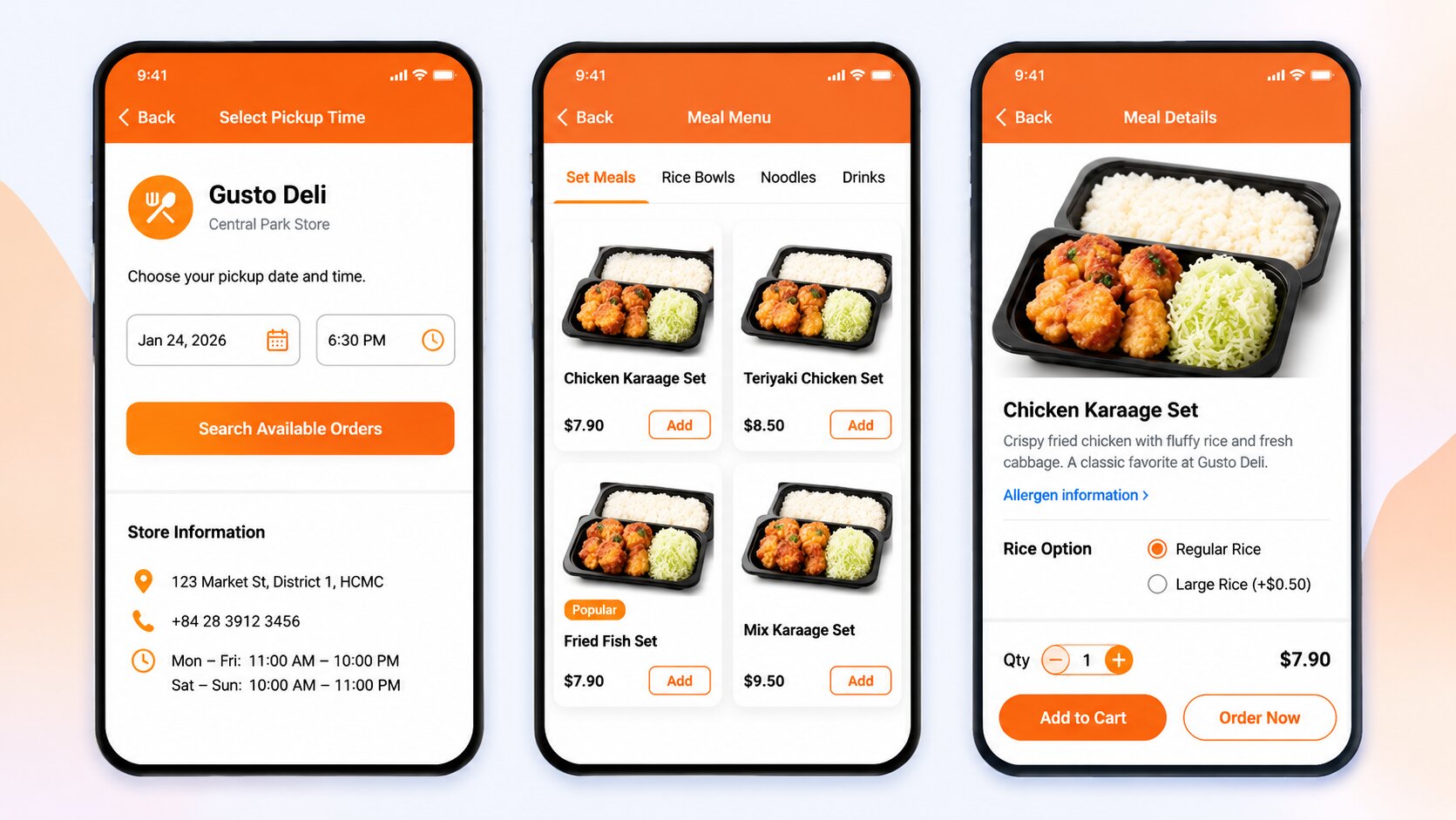
Mobile app | Gives customers one home for the group's restaurant brands: a tab for each brand, coupons gathered into a basket, a map of nearby and previously used stores, and a route into takeout ordering | Android (Kotlin) and iOS (Swift), push notifications through Firebase Cloud Messaging, Google Cloud services |
CMS | Lets staff manage the content shown in the apps and sites | Laravel and Vue |
The systems are linked, and a customer can feel it. Someone can open the app, pick a store, add a coupon, and carry straight on into the takeout service to choose a collection time and pay, so a change to any one system is a change to part of that journey. That is why the tickets were seldom as small as they looked.
Our work on these systems was customization and maintenance: each ticket asked for a change to one system or several, and each was delivered as development with testing in the same cycle.
For the app side, see our mobile app development practice.
THE RESULTS
The work was delivered on the schedule that was set, at the quality the customer expected, and by a team that kept a good working atmosphere throughout.
In practice, that meant the customer could rely on its priorities being respected, and could trust that a hard to find problem would be traced to its cause before a fix was proposed. For a restaurant group whose online offers change every month, that kind of steadiness is worth more than speed alone.
You may also like
-

Multi store luxury watch retailers safeguard repair agreements and customer trust through integrated LINE chat
-
A cross service rewards app turns offline kiosk transactions into long term customer loyalty
-

Bakery distributor eliminates manual stockouts and surplus with data-driven demand forecasting
-
All in one serviced apartment and office portal streamlines multi currency bookings and property accounting at scale
-

Centralized trade compliance and billing system speeds up international shipment settlements for global manufacturers
-
Automated bulk Excel validation and eight step contract workflows streamline service onboarding for retail chains
-
Multi company recruitment CRM delivers stable web and mobile operations across tailored hiring workflows
-
How a multi platform IoT architecture delivered real time supervision and ISO task tracking for field robots
-

A field camera app and verification album automate tamper proof photo documentation for site inspections

Related capabilities
Let's talk
Ready to get results?
Our team is here to help.