
Bakery distributor eliminates manual stockouts and surplus with data-driven demand forecasting
A web based ordering system now forecasts daily bread demand by store and delivery route, replacing manual guesswork with real sales, profit, and waste data.
PROJECT OVERVIEW
Field | Content |
Client | A Japanese bakery product distributor supplying retail stores across multiple delivery routes |
Industry | Retail |
Engagement Model | Dedicated development team |
Scale and Duration | A focused engagement covering design, development, and testing |
Core Technology Stack | PHP, Laravel, PostgreSQL |
ABOUT THE CLIENT
This case study is based on a real VNEXT project. The client's identity and certain project details have been anonymized or generalized for confidentiality purposes.
Our client distributes bakery products to retail stores across multiple delivery routes and regions, and needed a way to bring order quantities in line with actual store level demand rather than relying on manual estimates. Exact financials are withheld for confidentiality.
THE CHALLENGE
Ordering bread and pastry products by route and by store is not a simple counting exercise. Getting the numbers right meant working through sales history, profit margins, and waste rates together for dozens of individual products across many stores and delivery days at once, and getting any of that math wrong meant either running short at a store or discarding unsold stock.
PROJECT OBJECTIVE
The client wanted a web based system that let store and route staff enter and review order quantities directly, backed by sales, profit, and waste data for each product, so ordering decisions could be made from real numbers rather than estimates carried over from the previous week.
APPROACH AND METHODOLOGY
Confirming shared understanding before every task
With calculation heavy logic running through nearly every feature, the project manager reviewed each task directly with the team before work began, confirming that everyone understood what a given piece of functionality needed to calculate and why, rather than letting assumptions carry through into the code.
Building in daily rhythm and peer review
The team held a daily meeting from the very first day of the project, and reviewed work from both a developer's and a tester's perspective before considering it done, so mistakes in the underlying calculations surfaced early rather than after a release.
Keeping the whole team oriented to the bigger picture
Every team member was expected to understand the overall function being built in a given development cycle, not just their own individual task, so the separate pieces of ordering and forecasting logic fit together correctly once combined.
Escalating issues to the client immediately
Whenever the team ran into a question about the underlying business logic, it was raised with the client as early as possible rather than held until a scheduled check in, keeping ordering logic questions resolved quickly enough not to stall development.
TEAM SCALE
VNEXT staffed this engagement with a small, focused team of five.
- Project Manager: coordinated task clarity and client communication throughout the engagement
- Bridge communicator: translated requirements and business logic between the team and the client
- Developers: built the ordering and forecasting logic across the web application
- Tester: verified calculation heavy features against real order scenarios
THE SOLUTION AND TECHNOLOGY STACK
The finished system gives store and route staff a direct way to place orders and see the data behind those decisions in one place.
What was built
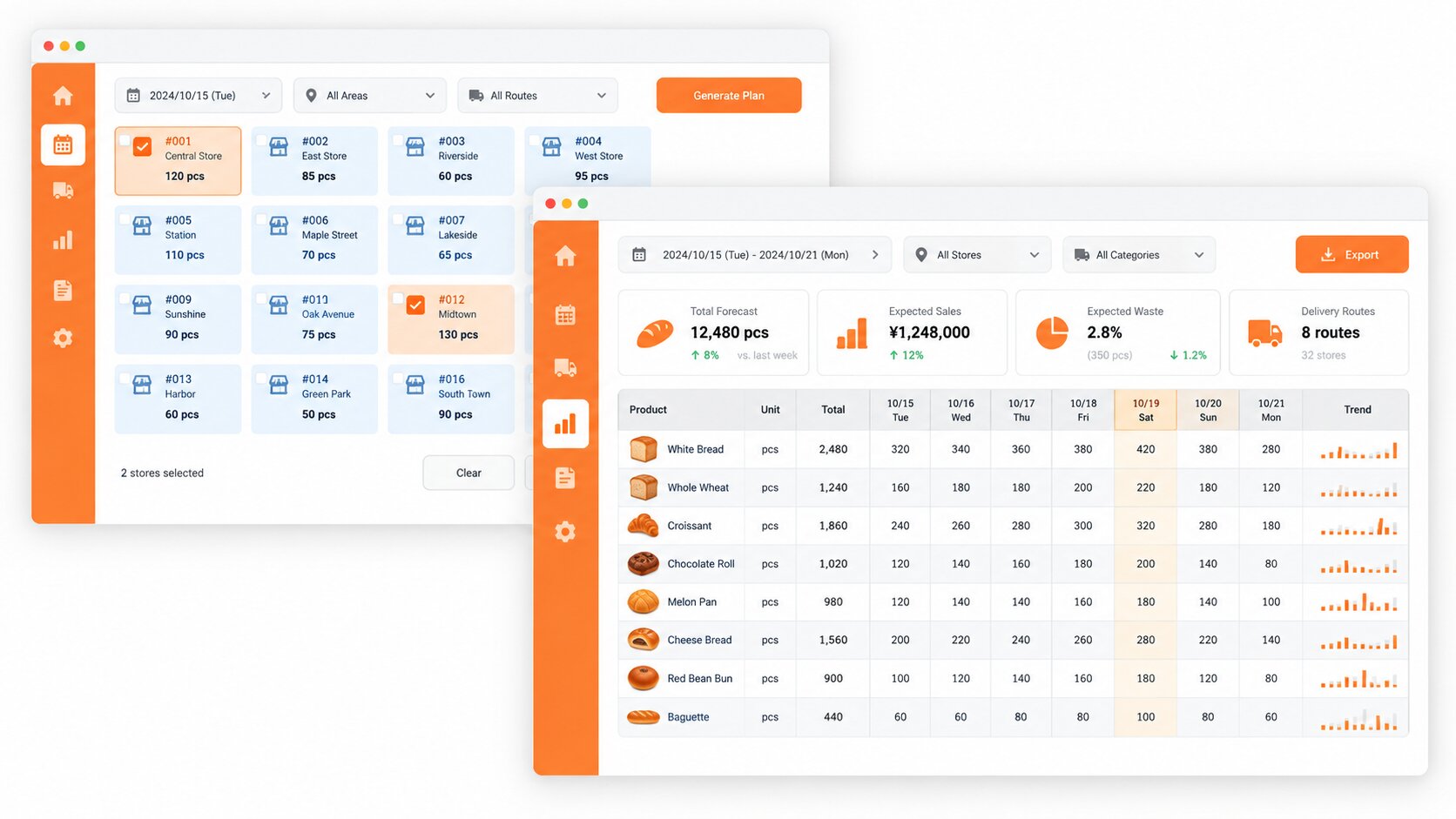
- Route based order entry: lets store and route staff enter daily order quantities for each product directly through a simple input screen
- Demand forecasting dashboard: shows sales, profit rate, and waste data by product across each day of the month, so ordering decisions are grounded in real historical performance
- Multi store, multi route visibility: covers ordering across many stores and delivery routes from a single system rather than tracking each one separately
Technology Stack
Layer | Technology / Platform Used |
Backend | PHP, Laravel |
Database | PostgreSQL |
Collaboration and Task Tracking | Slack, GitLab |
THE RESULTS
Order quantities that once relied on estimates now come from the same sales, profit, and waste data every time.
- Ordering decisions grounded in real data: staff set order quantities using actual sales, profit, and waste figures per product instead of manual estimates
- One system across many stores and routes: order management for the client's full distribution network runs through a single platform rather than separate, disconnected processes
- Steady delivery pace throughout the engagement: daily coordination and task level clarity kept development on schedule despite the complexity of the underlying calculations
- Positive client reception: the client reported satisfaction with the delivered system
For a distributor whose margins depend on getting order quantities right down to the individual store and day, a system built around real demand data rather than habit is what actually protects those margins.
You may also like
-

Security hardware company eliminates manual key handoffs with smart property access
-

Digital card catalog empowers collectors with frictionless online deck building
-

Synchronized DeFi product rollout delivers full asset management and staking across three blockchain networks
-

Automotive retail software developer eliminates paperwork errors through real-time digital repair orders
-

Creating a smarter business English learning experience with AI
-

Japanese healthtech leader enables 100% offline-ready biometric screening on cross-platform medical terminals
-
Japanese manufacturer resolves 99% of SAP BO interface errors using parallel session isolation
-
Automating urban safety with IoT road heating systems
-

Modernizing a legacy enterprise messaging app for secure corporate communication

Related capabilities
Let's talk
Ready to get results?
Our team is here to help.